Verse 2after 1847armile
G3
1
don't bury me in your street, after the murder!
2
through my address/information, why should everybody/'all creation' find your house?!
| References | |
|---|---|
| Arshi, Imtiyaz Ali | Ghazal# 212 |
| Raza, Kalidas Gupta | 399-400 |
| Hamid Ali Khan | Open Image |
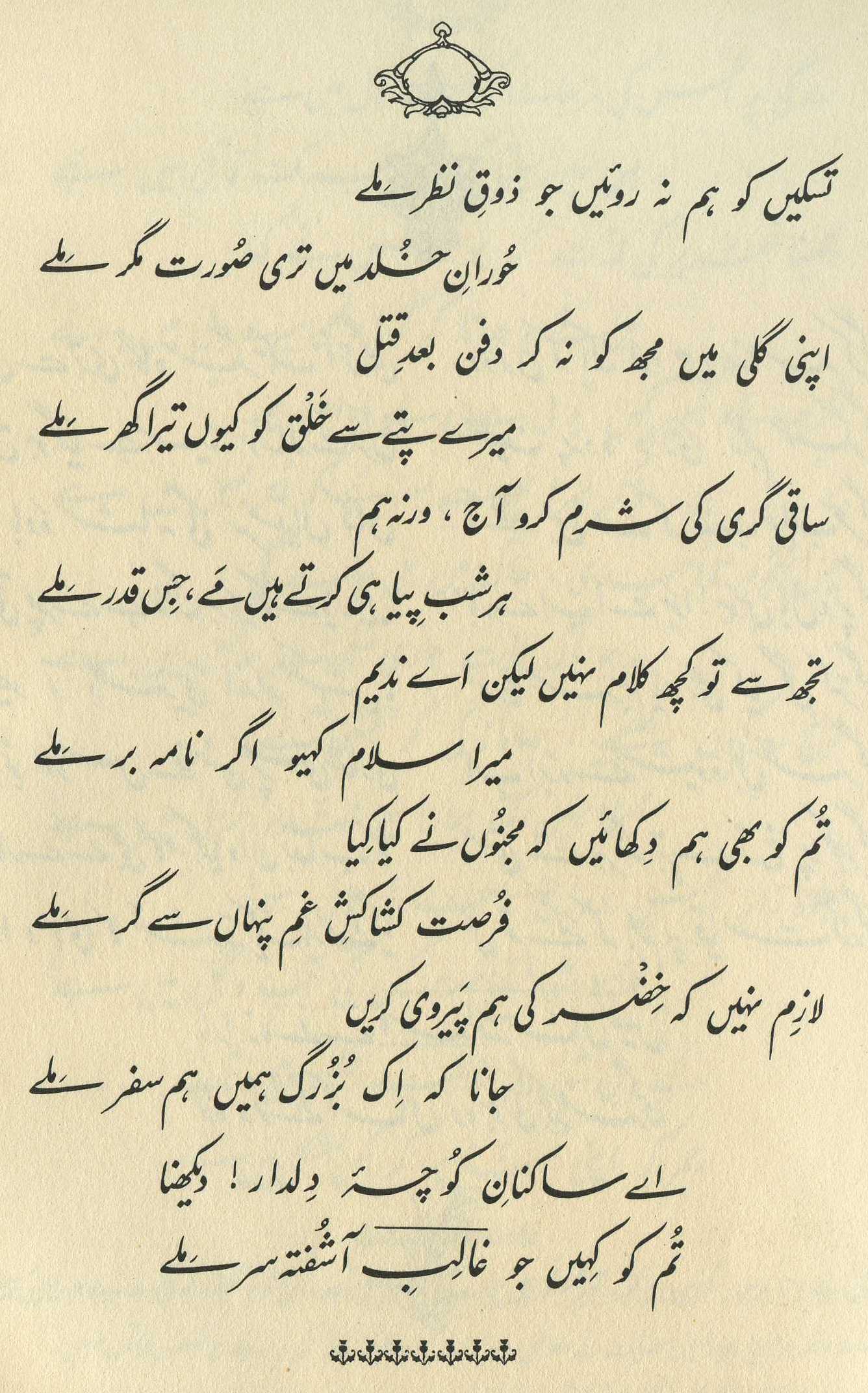
That is people will give the address like this: 'the street with a grave in it, that's where So-and-so's house is'. My envy/jealousy doesn't accept this, that Other people would search out your house through the address of my grave. And the second meaning is that my love doesn't accept that people would learn that you're a murderer, and that you'd be held accountable for my murder. (171)
== Nazm page 171

He says, if you bury me in your street, then two evils will be created. The first evil is that through my address, your house will become famous-- that is, people will make the 'street with the grave' famous; or they'll say 'the street in which Ghalib's grave is'. And under both circumstances-- even after dying, as if I won't feel envy/jealousy! The second, subtle meaning in this verse is that when from the address of the grave your house will become famous, then people will make you famous as Ghalib's murderer or beloved; in this will be disgrace and ill-repute for you. Even after dying, I won't want you to have ill-repute. (227-28)
The first excellence in this verse is that the lover always wants to be buried in the beloved's street. Mirza says the reverse of this, and takes refuge in envy/jealousy: 'I don't want to be buried in your street'. The second excellence is that the author has not said 'the Other ', but 'all creation'; from this it necessarily follows that the beloved's face is so fine that the whole world is dying for her. (305)
In this rhyme Momin and Abad too have produced praiseworthy verses. Momin says:
[oh let it go, the vision of the beautiful one; don't think of it!
may it not be that you would meet it/her at the enemy's house]
Abad says:
[Abad, having died, remained in the street of the beautiful one--
somebody had prayed that he would receive a house in Paradise] (676)
[See his commentary in M 1582,1 .]
The commentators point out some possibilities of interpretation, and I think they're right. But I want to take it a step further.
This is a doubly verse, the first line a command and the second a rhetorical question. It's one of those verses of wonderfully amusing disproportion, like 111,12 . In the most offhanded way ('after the murder') the verse dismisses the concerns that we, the ordinary 'people of the world', would have: that he is facing death, perhaps quite imminently; that it is the cruel beloved who intends to murder him; and that she is so unmoved by his love, passion, and ultimate sacrifice that she will then do something quick and convenient with his body and carry right on with her flirtatious life, surrounded by other adorers.
Nor does he have the great concern of a typical lover: to be near the beloved at all costs, in all situations whatsoever. For one example among many see 39,2 , which expresses the lover's continuing longing, even after death, to kiss her feet-- something that he could in fact imagine doing, if he were buried in her street.
Instead, most absurdly, the lover fixates on a small detail of the situation: that he doesn't wish to be buried in her street, because then 'all creation', 'every Tom, Dick, and Harry', would use his grave as a reference point for finding her house. He doesn't even mention the usual suspects, the ' Rival ' and the ' Other ' (perhaps because he knows they can find her house anyway). He might of course mean that he thinks that 'all creation' would become her lovers, as Bekhud Mohani suggests; on the complexities of jealousy see 53,4 . But the line also sounds wonderful as a kind of cranky, generalized grumbling.
graphics/delhi1857.jpg