Verse 4after 1847armile
G3
1
there's no criticism/'speech' toward you, but, oh companion
2
give/'say' my greetings, if you would encounter the Messenger
'Word, speech, discourse; a complete sentence or proposition; composition, work; --disputation; anything said (or to be said); against, objection, question'.
| References | |
|---|---|
| Arshi, Imtiyaz Ali | Ghazal# 212 |
| Raza, Kalidas Gupta | 399-400 |
| Hamid Ali Khan | Open Image |
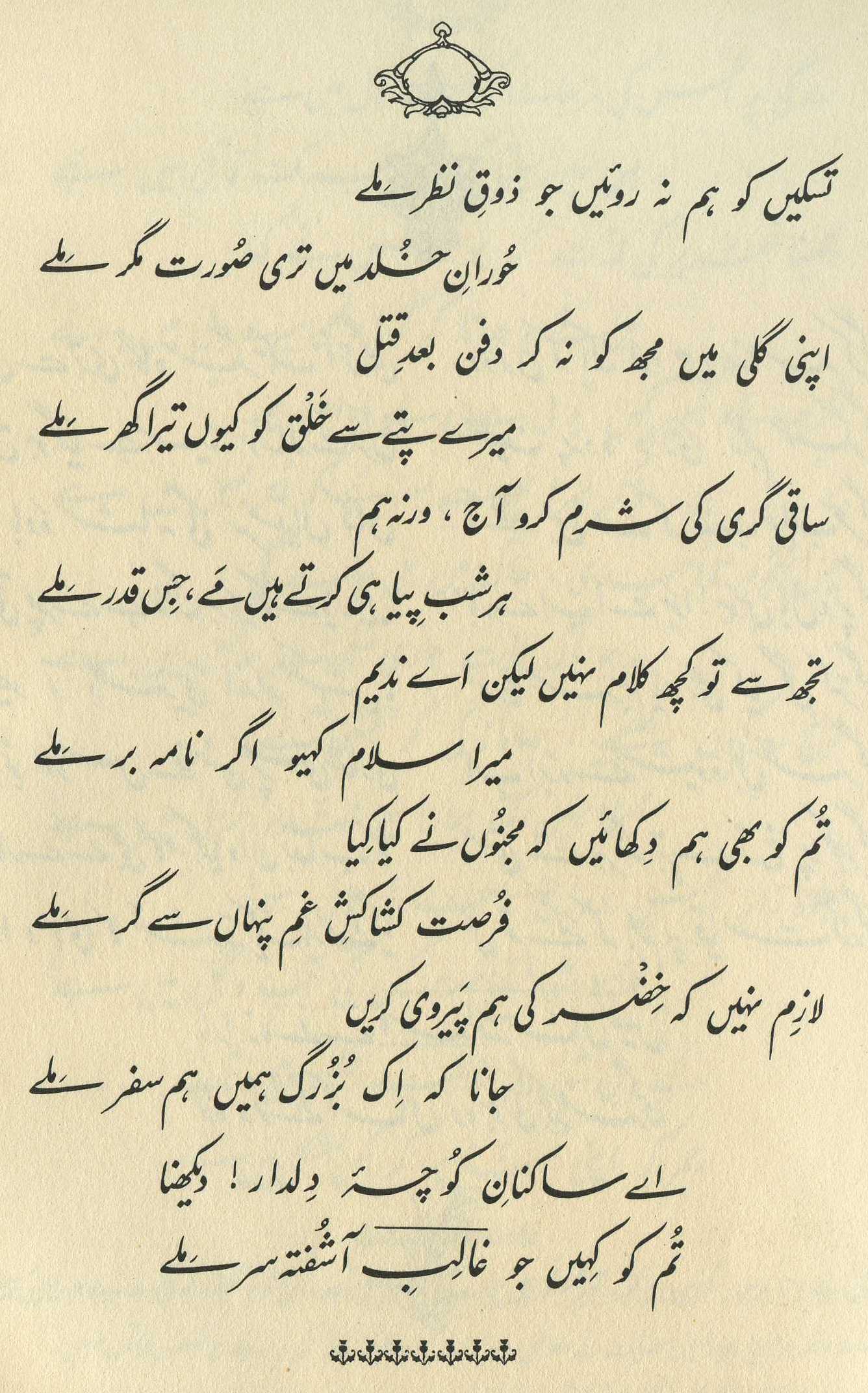
[1864, to Junun:] This theme requires some introduction. That is, the poet needed a Messenger . But he feared that the Messenger might fall in love with the beloved. One friend of this lover's brought a person, and told the lover, 'This man is steadfast and highly trustworthy; I vouch for him, that he won’t play such a trick'. Well, a letter was sent through his hand. As fate would have it, the lover’s suspicion proved true. The messenger, seeing the addressee, became distracted and crazed with love. What letter-- what answer?! He went mad, tore his clothing, set out for the wilderness. Now the lover, after this event has happened, says to his friend, 'God knows the hidden; what does anyone know about what’s inside anyone else? Oh my friend, there's nothing said against you. But if you see the Messenger anywhere, then give him my greetings: "Well, sir, after making such a number of claims of not becoming a lover, you became one; and indeed, what was the result?".' (Arshi 312)
==Urdu text: Khaliq Anjum vol. 4, p. 1514
==another trans.: Russell and Islam , p. 302
==another trans.: Daud Rahbar , p. 269
I have no complaint against you, but convey to the Messenger my complaint-mixed greetings. (171)
== Nazm page 171

He says, 'Oh friend, we have no great complaint or grievance against you. Although indeed, the Messenger whose praises you sang so loudly, and who claimed as he set off that he would certainly bring a reply to the letter-- so far he hasn't shown his face, and out of shame he's gone into hiding somewhere. If you meet him, then give him my greetings.' The meaning is, complain against him a little, and make him embarrassed. (228)
Oh companion, I have no complaint against you; but indeed, if you meet the Messenger, then give him my greetings. That is, 'If the beloved gave no answer, then why did you flee from me? Bravo! You carried out my task very well!' (306)
The central word is obviously , which is positioned with fine flair right in the middle of the first line, and resonates with in the second line. (The way is so precisely echoed by is also an enjoyable sound effect.) The speaker speaks to his friend-- in order to make the friend himself a speaker-- an oral messenger to the (written-letter-bearing) Messenger .
In a verse about trust and untrustworthiness, about written letters and oral messages, about complaints and greetings, every meaning and overtone of (see the definition above) works beautifully, and enhances our enjoyment of the verse. In particular, can mean either 'to hold discourse with someone', or 'to have an objection, etc., against someone'. Thus on the first reading, the first phrase becomes something like 'I have nothing to say to you' (because my message is only for the Messenger); on the second reading, it becomes 'I have no quarrel with you' (but I do have one with the Messenger). In either case, the tone of voice (friendly? hostile? neutral? wryly amused?) will provide a further range of interpretive suggestions.
It's thus very markedly a verse of implication , and we're fortunate to have Ghalib himself explain (with unusual elaborateness and care) what he means to imply. In his explication of what he calls 'this theme ', Ghalib refers first to 'the poet', then later to 'the lover', in a way that completely identifies them with each other. His third-person references also make it entirely clear that neither one of these abstract personages is to be identified with himself.
Ghalib does not explain his prominent wordplay with . Why not? My theory: because his correspondent is not a leading light of literary subtlety, and has been having (the usual?) trouble getting any sense out of the verse (or out of several others, including the not-so-difficult 115,6 ). Ghalib good-naturedly gives him the 'meaning' that he's asked for, but doesn't feel obliged to provide an exhaustive discussion. In only one ( 62,9 ) of the four verses explained in that letter does he discuss the wordplay; and that one is so simple there's not much else to discuss.
graphics/messagecase.jpg