Verse 1after 1847armile
G3
1
we wouldn't weep over [the loss of] rest/peace, if pleasure/relish of sight would be available
2 a
perhaps among the Houri s of Paradise your face/form might be available
2 b
but among the Houri s of Paradise your face/form should be available!
'Consolation, comfort, mitigation, rest, assurance, peace (of mind)'.
| References | |
|---|---|
| Arshi, Imtiyaz Ali | Ghazal# 212 |
| Raza, Kalidas Gupta | 399-400 |
| Hamid Ali Khan | Open Image |
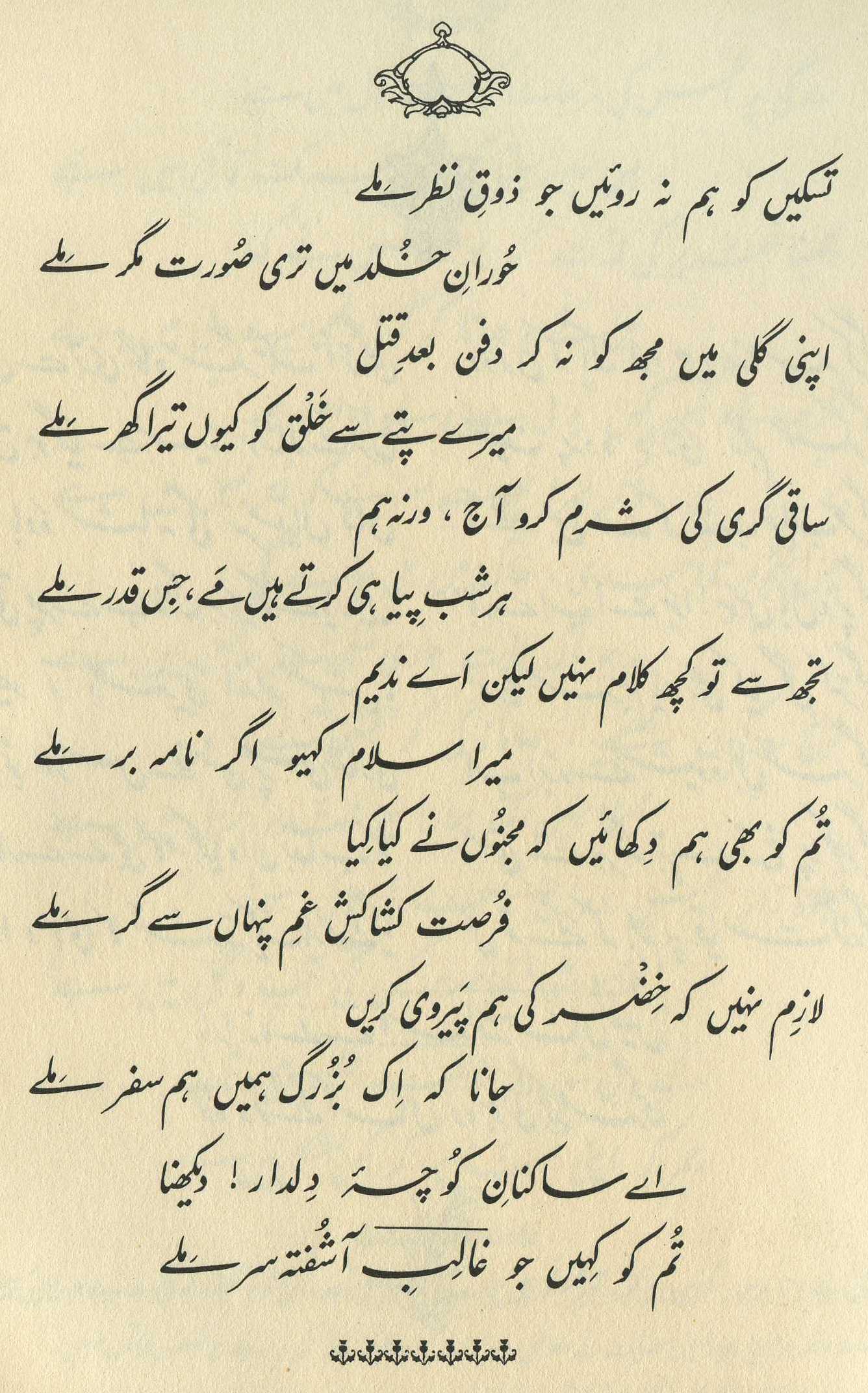
That is, if an aspect resembling yours would exist among the Houris, and merely the pleasure of sight would be obtained, then we wouldn't grieve over [the loss of] the peace of the heart: since if there's pleasure of sight, then if there's no peace of heart, so be it. (171)
== Nazm page 171

He says, for the lover these two things are their happiness and joy: one, peace of the heart; the other, relish of sight. If the Houris of Paradise would resemble you, then from obtaining them only the relish of sight can be achieved. But no-- it's not such that the aspect of the Houris would resemble yours; and even if it be agreed that their appearance would resemble yours, even then, peace of the heart can't be achieved without obtaining you. But upon obtaining the relish of sight, we endure-- but here [in Paradise] not even that joy will exist, because the Houris don't have your aspect. (227)
The lover is in Paradise, and says through his manner that 'from the Houris of Paradise my heart cannot find peace. If from looking at them at least the sight could obtain some pleasure, even then I would endure it; but alas, what shall I do? for here not even the relish of sight is available'. (305)
In the 3,31 (28 March 1848) a 'double ghazal' [] by Azurdah in this ground has been printed. It is not improbable that this ghazal too would be from that period. (312)
The first line contains two future subjunctives, so it seems to be about two interlinked possibilities, the first contingent upon the second. If the speaker would obtain 'relish' of sight, then he wouldn't weep over his lost peace of mind. All that's clear is that he's talking about not a present state, but a future possibility of some sort; and that he's talking about a vision of the beloved. Only in the second line do we realize that he's talking, at least in his own mind, to the beloved. Here are two forms that the conversation could take, based on the two meanings of :
=The lover could be talking about his situation in this life, and speculating about Paradise (2a): 'At present, we lament our lost peace of mind, since we're longing all the time for you, and get no comfort. If we would obtain at least the relish of sight, and feast our eyes on you, then we'd settle for that. For you're so beautiful that your peer would only 'perhaps' [] be available in Paradise! Perhaps there we might be able to enjoy the sight of your beauty.'
=The lover could be laying down conditions for his own future situation in Paradise (2b): 'Even if we suffered the constant agitation of passion, we wouldn't lament our lost peace of mind-- if the relish of sight would be available. 'But' [] the condition would be that your face/aspect would be available. Otherwise, no Houri could rival your beauty, and we'd never consent to live there.'
The Houri s of Paradise are available as 'companions', so the lover could certainly hope for many delights from them. But instead of looking forward to such an enticing prospect, all he thinks of is the relish of sight. Is this because he's so conditioned by the beloved's inaccessibility here, that he can't even imagine anything more? Then, too, his definition of the relish of sight is already fixed, and even fixated: out of the whole range of divinely beautiful possibilities, only the beloved's face/aspect counts.
This verse belongs to the 'snide remarks about Paradise' set; for others, see 35,9 .
This is also a georgeously resonant and flowing verse, especially the first half of the first line. Very singable, very memorizable, the kind that feels as if you've always known it.
graphics/barbier1928.jpg