Verse 121852aa;Nho ga))ii;N
G1
1
even if I would go there, then what answer [would there be] for her insults?
2
as many blessings/supplications as I remembered, became expended on the Doorkeeper
'Prayer, supplication (to God); an invocation of good, a blessing, benediction; wish; congratulation, salutation'.
| References | |
|---|---|
| Arshi, Imtiyaz Ali | Ghazal# 114 |
| Raza, Kalidas Gupta | 426 |
| Hamid Ali Khan | Open Image |
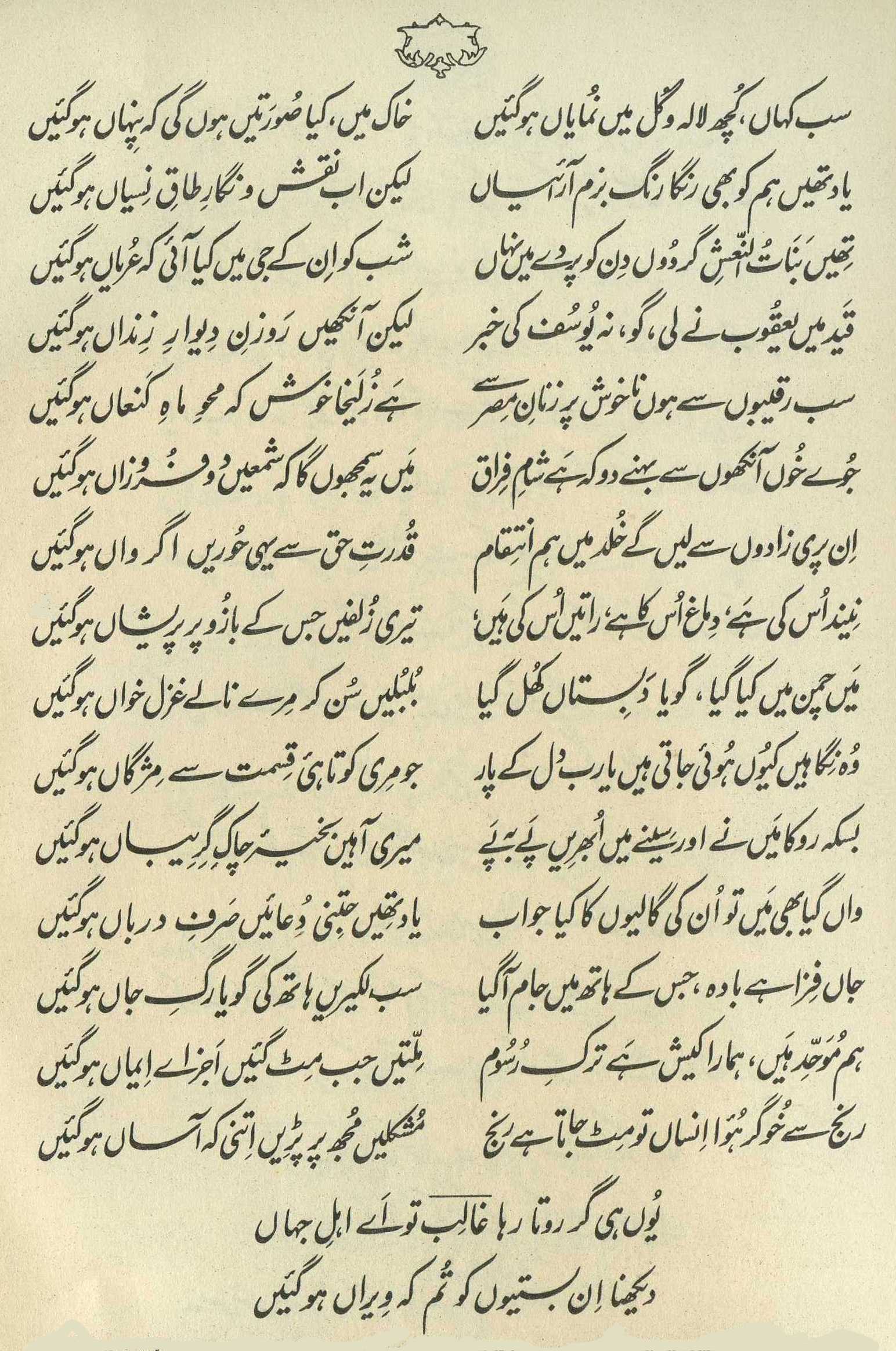
That is to say, now there’s no new blessing left in the mind; and those already-used blessings that have already been given to the doorkeeper-- he doesn’t want to use them in connection with the beloved. In this verse the true excellence and refinement is that he treats the giving of blessings in return for insults as such a commonplace and necessary thing that it's as if everyone considers it to be necessary; because in perplexity he asks everyone: 'Tell me, what reply shall I give to her insults, since the blessings have all been consumed?'.
==Urdu text: Yadgar-e Ghalib , p. 152
That is, however many blessings occurred to me to give, I already gave them all to the Doorkeeper. (119)
== Nazm page 119

This verse is a peerless example of lofty emotions, an extremely complete and captivating picture of a sequence of events.... The blessings that had already been given to the Doorkeeper can't be given to the beloved. The pride/shame and discrimination of lover-ship make it impermissible to use those same blessings for the beloved, that have already been given to somebody else. Because now those blessings have become false/polluted []. (224)
Hali does a good job on this one: he points to the wonderfully amusing effect of the lover's basic assumptions. Just think of all the things the lover is not worried about. The lover is not worried that the beloved's Doorkeeper , a menial servant, has rudely denied him admission; he's not worried that he's been forced to overlook such a slight; he's not worried that he has, most humiliatingly, lavished on the Doorkeeper all the wheedling and blessings he could think of (compare 43,4 ); he's not worried that he still might not actually get to see the beloved; he's not worried that even if he does get to see her, she will abuse him roundly; he's not worried that in that case he will have to endure her abuse in humble submissiveness, and even reply with blessings. All these are the kinds of things that would worry any of the rest of us, any of the 'people of the world'.
Instead, the only worry that preoccupies the lover is that if he actually sees her, he won't have enough-- and fresh and unpolluted enough-- blessings to offer in reply to her abuse. And of course, in proper mushairah -verse style, the kicker, the actual word 'Doorkeeper', is withheld until the last possible moment. How could this verse not have been a delight in the mushairah? The lover's intense, nutty scrupulousness (he must offer the beloved, in reply to her abuse, not just blessings, but only the freshest and purest blessings) is so wildly out of line with his awful situation-- he is abused, humiliated, in line only for further humiliation and abuse-- that it creates a wonderfully amusing effect.
Compare 234,1 , in which styles of cruelty too seem to become 'used up', and thus show the same zero-sum economy that operates here for blessings.
On the use of the perfect verb form as a subjunctive, see 35,9 .
An unusual Indian padlock (1800's), in the form of an armed man, perhaps dancing (?); I think of him as a Doorkeeper enjoying the lover's humiliation:
graphics/padlock.jpg