Verse 4Feb. 1848aa;Napnaa
G4
1
no matter to what extent he might abase/humiliate us, we'll {pass over it / let it go}, in laughter
2
finally, he {became / turned out to be} our friend-- her Gatekeeper
'Baseness, meanness, vileness, abjectness, contemptibleness, abasement, humiliation, dishonour, disgrace, indignity, affront, insult'.
'To pass over, go beyond, exceed (a fixed time); to put off, defer, postpone; to reject (a request); to elude by subterfuge, to evade, prevaricate; to avoid'.
'Once, one time, all at once; at last, at length'.
'Acquaintance; friend; associate; intimate friend, familiar; lover, sweetheart; paramour; mistress, concubine'.
| References | |
|---|---|
| Arshi, Imtiyaz Ali | Ghazal# 42 |
| Raza, Kalidas Gupta | 406-407 |
| Hamid Ali Khan | Open Image |
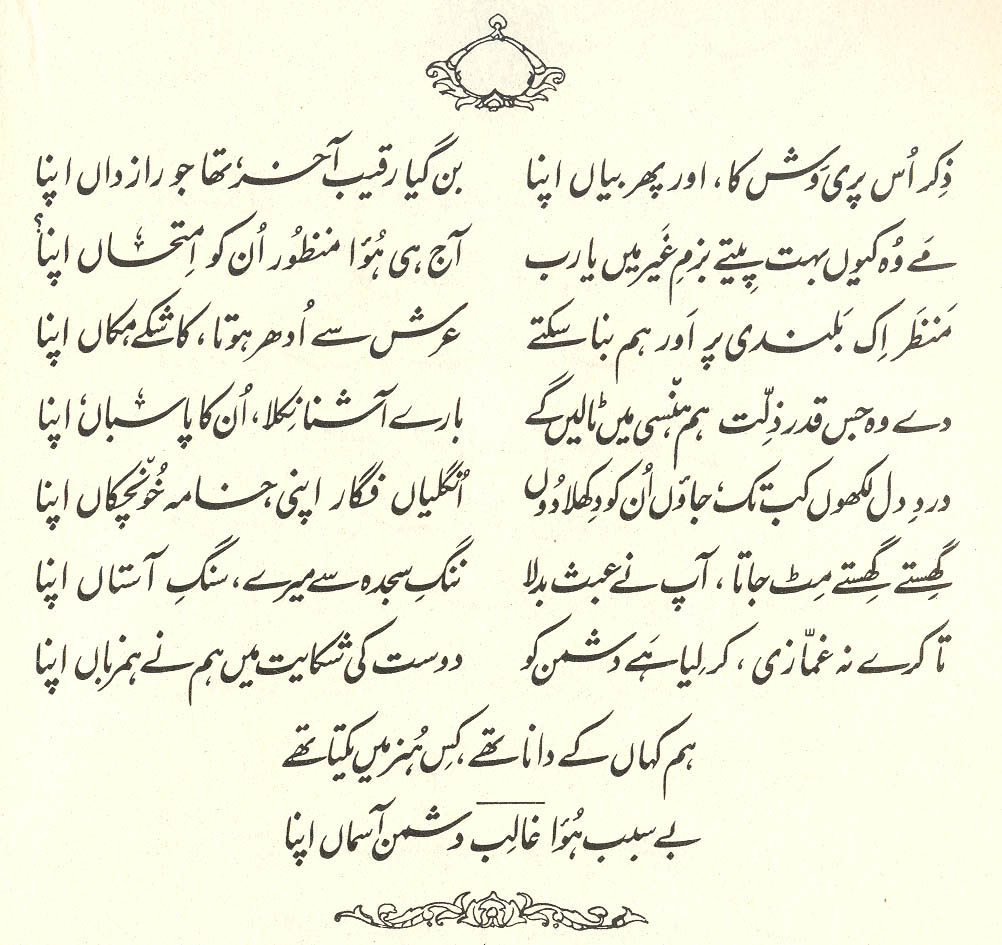
That is to say, it was excellent that the beloved's Gatekeeper became our friend. Now we've obtained an occasion for this: however much he may abuse us, we'll keep accepting it laughingly, and we'll make it clear that he is our old friend, that for ages this has been our behavior.
==Urdu text: Yadgar-e Ghalib , p. 142
== Nazm page 40

At this thought how happy he is, and he doesn't reflect that the world will consider how vile he is, and he chooses as his friend such a commonplace man as a Gatekeeper, and that too a friendship of such informality! (100)
In this verse the refrain , because it's very far away, creates an . This was created because the word [own] is near 'Gatekeeper' and far from [friend]. (113)
../apparatus/txt_sets.html Hearing the first line, we'd of course assume that the lover was, as usual, almost groveling before the beloved, and willingly submitting to any indignity at her hands. Even when-- after, under mushairah performance conditions, a suitable delay-- we hear the second line, not until the very last minute do we get the 'punch'-word, , that suddenly makes the whole verse interpretable.
It ought to make it really funny too, but actually it feels so pathetic that it's hard even to laugh at the poor lover's wretched state. He's so abject that not only does he eagerly cultivate a low-class servant (as Bekhud Mohani points out), and not only does he willing accept abuse and humiliation from him (and is a very strong word; see the definition above)-- he actually considers this sneering Gatekeeper to be an (see the definition above). How much more abject and self-abasing could any lover possibly be?
Thematically, this verse is a cousin of 111,12 -- in which, as in this one, the lover enthusiastically abases himself before the guardian of the beloved's door.
On the use of to mean , see 15,12 .
graphics/doorway.jpg