Verse 3Feb. 1848aa;Napnaa
G4
1
we would have been able to make a viewing-site on a single/particular/unique/excellent height more
2 a
if only our house were on this side of the heavens! [reading ]
2 b
if only our house were on that side of the heavens! [reading ]
zar>>: 'An object of sight, a sight, a view; a landscape; a show, spectacle, theatre, scene'.
'A roof; a canopy; the highest (the ninth) sphere, the empyrean (where the throne of God is); a throne, chair of state'.
is a variant spelling of , designed to make the expression fit the meter.
| References | |
|---|---|
| Arshi, Imtiyaz Ali | Ghazal# 42 |
| Raza, Kalidas Gupta | 406-407 |
| Hamid Ali Khan | Open Image |
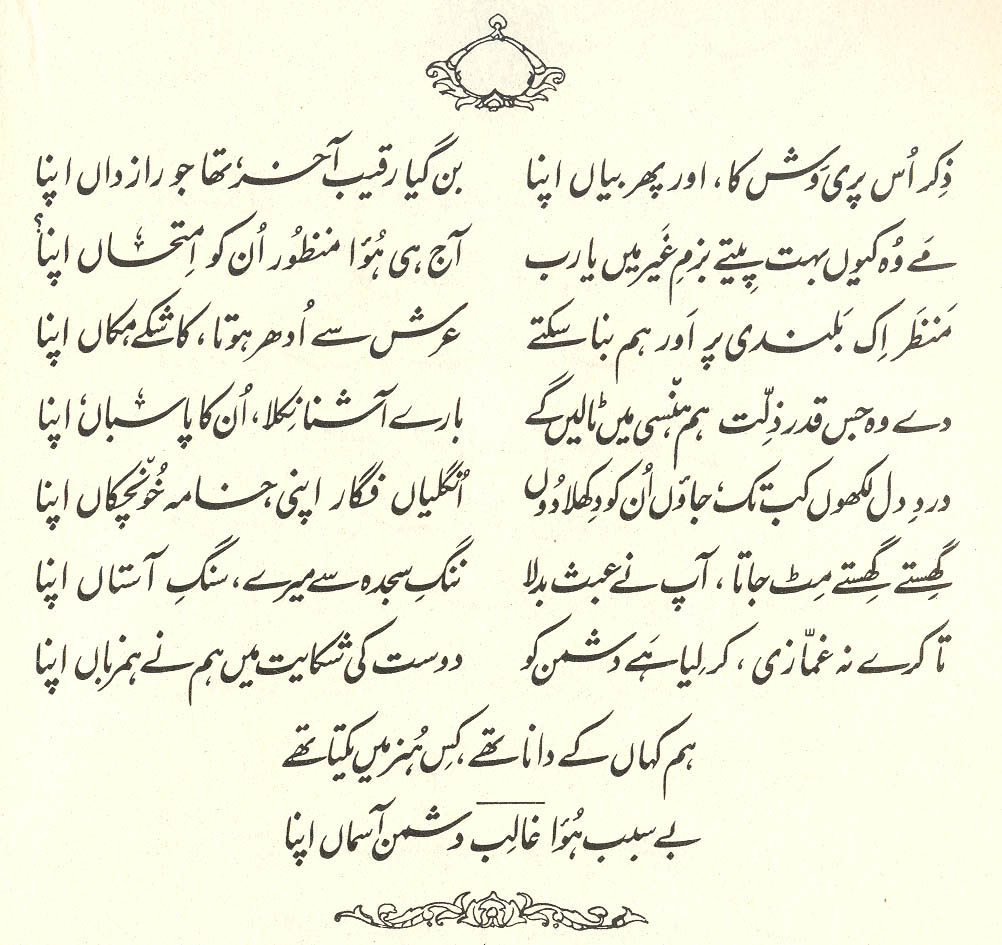
That is, if only our house were on this side of the sky, so that we could establish a viewing-site in the sky and see our place. But the difficulty is that there is no place higher than our house itself. This is the reason that we are unaware of our true reality and essence. (40)
== Nazm page 40

This verse can be read in two ways-- that is, in the second line, with the in the third word pronounced to make the word either , 'this way', or , 'that way'.
Solution 1: To hell with the tyranny of existence and the necessities of humanity, such that our soul can't fly to that side of the heavens! If only our house were beyond the heavens (that is, that side of the heavens)! Then we wouldn't remain trapped in the oppressions of the human condition. And we'd stroll around and see the scene [] of being incorporeal [].
Number 2: Our spirit flies (through mystical knowledge) beyond the heavens. That is, we've already strolled around in incorporeality. Now there's no viewing-site left to see. Now the ardor for the revealing of the secrets of True Reality is empty. If only our stroll were not so lofty, and when we obtained access to the heavens, then we would be attentive to the viewing-site beyond the heavens. Now, for the eye that seeks ever-new views to look at, there's nothing attractive left. (99-100)
He says, if only our house (which in reality is the heavens itself) were somewhat to one side of the heavens, and we could make a viewing-site in the heavens and see our place. But alas, the house is situated on such a height that there's no place higher. The point is that we are entirely ignorant of our true reality and essence. And how philosophical too is the reason for that ignorance! (113)
As Bekhud Mohani observes, the vs. question is perennial. Hamid uses and even argues for it in a note, and other editors seem also to be divided. As always, I follow Arshi, who goes with .
But I want to disagree with Arshi's reason for doing so. He argues in his introduction (p. 158) that in Ghalib's day was still used for , and the fact that no manuscript has makes it clear that Ghalib means not but . I rely on the clear fact that in Mir's poetry, which of course comes right up to Ghalib's earlier years, and were both extremely common, and there's no particular reason to think that in Ghalib's day the spelling of one, but not the other, had differentially changed much faster. Moreover, a fine proof to the contrary is in the early 205,4 , where both forms with modern scansion (and spelling) appear in opposition to each other.
Ghalib may in fact have deliberately modernized his spelling to the undecideable contemporary form, since after all it gave him a whole new range of possibilities for multivalence. (For a similar case involving and , see 154,5x .) And he certainly did modernize at times, even when no poetic advantage could be expected-- as for example from the of early manuscripts to the of later ones. So why would he not have gleefully pounced on the possibility of two meanings for the price of one?
Of the two possible readings, I share Arshi's preference for , not on textual grounds but simply because it's so much jazzier and wilder and more un-obvious. After all, to wish for a house on the far side, on 'that' side (over toward Paradise?), so that we could have a better look at some new territory, is what anyone might do. Since when is Ghalib content to do what anyone might do?
But to wish for a house on 'this' side-- how much more irresistibly grandiose! How much more provocative and complex are the implications! That one small word shows that the speaker knows much more about the world beyond the heavens than about this world; that he now apparently lives on 'that side' rather than 'this side', so that he is somehow separated from ordinary human reality; and that the view where he is does not fully satisfy him-- he would also like a view of life on 'this side'.
The clever arrangement of the words in the first line makes it impossible to say which 'height' would be higher, this one or that one beyond the sky. In fact, it makes them look parallel and similar to each other. Each of them is a spectacle or scene in its own right, each of them is on a height. The speaker would prefer to have two of them rather than one-- simply, it seems, for the sake of novelty. Whichever one he has, he also wants the other, if only for variety. (And there seems to be no other grounds for choosing.)
It's a magnificent verse, isn't it? Witty, resonant, colloquial-feeling. It uses the technical devices of speech and orthographic multivalence not just for sophisticated amusement, but for genuine thought and perceptive observation. And with all that, it still has a wonderful flowingness , and a faux-naïf quality that makes it instantly memorizable.
On the use of to mean , see 15,12 .
Compare the access to 'that side' envisioned in 244x,1 . There's also Mir 's similarly elegant play with in M {485,3 .
Here's a Pakistani commemorative stamp, issued on Ghalib's death anniversary in 1969, that includes this verse-- and MISQUOTES it:
graphics/pakstamp1969.jpg
By reading , the stamp destroys all the delights of the whole versus question. It also uses the ordinary spelling of , so that the verse won't readily scan; but that's nothing compared to the loss of the cleverly framed ambiguity that's at the heartof the verse. It's remarkable that apparently during the whole stamp-designing process no one thought it necessary to consult a divan .