Verse 121816aabthaa
G1
1
incapable/ineffective madness did nothing for me/us/itself, otherwise here
2 a
every sand-grain was a {rival / equal / imitator / mirror-cover} of the world-warming sun
2 b
every sand-grain would have been a {rival / equal / imitator / mirror-cover} of the world-warming sun
'Unworthy, unfit; incapable'.
'A mote, atom, particle, a little'.
'Having or presenting an exterior different from the interior; --anything whose exterior and interior differ; --cover of a mirror'.
| References | |
|---|---|
| Arshi, Imtiyaz Ali | Ghazal# 9 |
| Raza, Kalidas Gupta | 158-160 |
| Nuskhah-e-Hamidiyah | 42-46 |
| Asi, Abdul Bari | 57-58 |
| Gyan Chand | 78-82 |
| Hamid Ali Khan | Open Image |
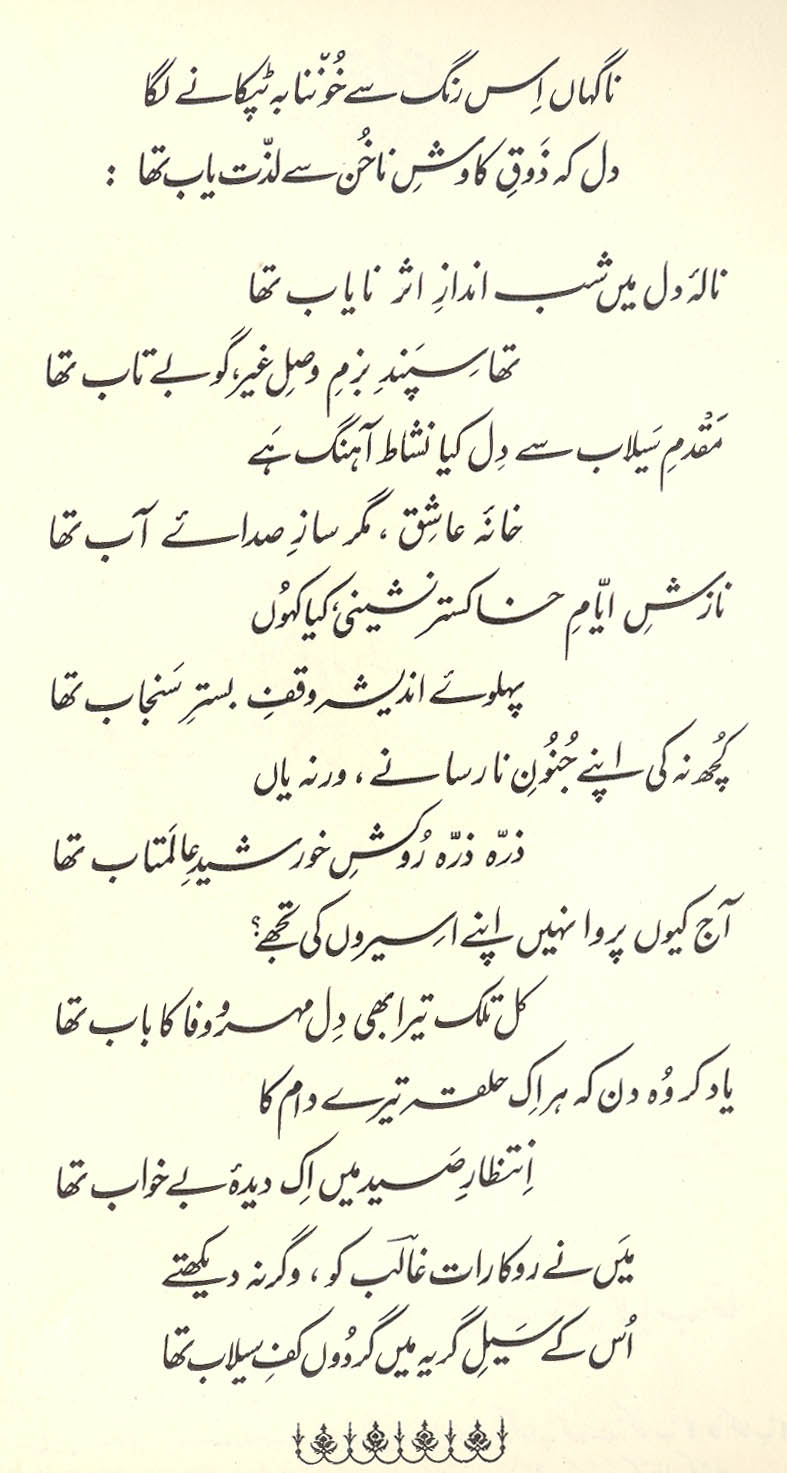
'Incapable madness did nothing', that is, it kept me deprived of receipt of generosity and union with the beloved. Otherwise, every single grain of dust [would have] received so much light that it resembled the sun. (16-17)
== Nazm page 16 ; Nazm page 17


In this verse a moral lesson has been given, that if we can do nothing, then it's no fault of our nature and the natural world. The cause of our failure was the deficiency of our passion....
[Or:] Every sand-grain, like the sun itself, is an expression of the divine light. If we aren't possessors of mystical knowledge, then why aren't we-- apart from our lack of zeal? (37)
[Asi says:] My madness displayed incapability, and could not arrive at the limit of madness. Otherwise, every grain of the realm of madness was [=would have been] the envy of the sun. (2) In the realm at which madness had already arrived, in that realm even every grain assumed the aspect of the sun. (55)
ABOUT : Officially means 'pertaining to the subject of the sentence'. But since here the subject is , we need to read as short for , 'someone's own'. (For a discussion of gender issues and the omitted , see below.) Only the conventions of the ghazal then permit us to read that 'someone' as the speaker (=the lover), so that it becomes a contracted form of . Which then raises the further question: why didn't Ghalib just use , which scans the same way as , and would have removed all ambiguity? Perhaps he wants us also to consider a reading of , 'our own', so that the reference might be to all lovers. Or perhaps even to all human beings, since , 'here', can easily mean 'in this world'. Or perhaps the reference could be to the madness itself, which did not accomplish 'its own' work? For other examples of this kind of unspecific-- and often deliberately ambiguous-- use of , see: 1,4 ; 30,2 ; 43 (which has as a refrain ); 86,5 ; 114,1 ; 148,4 ; 167,3 .
As Baqir, quoting Asi, points out, the past-tense grammar of permits either a past or a contrafactual reading of the second line (for discussion of this see 3,5 ). There are other such examples, in which the meaning can be either indicative or contrafactual; this is another tool in Ghalib's tool-kit of what might be called meaning-multipliers.
If we read as a simple past as in (2a), then the emphasis falls on , 'here,' meaning in the lover's vicinity or the lover's world. This world is already in the desired state of radiant sun-like madness, and the failure is in the inability either to extend the condition-- no doubt to or 'there,' where the beloved is-- or else to somehow use the condition as a jumping-off point for the great leap to the beloved that the lover is always longing for.
If we read as contrafactual as in (2b), then the lover is accusing unhelpful madness of failing entirely, of not achieving the kind of 'access' that he wanted from it. He wanted a madness so acute and brilliant that every grain of sand would have glistened and radiated heat and energy like the sun. Perhaps then, seeing such a cosmic feat, the beloved would have paid attention.
Or alternatively, perhaps what the madness was supposed to do was not to create but to react to this astonishing world, in which every sand-grain resembled (or would have resembled) the sun. The word is so flexible that it can permit a lot of ambiguity and shifting around. In a world of miracles and wonders, why do we live so tamely? Why can't we offer a response proportional to the dazzling sensory (and emotional) experience of the cosmos?
The commentators take to mean something like 'rival' or 'equal', and that's clearly a sense that works very well. Platts, however, offers a definition that emphasizes the covering up of something inner with something else on the outside, like an imitation; and in particular, he says the term applies to 'the cover of a mirror'-- quite a piquant way to think of a sand-grain in relation to the sun.
Note for grammar fans: Since is masculine we have to take as referring to some implied feminine noun, presumably the usual . (Or here perhaps , or ?) For discussion, see 59,2 .
Note for translation fans: It's true that a can be any tiny particle (see the definition above); but since its main Ghalibian role is in relation to the sun, I use 'sand-grain' to emphasize the possibilities of glittering and reflecting.
graphics/sandgrains.jpg