Verse 4after 1816athii sahii
G11
In this meter the first long syllable may be replaced by a short; and the next-to-last long syllable may be replaced by two shorts.
1 a
even/also we are not our own enemy!
1 b
even/also we are not an enemy, we're your own
2
the Other loves you-- so be it!
| References | |
|---|---|
| Arshi, Imtiyaz Ali | Ghazal# 182 |
| Raza, Kalidas Gupta | 298-99 |
| Nuskhah-e-Hamidiyah | 243 |
| Hamid Ali Khan | Open Image |
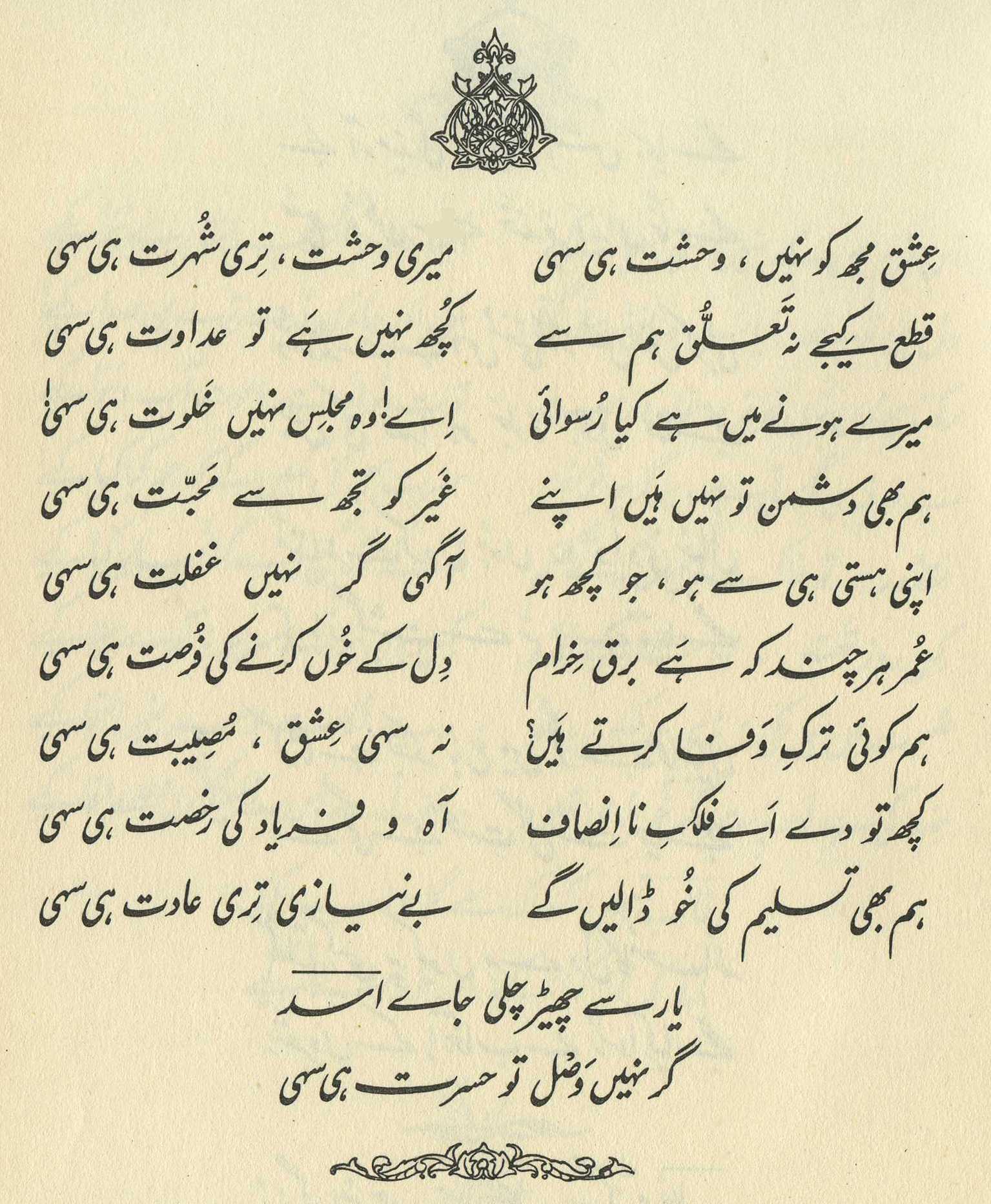
That is, then why would we show enmity toward ourselves by loving you, when you're convinced of the Other's love? (156)
== Nazm page 156

He says, 'We are not our own enemy, that we would show love for you and enmity toward ourselves; when you have perfect belief in the Other's love, and consider him your true lover-- why would we meet you?' (214)
The meaning of is that we don't believe that the Other loves you. And even if we would believe it, then we aren't our own enemy. That is, when you believe in the Rival 's love, then why would we give our heart and fall into a disaster?
[Or:] The Rival loves you, so be it []. But we too are not your enemy, but your own. (286)
For discussion of the versatile idiomatic expression , see 148,1 .
As in so many verses, the first line is opaque until we hear the second; even then, it remains incurably multivalent. Here are some possible ways the verse could be read, using the primary and more interesting meaning (1a):
=I'm not going to keep on driving myself mad over you, since you've already accepted the Other as your lover. (This is the commentators' consensus reading.)
=Why should I knock myself out to fight a losing battle? So be it: the Other loves you! (This is said sarcastically, in the course of an argument in which the speaker has been maintaining that the Other's love is false.)
=Well, I too know which side my bread is buttered on, and how to advance my own interests! Just as the Other does, when he claims that he 'loves' you!
Compared to the protean (1a), (1b) is almost self-explanatory. To me it looks strange, since would normally refer to the subject of the sentence. We discussed this on the Urdulist, and I thank the members of the list for their helpful arguments going both ways. S. R. Faruqi says that the lover and beloved are to be considered so closely identified that the 'own' can apply either way; although he finds this meaning less 'dramatic' of course than (1a). For further discussion of the ambiguities of , see 15,12 .
In either case, the 'enemy' in the first line forms an enjoyably balanced pair with the 'love' in the second line; and the verse offers the well-matched set of 'we', 'one's own', and the 'Other'.
graphics/loversquarrel.jpg