Verse 2after 1816athii sahii
G11
In this meter the first long syllable may be replaced by a short; and the next-to-last long syllable may be replaced by two shorts.
1
let relationship not be cut off with us!
2 a
if there's nothing [else], then [let there be] enmity at least
2 b
if there's nothing, then [that's] enmity indeed
is an archaic form of the passive ( GRAMMAR )
| References | |
|---|---|
| Arshi, Imtiyaz Ali | Ghazal# 182 |
| Raza, Kalidas Gupta | 298-99 |
| Nuskhah-e-Hamidiyah | 243 |
| Hamid Ali Khan | Open Image |
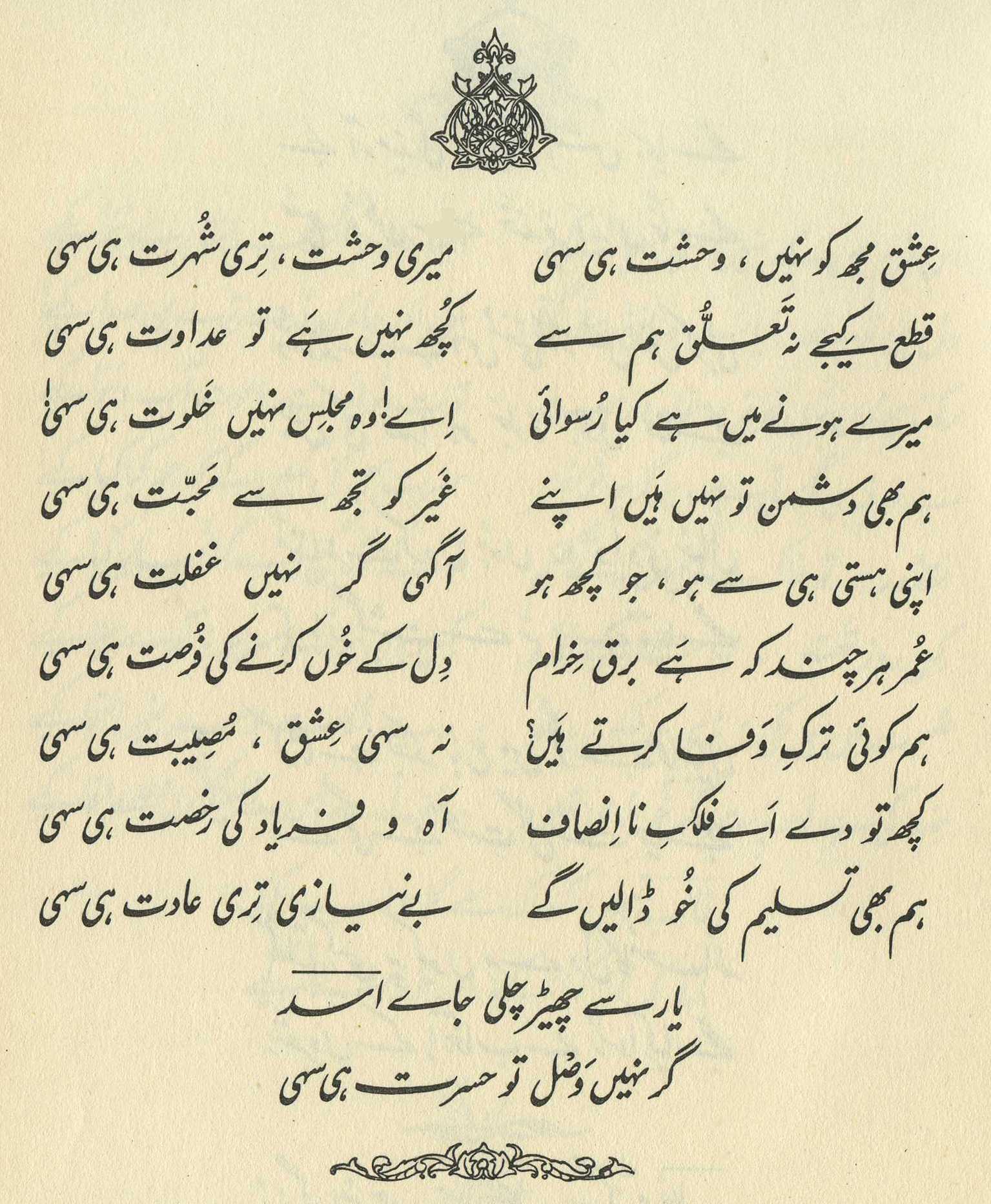
In the ' description of an affair ' [], this theme is part of the author's special portion. And he has versified it very very well-- and where he has versified it, he has used it in a new style. In one place he says: 48,4 . Then he has used it like this: 134,1 . (156)
== Nazm page 156

This theme has come into Mirza Sahib's portion. Where he has versified it, he has versified it peerlessly. In every place he has used it in a new style. He says, why do you cut off the connection? If there's no affection left, then please show enmity towards us. If not love [], then enmity []. (214)
The point of is that if you maintain enmity, then I'll have the pleasure of your cruelties, and the hope of your sometime or other becoming kind. In is hidden the idea that the heart wants you to be kind to us, to love us, to value our love. But if none of this can be done by you, then-- well, at least let there be enmity []. (286)
Compare 119,1 . (243, 285)
For discussion of the versatile idiomatic expression , see 148,1 .
As Arshi suggests, 119,1 is an excellent verse for comparison; 46,3 might also be of interest. The basic idea that enmity is a form of connection, and thus far better than the loss of all relationship, is, as Nazm says, characteristically Ghalibian.
The second line offers some pleasures of its own. It might be construed, as in (2a), as a call for enmity: if there's nothing else available, at least she should give him enmity! But it might also register the thought, as in (2b), that if there's nothing at all (in the beloved's heart), then such complete indifference is enmity indeed. Is this latter thought the most exquisite torment (since her indifference is the worst imaginable fate)? Or might it be perversely consoling (since even her indifference is a form of enmity, and thus a form of connection with her)? We're back once again to the fundamental ghazal paradox: the lover's ability to rejoice in the beloved's cruelty. And all this in just a few brief phrases, containing only thirteen words.
graphics/connection.jpg