Verse 1after 1816athii kyuu;N nah ho
G3
1
[we] are saved/freed from this [idea]: that 'why wouldn't there be only/emphatically love?'
2
let it be done/performed with us-- even if it would be only/emphatically enmity
'Delivered, saved; escaped; --humble'.
is an archaic form of the passive subjunctive ( GRAMMAR )
'Why should it not be? why not? undoubtedly, assuredly'.
| References | |
|---|---|
| Arshi, Imtiyaz Ali | Ghazal# 118 |
| Raza, Kalidas Gupta | 295-96 |
| Nuskhah-e-Hamidiyah | 147-148 |
| Hamid Ali Khan | Open Image |
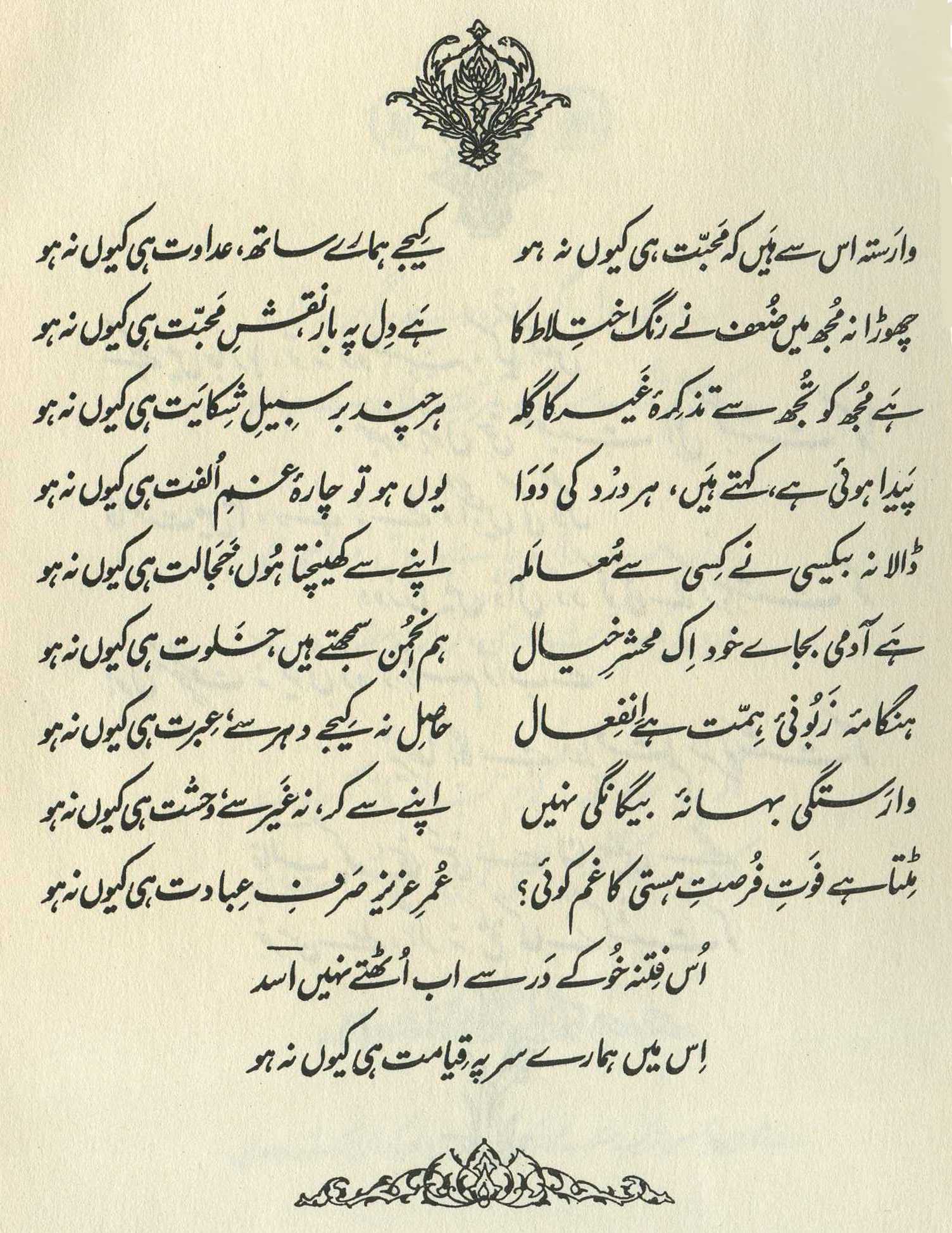
That is, we are free from this thought: that we would insist that you should do with us only love. Even if you don't do love with us, then do enmity with us, but do it with me alone-- I don't want the Other to have a share even in enmity. (127)
== Nazm page 127

The meaning is that from between these two things, friendship and enmity, do with us the one that wouldn't be done with the Enemy. (179)
We don't say, do love with us. Do enmity with us instead. But don't remain without a relationship to us. (239)
Compare 148,2 . (243) (285)
This is one of the very few early ghazals from which Ghalib selected every verse for inclusion in his published divan .
Nazm, and various other commentators following him, emphasize a demand for something from the beloved that is not shared with any competitor. But plainly there's nothing in the verse itself that requires, or even invites, such a reading. I think Bekhud Mohani is on the right track, backed up by Arshi who cites in 148,2 an absolutely perfect parallel verse to prove the point.
The key word in the verse is obviously the striking , with its conspicuous past-participial sense (see the definition above). It suggests that the lover has reached a late (literally 'open-roaded'?) stage on the journey of passion: he is no longer so importunate, he has learned to separate what is really necessary from what is merely desirable. He has been 'liberated' from the need to demand love-- 'love' emphatically or 'love' alone, depending on how we read the .
Now he demands, all the more urgently, only connection-- any sort of connection, but some sort there must be. For his purposes, enmity will do very well. Is it because he's learned that the opposite of love is not hate, but indifference? Is it because he dreads above all else the thought that he might just fall off her radar screen entirely?
For another verse about the indifference that the lover so dreads, compare 230,6 .
Note for grammar fans: The construction seems literally to mean 'why would [it] not be'. Idiomatically, it means something like 'even if [it] would be'. Platts goes for 'Why should it not be? why not? undoubtedly, assuredly', which isn't at all helpful. In my experience, 'even if [it] would be' works every time.
graphics/lovehate.jpg