Verse 2after 1816athii kyuu;N nah ho
G3
1
weakness didn't leave in me the style/'color' of affection/intimacy
2
it's a burden/weight on the heart-- even if it would be only/emphatically the stamp/imprint/image of love
'Colour, tint, hue, complexion;...appearance, aspect; fashion, style; character, nature; mood, mode, manner, method'.
t>> : 'Mixture; union; amalgamation; intercourse, familiarity, intimacy, friendship, warm attachment'.
'Load, burden; cargo; weight, heaviness'.
'A picture; portrait; drawing; a print; a carving; an engraving... --an impression; a stamp; a mark'.
| References | |
|---|---|
| Arshi, Imtiyaz Ali | Ghazal# 118 |
| Raza, Kalidas Gupta | 295-96 |
| Nuskhah-e-Hamidiyah | 147-148 |
| Hamid Ali Khan | Open Image |
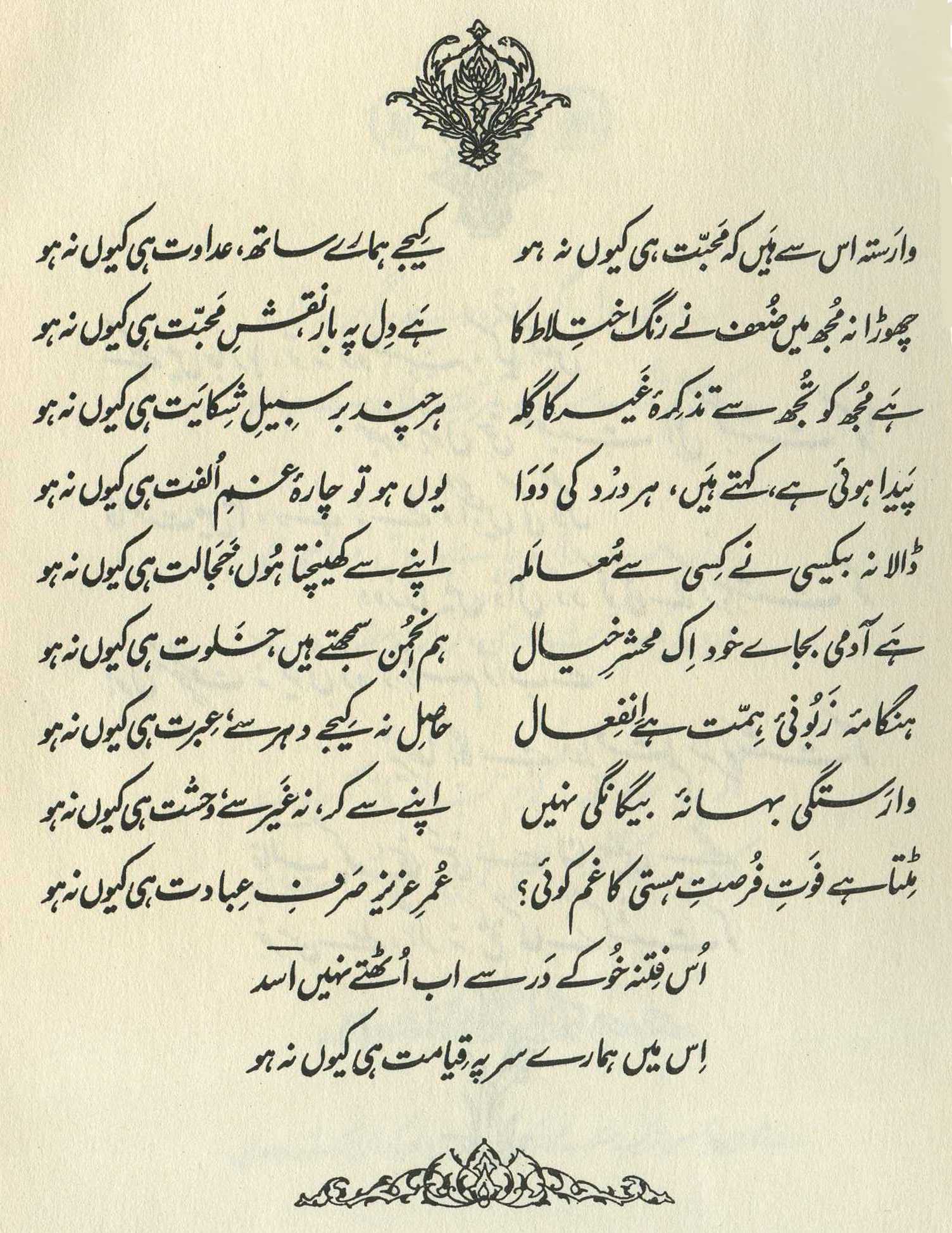
From excessive weakness, the strength for mingling/intimacy did not remain in me-- so much so that the stamp/imprint of love is a burden on the heart. The word is only for its affinity with 'picture'. (127)
== Nazm page 127

He says, 'Weakness has so dried me out that in my body no blood is left; and because there's no blood left, the 'color of intimacy' too has been erased. Now on my heart even the stamp/imprint of love is a burden.' (180)
'Now, because of weakness, not even so much as a hint (shadow) of warmth has remained in me. Now even the stamp/imprint of love is a burden; that is, now I have no mind even for love itself-- so why even speak of any other matter?' (239)
The truth is that [Nazm] Tabataba'i's objection to this verse is not at all admissible. Muhammad Husain Tabrizi has given in [his Persian dictionary] thirty-three meanings for . From among them, the following are of interest for our purposes: (3) fate, destiny, fortune; (5) force, power, strength; (8) wealth, gold, property; (11) style, manner, habit, rule, law; (16) fineness, refinement; (17) wellbeing and health; (19) blood; (20) custom, practice; (21) a small or minimal amount.
It's clear that with 'weakness' and 'burden' the wordplay of as 'force, power, strength' is extremely fine. There's also a point in . Because one meaning of itself is 'power'.... The wordplay of 'blood' is legitimated by Bekhud Dihlavi's interpretation.... According to Bekhud Mohani's commentary, meaning 'trace' is justified from meaning (21). The enjoyable thing is that both Bekhud Sahibs were probably unacquainted with these meanings of . But their right taste led them to virtually the correct place. (No telling why the old commentators didn't use dictionaries; perhaps they might have considered it beneath their dignity.)
== (1989: 203-04) 2006: 225-26
For another such surprisingly ill-conceived objection by Nazm, in a very similar context, see 6,1 . Faruqi's observation that the traditional commentators didn't use dictionaries seems all too accurate; it's not their only problem, but it's certainly a symptom.
From the first line alone, it's not clear which of the many senses of is going to be appropriate for this verse, or of either. The verse might even be about sexual intimacy. The range is so wide that a great many possibilities are open. In true mushairah performance style, we have to wait for the second line before we can properly interpret the very broad first one.
And in the second line, we get a surprise: the basic image seems to be that of a seal or stamp, something that could never have been predicted from the first line alone. The stamp of love on the heart (perhaps the beloved's seal of possession) is envisioned as a defining mark of the lover; the design is stamped with colored ink, and the joining of the stamp to the heart is a form of 'mixture' or 'intimacy'. The worn-out lover is now in such a dire state of weakness that even this once-ardently-desired stamp of love is a 'burden' almost too heavy for the frail heart to bear. People in Ghalib's world constantly used their personal seals on letters and other documents; Ghalib had his own seals too.
Faruqi points out some of the other patterns of wordplay in the verse, and wordplay is certainly its chief charm. But the idea of a seal or stamp is surely at the center of the wordplay. For it makes the best sense of the wonderful 'it's a burden on the heart' []. What an image of extremity! The lover is so weak that a single seal-mark (or shape, or image) stamped on his heart even in colored ink-- not to speak of sealing-wax!-- is a huge, wearisome weight for the frail heart to bear.
On , see 119,1 .
graphics/stamp.jpg