Verse 10after 1816athii kyuu;N nah ho
G3
1
we do/will not rise now from the door of that torment-tempered one, Asad
2
even if, in that, Doomsday itself would come upon our head
'Trial, affliction, calamity, mischief, evil, torment, plague, pest (applied to persons as well as things)'.
'The resurrection, the last day; --confusion, commotion, tumult, uproar, extraordinary to-do; anything extraordinary; a scene of trouble or distress; a great calamity; excess'.
| References | |
|---|---|
| Arshi, Imtiyaz Ali | Ghazal# 118 |
| Raza, Kalidas Gupta | 295-96 |
| Nuskhah-e-Hamidiyah | 147-148 |
| Hamid Ali Khan | Open Image |
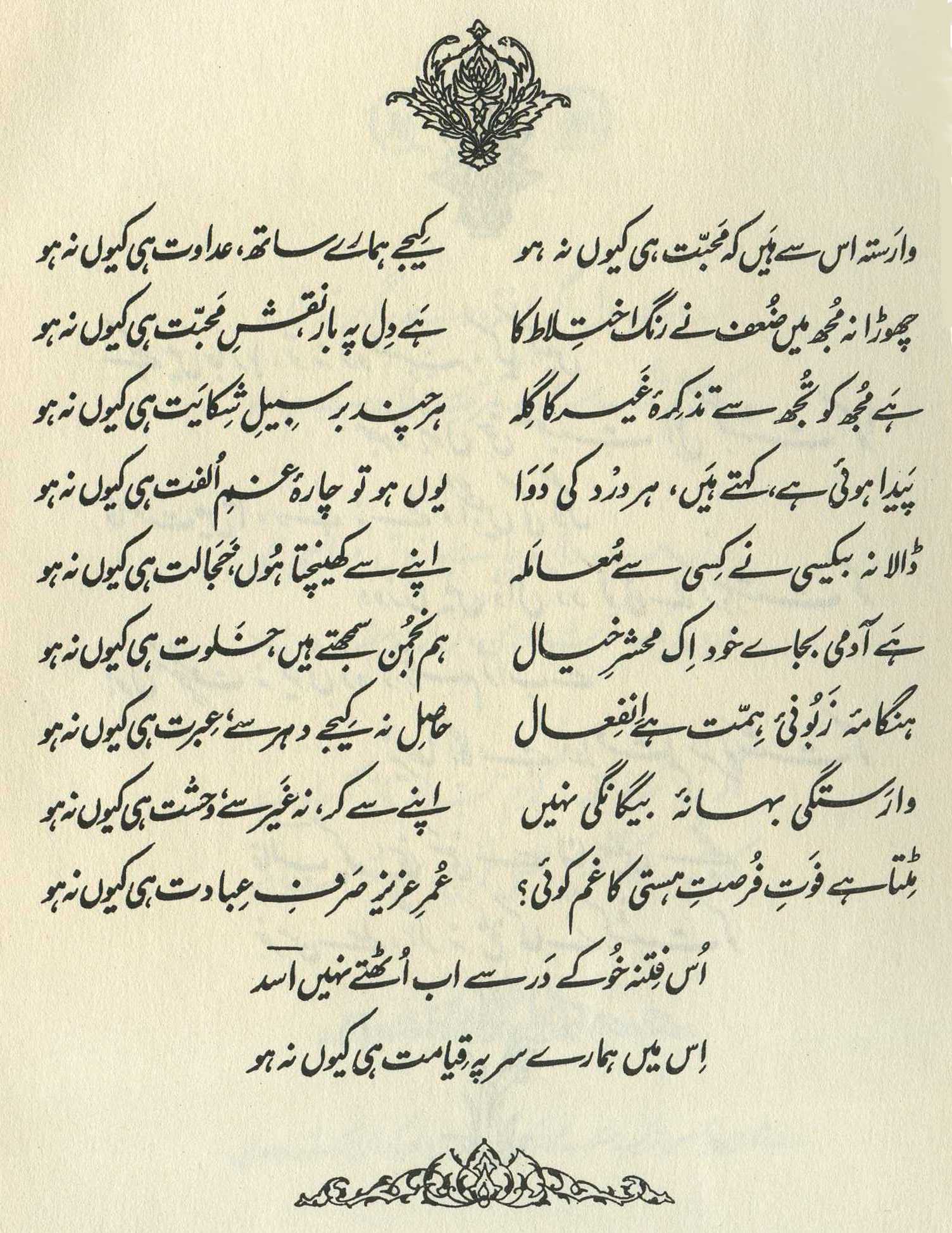
Although on Doomsday everyone certainly has to rise up, still now we will not rise. [The future form and the present ] here have the same meaning. But from the latter verb emerges an insistence too, that is not in the former. (128)
== Nazm page 128

The pleasure in this verse is that on the day of Doomsday, all will rise up; but we won't rise up even then. (181)
Now we've sat down at her door; anything at all may happen, we do/will not rise. The word tells us that we know that will arise, and disasters will arise; but what the hell [], let them come! (241)
Compare 46,5 . (244)
Here is a lovely, amusing verse of wordplay . The wordplay is so manifest, and so fundamental to the charm of the verse, that the commentators themselves, most unusually, point it out with delight.
As Nazm observes, the verb in the first line, though grammatically only a present habitual ('we do not rise'), idiomatically has the force of firm resolve ('we will not rise!').
The word comes ultimately from an Arabic root meaning 'to stand', and is derived from , meaning 'standing upright; rising up' (Platts p.796). Theologically speaking, it's really a Judgment Day, when all the dead will be summoned to arise and face the divine tribunal. But I translate it as 'Doomsday' because it also has the sense of turmoil, confusion, disaster.
So, as the commentators point out, the lover plants himself by the beloved's door, vowing that now he won't arise even if 'Doomsday' comes upon his head. The lesser doomsday-calamities-- being beaten by her Doorkeeper, being scolded by her, maybe being deluged with dirty water from a window above, and so on-- can no doubt be expected, but apparently the lover firmly plans to sit there forever. Even God may have trouble budging him when it's time for the real Doomsday-- an amusing thing to imagine.
Moreover, the beloved herself is a and, as Bekhud Mohani suggests, a major amount of is one of the expected features of Doomsday. So we also have the vision of the beloved herself as a source of Doomsday, as she inflicts her wrath on the stubbornly unmoving lover seated by her door. Sitting by someone's door is normally a display of humble submission, so that the lover's stubborn, flatly non-humble refusal to budge becomes a further source of amusement.
Ultimately, can the lover even tell the difference-- or would he even want to?-- between the beloved's version of Doomsday, and the divine one? Of course, mystically speaking, they can always be imagined as one.
On , see 119,1 .
graphics/doomsday.jpg