Verse 6after 1816athii kyuu;N nah ho
G3
1
a man is, {in his own right / 'instead of himself'}, a single/particular/unique/excellent assembly/Doomsday of thought
2
we consider it a gathering, even if it would be privacy
'In place; proper, suitable, fit, becoming; right, just, true; — adv. Fitly, properly, rightly, as it should be all right; just so, precisely; ... — , prep. In place (of, - ), in lieu of, instead of'.
'A place of assembly or congregation;... the day of the place of congregation, the day of judgment'.
'Assembly, meeting, company, society, institution; party, banquet'.
'Loneliness, solitude; seclusion, retirement, privacy; a vacant place, a private place or apartment'.
| References | |
|---|---|
| Arshi, Imtiyaz Ali | Ghazal# 118 |
| Raza, Kalidas Gupta | 295-96 |
| Nuskhah-e-Hamidiyah | 147-148 |
| Hamid Ali Khan | Open Image |
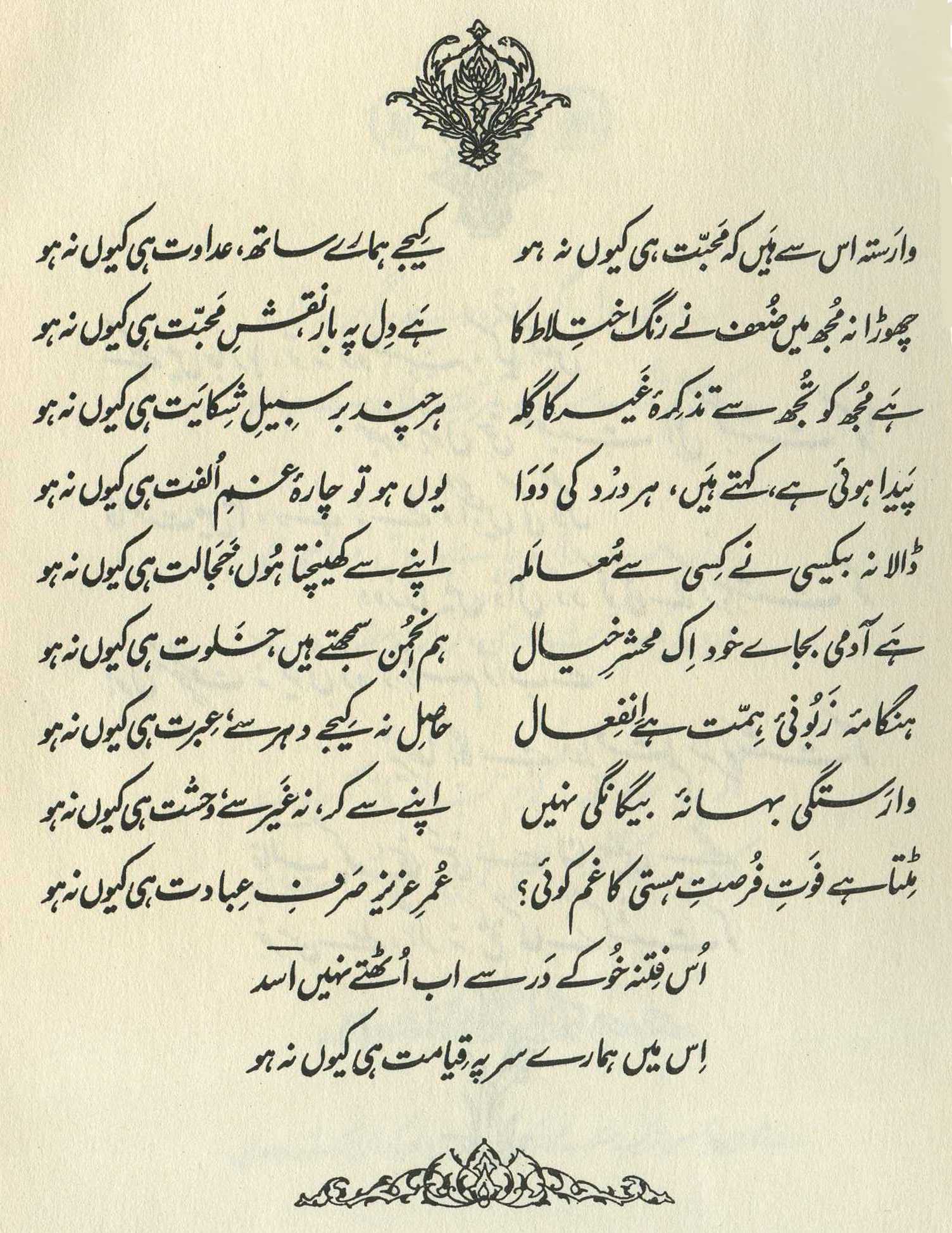
That is, even in solitude the turmoil of imagination and thought remains warm. Is that any less than a gathering? The gist is that shaping the spirit is difficult, and to attain mastery over the thoughts of the heart is very hard. It's a mystical verse. (127)
== Nazm page 127

For control of the spirit, sitting off in a corner is of no benefit. Because just the way there's no privacy in a gathering, even in solitude thousands of thoughts remain clustered in man's heart and mind. So what difference would there be between solitude, and a gathering! That is, it's very difficult to escape the thoughts of the heart and desires of the spirit. Man ought to turn his attention toward the Lord. (240)
[The commentarial consensus is fine, but there are more points to be noted.] The word has three branches of meaning: (1) to be raised/excited; (2) for people to become alive and to be gathered together; and (3) for people to be gathered together.
Then, the word too demands attention. By saying [the second line of 17,1 ], he's made a difference between and . Here too, that difference must have been in his mind.... The meaning is that the essence of all men is such that thoughts keep arising in their minds. A man's mind is never silent, never empty-- not even in madness or sleep. The nature of man is that thoughts always surround him. But these thoughts don't surround him the way, for example, water surrounds an island. Here things are in such a state that a man is a , in which dead thoughts-- that is forgotten, lost things-- or things that were never in the mind before, keep coming to live and appearing. Or having appeared, they move, and begin to collect themselves together. Like the field of Judgment Day [], in a man's mind good, bad, commonplace, great, foolish, insightful, philosophical, etc., thoughts keep crowding in, troop after troop.
If would be taken in the sense of 'Doomsday' [], as it is in Persian too (see ), then a vision of turmoil, clamor, helter-skelter confusion in the mind is also created.
== (1989: 206-07) 2006: 228-30
A grandly Ghalibian verse, with resonances that reach all over the cosmos and back. Ghalib is not only such a humanist, but also such a lover and champion of the powers of the imagination-- no wonder he's irresistible to us free-range westerners. Another verse along (some of) the same lines: 169,5 .
Everybody takes to mean something like 'in his own right' or 'in himself', which is perfectly plausible. But there also surely lurks in the background the normal meaning for , 'instead of', 'in place of' (see the definition above), as in 71,5 . On this more radical reading, a man is not 'himself' (or even perhaps 'a self') at all. What is he instead? Something framed for maximum contrariness and paradox: a single [] multiplicity-- a 'single' (or 'particular'? or 'unique'? or 'excellent'?) gathering-place [], of thought. Is it this 'singleness' that makes him believe that he is, or has, a 'self'? Is it his 'gathering-place of thought' nature that makes his belief false? And of course, as the 'gathering' of Judgment Day or Doomsday emphasizes the dire, chaotic, dangerous, uncontrollable nature of all these convergent thoughts. Compare the radical helplessness and constant 'shuffling' of the self in 81,2 .
Instead of resolving such questions, the second line merely adds new ones. Who is the 'we'? Is it the poet speaking of himself in the plural as he often does, and expressing a view uniquely his own? Or is it we the species-- the group of all humans referred to in the first line, who all share this view? Then, of course, if we 'consider' [] something to be so, are we right or wrong? ('We' often do 'consider' wrongly, as in 98,10 .)
And what exactly is it that we 'consider'? We consider that we are-- or are in?-- an , even if we are alone. And the clever thing is the wide range of meanings that can have. At bottom, it shares a domain with , since both can refer, somewhat neutrally, to an assembly or gathering. But in tone, their paths diverge considerably: has ominous overtones of crowding, uncontrollableness, doom, even Doomsday-- while an can be a delightful evening party of great formality, sophistication, and desirability.
So if we emphasize the root meanings of and , we have a neutral-seeming recognition of the (more or less radical) complexity of man's inner life, such that there's always a 'gathering' going on in our heads, even in solitude.
But if we emphasize the divergent nuances of the two words, things look much bleaker. Each of us is basically a wild, uncontrollable, almost 'Doomsday'-like tangle of jostling thoughts, but we don't fully know or acknowledge it. Instead, we consider that we're at a party. Are we naive? Or vain? Or is it a desperate form of 'self'-deception?
For another , see 229,8x . On , see 119,1 .
Compare Mir 's reflection about words, crowds, and Doomsday: M 1357,7 .
Courtesy of the Wellcome Institute-- an oil painting, 'Testa anatomica', by Filippo Balbi, 1854:
graphics/gathering.jpg