Verse 5after 1826oshhai
G3
1
vision/appearance, wine; spirit/'stomach', Cupbearer ; gaze, intoxicated [one]
2
the gathering of thought is a wine-house without tumult
'Sight, vision...; look, appearance; face, countenance, cheek'.
'Stomach, maw; crop, craw; (fig.) capacity; desire, ambition; resolution; spirit, courage'.
'Loud noise, cry, call, shout, yell; tumult; crush'.
| References | |
|---|---|
| Arshi, Imtiyaz Ali | Ghazal# 199 |
| Raza, Kalidas Gupta | 373-74 |
| Hamid Ali Khan | Open Image |
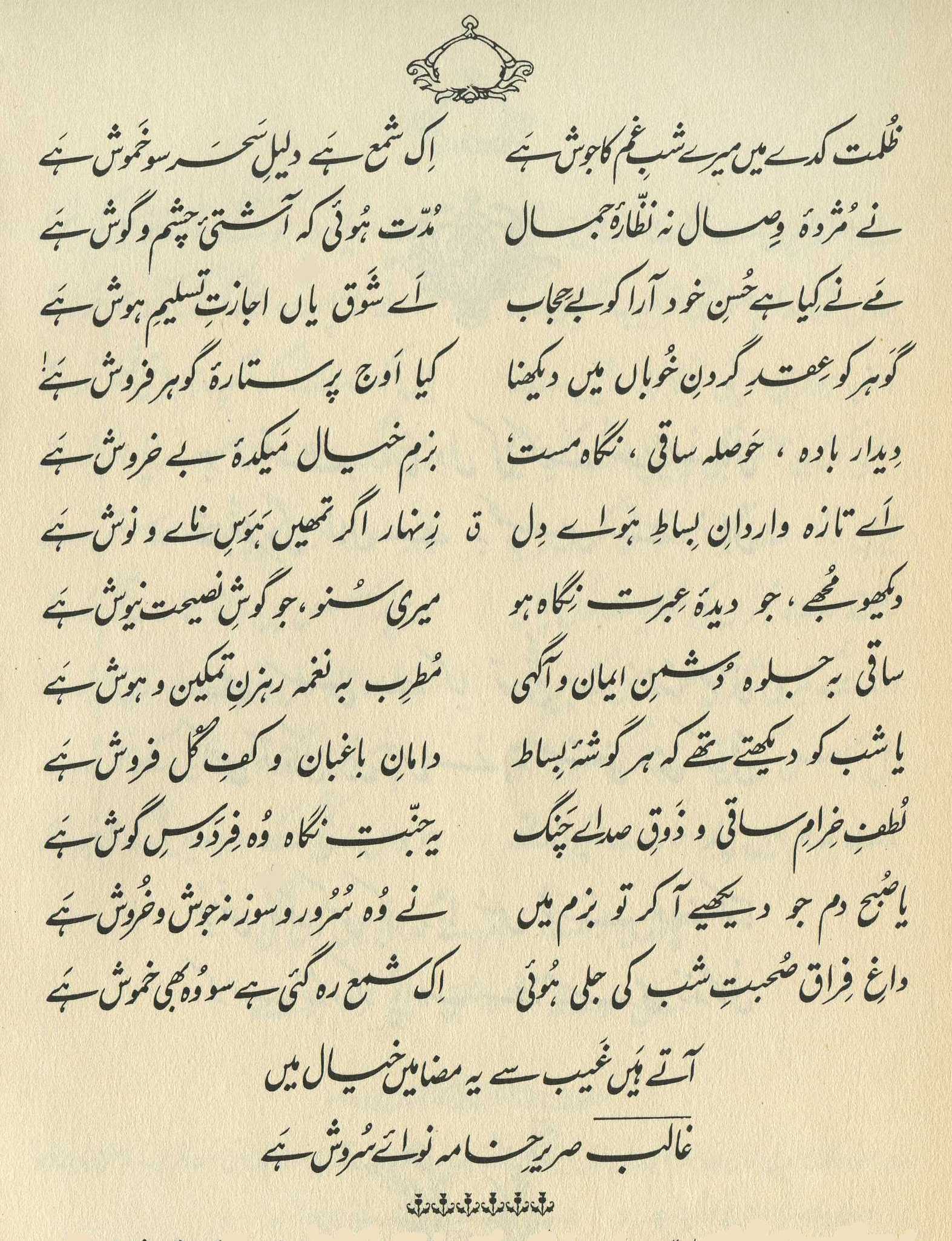
In the first line there is no anywhere. He shows the aspect of the gathering of thought: there vision/appearance is the wine, the gaze is the wine-drinker, ambition/spirit is the Cupbearer. (190)
== Nazm page 190

The imagined gathering is a kind of wine-house in which there is no sort of turmoil and commotion. The meaning is that the gathering of thought is an extraordinarily enjoyable scene. (245)
That is, if you would turn your attention to the heart, then both divine and worldly passion would become visible, and with such glory/appearance that you wouldn't be able to endure it, and the gaze would remain intoxicated. That is, the glory/appearance place of thought is more than the beloved's gathering in one respect: that if the beloved would appear before you, then if you have the endurance for the sight, then-- well, you've seen it; if you don't have the endurance, then you won't see it and you'll remain deprived of the sight. But in the gathering of thought, it's not like this. Here, as many glories/appearances come as your ambition/spirit permits. (331)
../apparatus/txt_sets.html The first line initially offers nothing but confusion: a string of six nouns and no accompanying grammar whatsoever. (And needless to say, Ghalib didn't punctuate his verses.) The line is thus technically one of his 'list' lines; for more on these, see 4,4 .
But we're not at a loss-- as we reflect on the line we easily notice that the odd-numbered words are from the mental/sensory domain, and the even-numbered ones are from the domain of wine-drinking. With that realization, it doesn't take long to group them into three sets of pairs, one from each domain, and to notice that they're apparently being linked, or perhaps even equated.
After getting that far, however, we still can't really tell where the second line is going. And under mushairah performance conditions, we'll be made to wait as tantalizingly long as possible before we're allowed to find out. Then even when we hear the second line, it remains a bit enigmatic. All the elements of the wine-house have their counterparts in the mind-- in fact, the 'gathering of thought' actually 'is' a wine-house, with only one difference: it is a wine-house without clamor, tumult, outcries [].
But what are we to make of that description? Several possibilities present themselves:
=The mental wine-house is better than the physical one, because it isn't full of noisy outcries, confusion, crowds; the drinker can just lose himself in his own intoxication.
=The mental wine-house is inferior to the physical one, because it lacks the hustle and bustle, the ebullience, the vibes, the , that are so much a part of an enjoyable evening at the wine-house.
=The mental wine-house is basically just like the physical one; the only difference that can be detected-- a discrepancy in the noise level-- is trivial and immaterial.
Then if we're in the mood to ponder, each of the pairs in the first line also admits of subtlety. How abstractly are we to read ? How literally are we to read ? And the whole wine-house scene-- is it good? bad? desirable? inadequate? ruefully funny? melancholy? romantic? mystical? pathetically limited? infinitely inspiring? Etc. etc. We readers have to invent the whole tone of the verse-- and invent it afresh with every reading. Every reading is, after all, another glass in the wine-house of the imagination. A glass that I lift in a toast to Ghalib. I've loved this verse since the first time I heard it.
Compare 223,2 , a more ambiguous, and perhaps more dangerous, vision of the same situation. And see also the amusing variant view presented in 322x,2 .
For another treatment of the , see 229,2 . And don't forget the neutral-sounding, but sobering, 119,6 .
Ghalib has a wine-house of the mind; Mir has a garden of the mind: M 1537,4 .
graphics/didar.jpg