Verse 13after 1826oshhai
G3
1
they come into the mind, these theme s, from the 'hidden/absent' [realm]
2 a
Ghalib, the scratching of the pen is the voice of an angel
2 b
Ghalib, the 'voice of an angel' is the scratching of the pen
'Absence; invisibility; concealment; anything that is absent, or invisible, or hidden (from sight or mental perception); a mystery, secret; an event of futurity; the invisible world, the future state'.
'Creaking; grating (as of a door on rusty hinges); scratching sound (of a pen)'.
| References | |
|---|---|
| Arshi, Imtiyaz Ali | Ghazal# 199 |
| Raza, Kalidas Gupta | 373-74 |
| Hamid Ali Khan | Open Image |
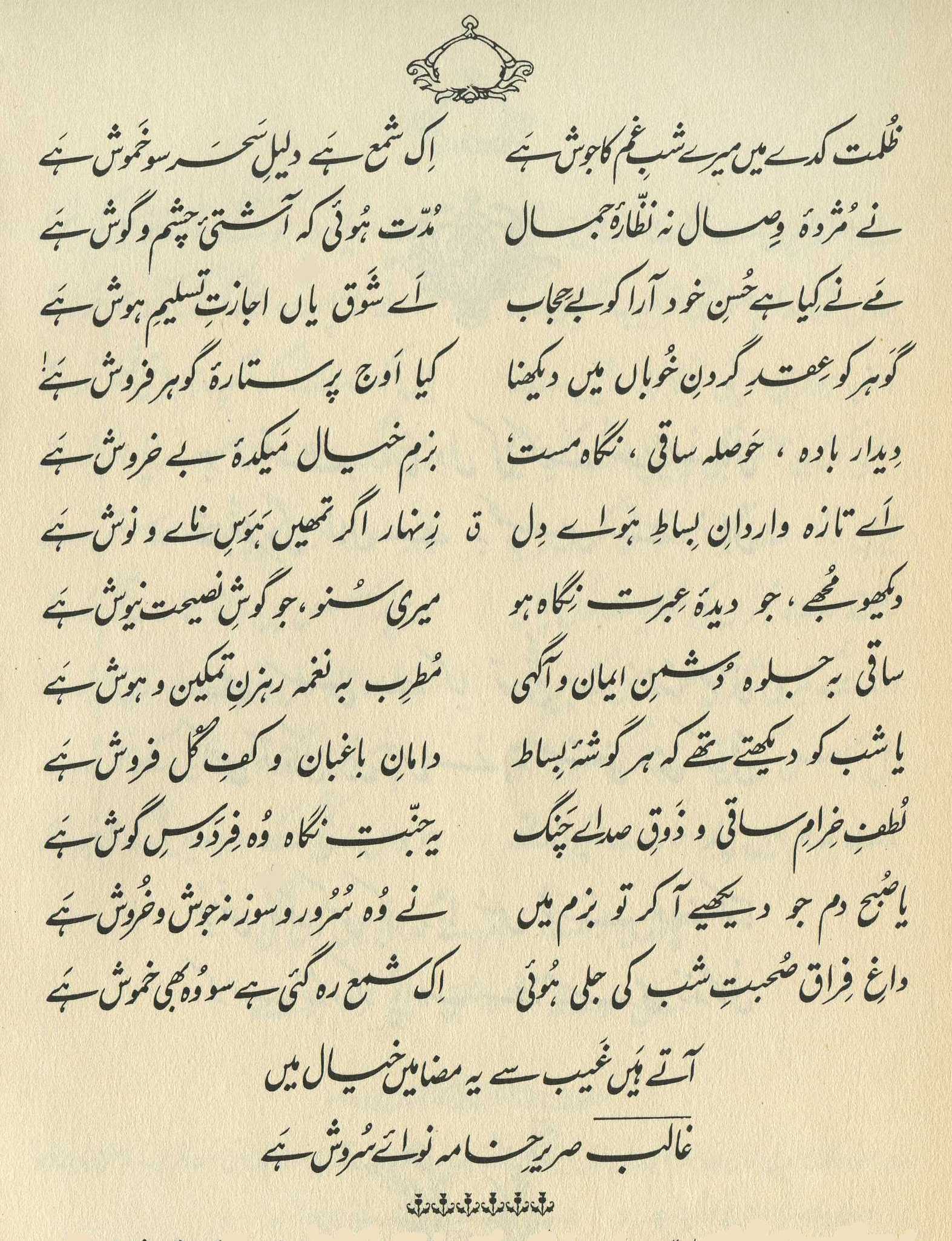
His manner of composition [] was that often at night, in a state of intoxication, he used to think []. And when some verse came to fruition, the he used to make a knot in his belt-tie []. In this way, having tied eight or ten knots, he would go to sleep. And the next day, through memory alone, he would think of them and consign them to pen and paper.
==Urdu text: Yadgar-e Ghalib , p. 64
That is, if these themes that emerge from your pen are themes of the 'hidden', then you ought to consider the scratching of the pen to be the voice of an angel. (191)
== Nazm page 191

The truth is that having written such a wonderful ghazal, Mirza Sahib's writing this closing-verse is absolutely not to be counted as boasting; rather, it's the true state of affairs. He says, such lofty themes come from the 'hidden' into my mind-- oh Ghalib, the sound of my pen ought to be considered the voice of an angel. (246)
Oh Ghalib, these themes come into my heart from the Lord. The sound of my pen is the voice of Gabriel. That is, I am the Prophet of Poetry, I sometimes have inspiration and sometimes have revelation. (332)
The complexities of (see the definition above) leave the poet, and the commentators, lots of wiggle room. The source can be mystical, religious, unknown, hidden, or completely vague. For another verse that takes advantage of the mysteries of , see 98,10 .
The second line too can be read with a variety of tones, from the extremely arrogant to the relatively humble:
=Since Ghalib is directly inspired by the Lord, his writing is in the revelatory voice of an angel.
=Since Ghalib's themes come from a realm of mystery, and angels too come from a realm of mystery, there must surely be some kind of expressive connection.
=Since Ghalib is so deeply creative and inventive, his own themes are equal to the voice of any angel
=Since there are no real angels (or Gods?) in the world, the best Ghalib can do, ruefully or despairingly, is to divinize the scratching of his own pen (compare 62,8 , and especially 174,10 ).
Moreover, there's nothing in the verse to restrict the frame of reference to the speaker alone: it could be a truth of all human experience-- one either inspiring ('Angels talk to us!') or bleak ('Our own pens provide the only angels' voices that exist'), as we choose.
As Bekhud Dihlavi observes, even if it's boastful, it's still no more than than the truth, especially coming at the end of a brilliant ghazal like this one.
graphics/pen.jpg