Verse 11after 1826oshhai
G3
1
or else having come into the gathering at the break of dawn, if we look
2
there is neither that joy and burning/heat, nor turmoil and commotion
The spelling instead of is to make it a long syllable, to suit the meter.
'Burning; heat, inflammation; ardour, passion; affection; heart-burning, vexation'.
'Boiling, ebullition; effervescence; heat, excitement, passion, emotion; lust; fervour, ardour, zeal; vehemence; enthusiasm; frenzy'.
'Loud noise, cry, call, shout, yell; tumult; crush'.
| References | |
|---|---|
| Arshi, Imtiyaz Ali | Ghazal# 199 |
| Raza, Kalidas Gupta | 373-74 |
| Hamid Ali Khan | Open Image |
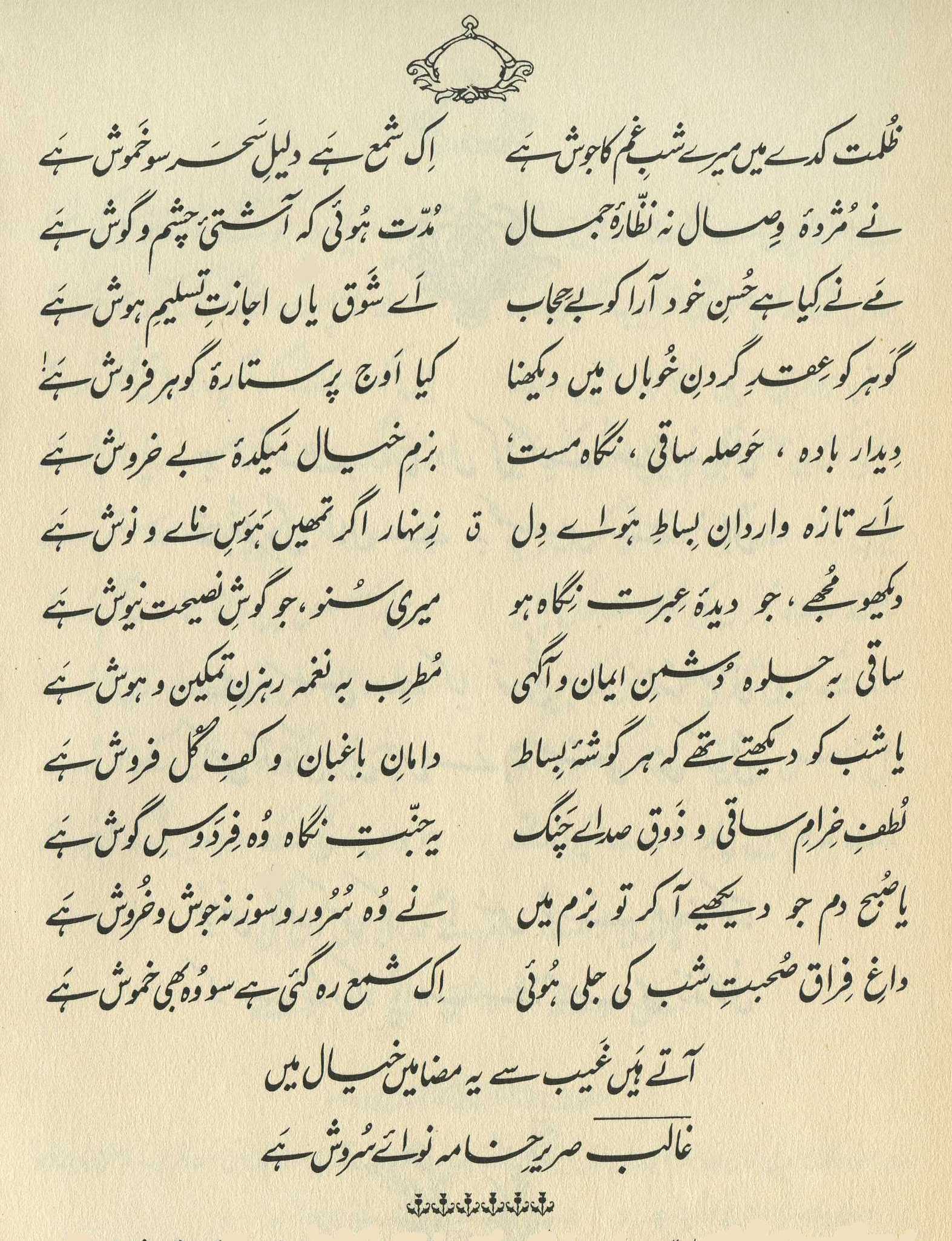
That hustle and bustle, and heart-attraction, and festivity of the night-- the morning's state of sadness, and desolation, and bleakness. They are two opposite moods. The former delights the listener, and the latter saddens him. The former opens out his temperament, and the latter contracts it. For this reason, the last two verses of this verse-set are the most eloquent-- because their effect is contraction/sadness of the temperament, and that contraction which occurs after an opening-out has a greater effect. (190)
== Nazm page 190

At dawn if you come and look, then in the gathering an extraordinary sadness and lack of brilliance [] is found. Neither those sounds of instruments, nor the burning and melting of the people of the gathering, nor the turmoil and commotion of the gathering. (246)
Now if you come at dawn and look, then neither can that hustle and bustle be seen, nor that brilliance []. (332)
../apparatus/txt_sets.html This is the sixth verse of a seven-verse verse-set ; for discussion of the whole verse-set, see 169,6 .
The introductory is a follow-up from the one that appears two verses before; see that verse, 169,9 , for discussion of this structure.
Everybody emphasizes the starkness and awfulness of the scene at dawn, and indeed they're right. But there's just enough leeway in the description to allow for a bit of complexity. Apart from , the other three descriptors -- and and -- all have negative as well as positive resonances. They can evoke the things that make you tired of a big lively party after a while-- the irritation, the hyperactivity, the clamor, the noise and crowding, the general assault on the senses. Anybody who's ever gone home early from such a bash will remember the feeling. This possible touch of vexation spices up the verse, and makes it much more evocative.
Those three nouns so easily bridge the gap between physical conditions-- burning, boiling, tumult-- and their mental or emotional metaphorical counterparts. The 'great party' may be a heaven, but it also shows some little overtones of a hell. It reminds me of the elegant unresolvability of 169,5 .
graphics/aftermath.jpg