Verse 2after 1826oshhai
G3
1
neither the good-news of union, nor the vision of beauty--
2
it's been a while, that there has been peace between eye and ear
The spelling instead of is there to permit the syllable to be metrically long.
'Peace, concord, reconciliation, agreement'.
| References | |
|---|---|
| Arshi, Imtiyaz Ali | Ghazal# 199 |
| Raza, Kalidas Gupta | 373-74 |
| Hamid Ali Khan | Open Image |
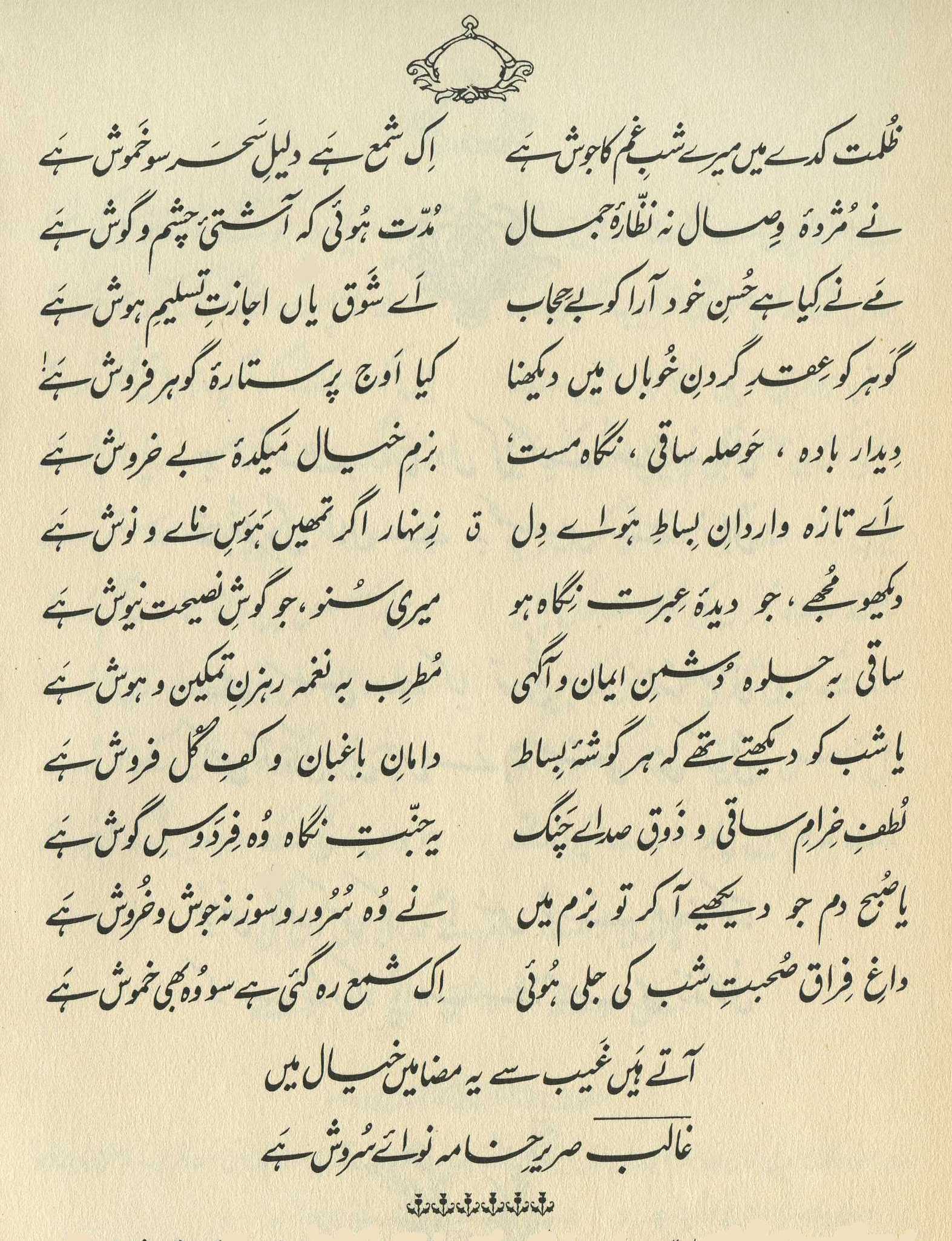
That is, the time has gone when if the eye saw the sight of beauty, then the ears felt envy/jealousy: 'let us too hear the good news of union'. Or if sometime the good news of union reached the ear, then the eyes felt envy/jealousy: 'they have heard the good news of union already, and we haven't yet succeeded in having a vision of beauty'. (189)
== Nazm page 189

He says, 'Now neither do the ears obtain good news of union, nor do the eyes attain a vision of beauty. For some time, the eye and ear have had mutual agreement between them.' (244)
That is, now the eye is not envious/jealous, that 'the ears hear the name of the beloved, and we are deprived'; nor is the ear envious/jealous of the eye because of the sight of the beloved. That is, both are deprived. (330)
What a great mushairah -verse this must have been! The first line sets us up for a classic ghazal lament-- 'Alas, how I suffer! I have no hope or rewards at all, my wretchedness is complete, what can I do but lament', etc. etc. We in the audience can easily think of lots of conventional ways for the second line to develop.
When we finally (after the ritual delay) are allowed to hear the second line, even up to the halfway point we think we're right. 'It's been a while'-- and we're expecting 'since I saw that cruel one', or something of the sort. But then the verse veers completely off course. We can't get it until the very end, and then we suddenly get it. The line turns out to describe not further wretchedness, or more laments, or something else dire-- but a small matter-of-fact consolation prize.
Things are so totally awful, says the lover, that the eye and ear no longer have any goodies to quarrel over, so nowadays they are reconciled and get along well. He no longer has to put up with their jealousies and mutual complaints. Any harassed parent will know what he's talking about. His misery as a lover has at least brought him the relief of peace and quiet-- no more whining, no more squabbling and bickering, nothing to set his teeth on edge. What price domestic harmony?!
Rhetorically, this verse might be considered to show a basic (and reversed) form of the device called ' collecting and scattering '.
Note for grammar fans: On the translation of as 'it's been a while', see 38,1 .
graphics/eye_ear.jpg