Verse 12after 1826oshhai
G3
1
[in a state of having been] burned by the wound of the separation of the companionship of the night
2
a single/particular/unique/excellent candle has remained-- thus even/also it is extinguished/silent
'So, so that, therefore, hence, consequently, accordingly; but then; thereupon; now, well'.
| References | |
|---|---|
| Arshi, Imtiyaz Ali | Ghazal# 199 |
| Raza, Kalidas Gupta | 373-74 |
| Hamid Ali Khan | Open Image |
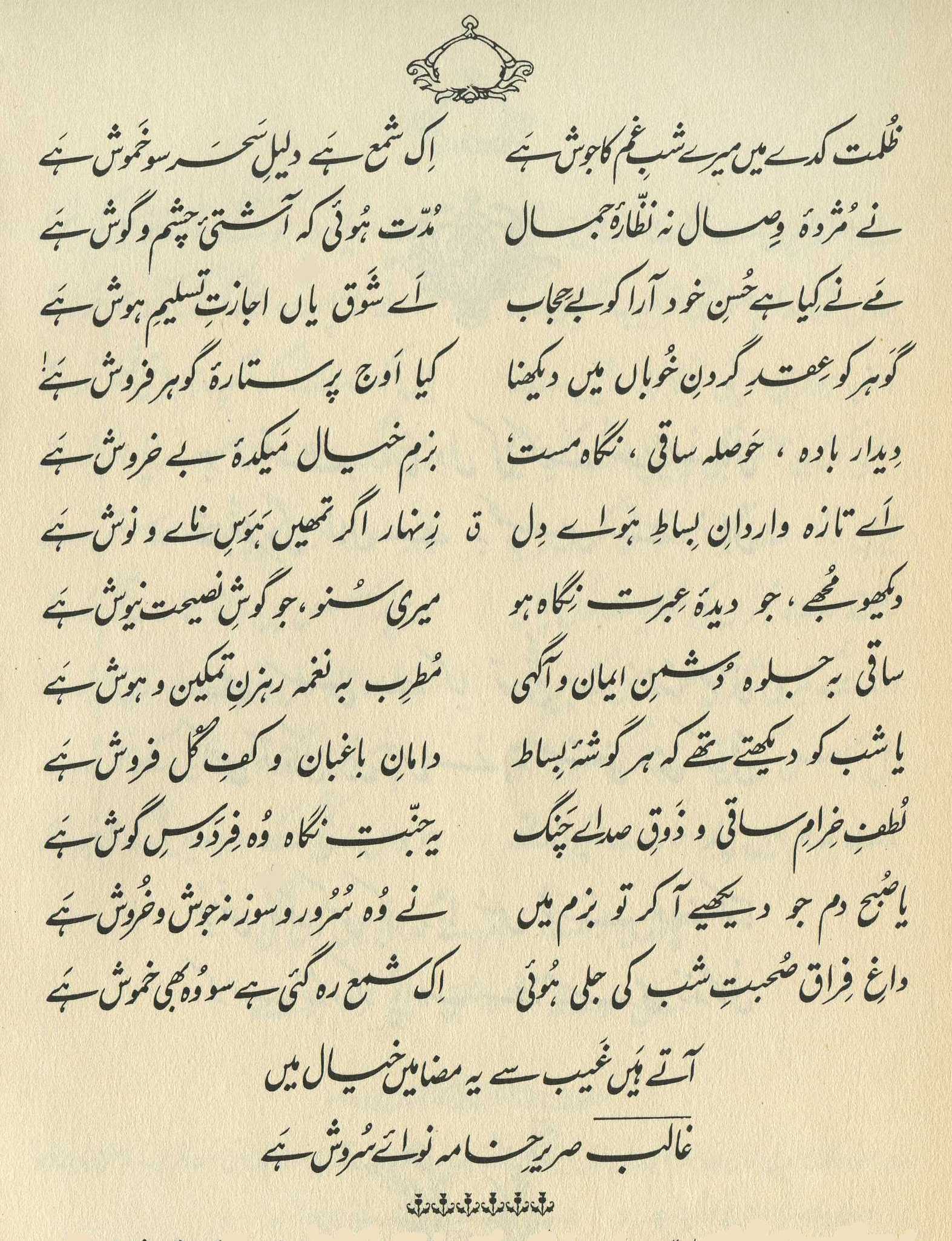
[See his comments on 169,11 .]
== Nazm page 190

Instead of all those moods and equipment of enjoyment, this can be seen: one candle remains, burnt by the companionship of the night and saddened/chilled by the wound of separation-- and that too, like the wretched heart of the lover, is extinguished. (246)
Only one candle is to be seen, from which it's possible that it too has been burnt out by the events of the night, and it shouldn't be considered to have been extinguished on the coming of dawn. Rather, burning in grief at the scattering of the heart-bewitching company of the night, it has become burnt out. (332)
This is the final verse of a seven-verse verse-set ; for discussion of the whole verse-set, see 169,6 .
How satisfyingly this verse evokes the extinguished candle of 169,1 , and Ghalib's own comments about the extinguished candle as a herald (?) of dawn! We have almost come full circle.
The majority of lines in the ghazal world are end-stopped, but there are still plenty that show enjambment-- that carry over their grammar into the next line. Few, however, carry it over as drastically and dramatically as this one. Because English is a subject-verb-object language, and thus has prepositions, while Urdu is a subject-object-verb one and has postpositions, I can't really retain the word order of the first line; but it would go like this:
{wound-of-{separation-of-{companionship-of-night}}}-by [in a state of having been] burned
The word 'burned' is delayed as much as possible and comes at the very end, so that it feels like the end of a long, slow, complex process-- and after it's all over we realize that all we've got is one gigantic adjective. (Or actually, as we grammar fans know, a past participle, so that the burning is placed strongly in the past, and what is described is the state of the candle after having been burned.) The whole long line only basically means 'wound-burned' (in the feminine singular), with some description of the wound-- there's no other grammar whatsoever.
That final 'burned' thus hits harder than its English counterpart-- but also seems to desperately reach forward, to beg for access to its noun and verb and the whole of its grammatical meaning, all of which have been carefully deferred to the second line. At the end of the first line, we in the audience are left with nothing but a burnt-out X for company. How thrillingly vexing it must have been to the audience in the mushairah to have to wait for the second line. No doubt they could guess what a feminine singular burnt-out thing might be-- but still, how annoyingly the first line teases us, how little it really gives us!
The effect is to focus everything on that single candle; located at the center, it is the pivot on which the verse turns. It comes to us carrying a kind of pre-draped mantle of suffering, the whole first line's worth of massive adjectival past action. But then in the second line, it just stands there-- it 'has remained', it 'is silent' (meaning, by extension, 'extinguished'). No present or future action is to be expected from it. We don't know what it might be thinking or feeling, if anything. It's over, it's history, it's done for. No doubt it's described as -- with a range of meanings that includes 'unique' and 'excellent'-- so that its fate may well be mystically significant. But the outcome is nevertheless clear. We may not entirely like the wild noisy party, but in this verse-set, the only alternative is radical silence and desolation.
http://www.flickr.com/photos/scrambler27/479436331/ http://www.flickr.com/photos/scrambler27/479436331/ graphics/burntcandle2.jpg