Verse 3after 1826oshhai
G3
1
wine has made self-adorning beauty unveiled
2
oh ardor, indeed, there is permission/dismissal of the 'taslim' of awareness/sense
'Permission, liberty, leave, authority, sanction; leave to depart, dismissal; authority or liberty to do anything'.
''>>Saluting, greeting; salutation, obeisance, homage ... ; delivering, consigning; committing to the care of; surrender, resignation; conceding, acknowledging, granting; assenting to, accepting'.
'Understanding, judgment, intellect; sense, discretion; --mind, soul'.
| References | |
|---|---|
| Arshi, Imtiyaz Ali | Ghazal# 199 |
| Raza, Kalidas Gupta | 373-74 |
| Hamid Ali Khan | Open Image |
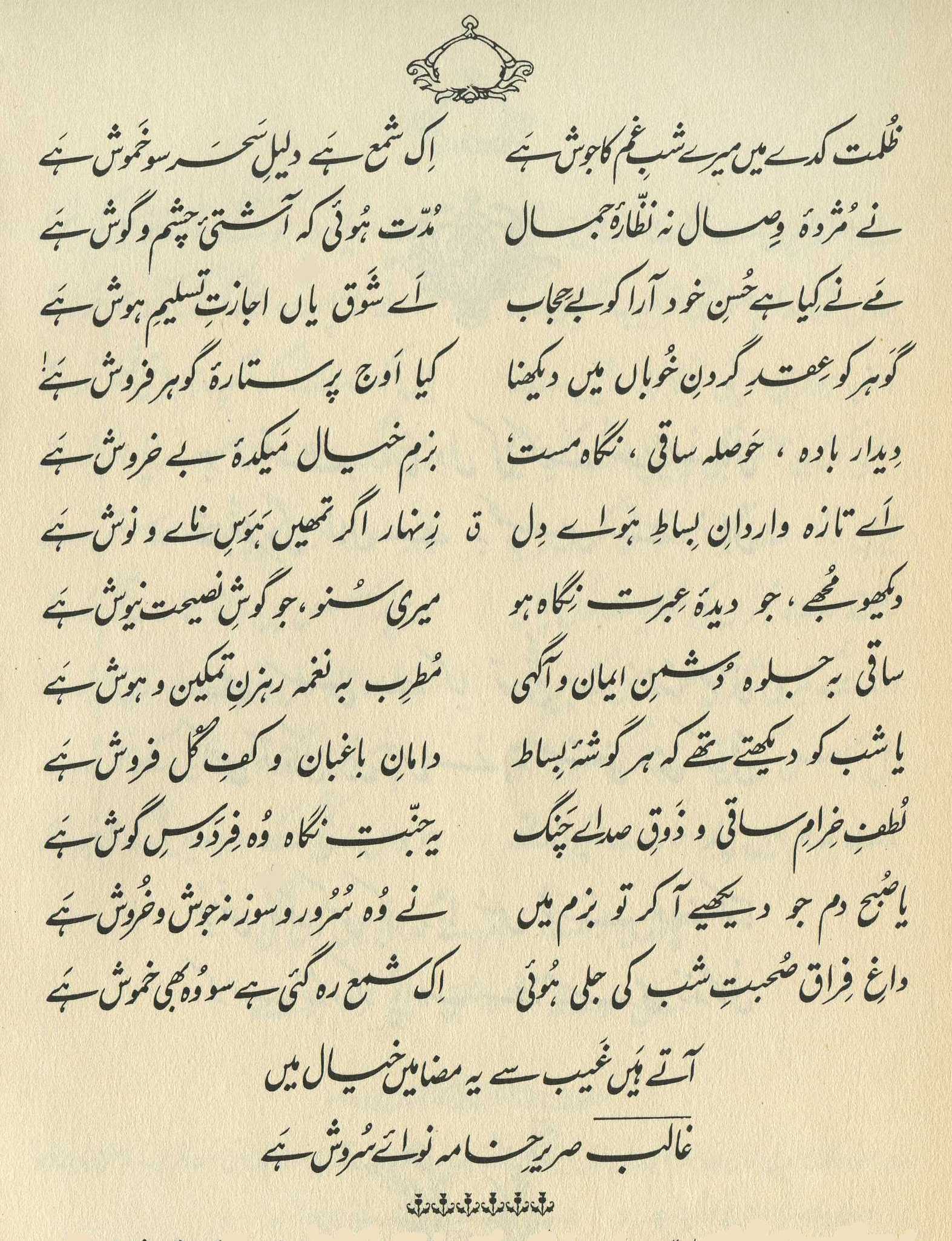
There is permission to confide the awareness and senses to that one's custody, because the sense-stealingness of wine has created a veil. (189)
== Nazm page 189

He says, wine has made self-adorning beauty unconscious. Oh ardor of the heart of the lover, now you too have permission, that you too for a little while may sacrifice your awareness and senses to that unveiled beauty. (244)
In the intoxication of wine the beloved, who keeps her self-adornment in mind, has become unveiled. Oh ardor, now what do you see! This is the very time for the sacrifice/offering of the awareness and senses. That is, in her becoming unveiled is a hint that now the time for my becoming self-less has come. The necessary consequence emerges that when the beloved becomes unveiled, no one can remain in his senses. (330)
Some editions (including Hamid) have instead of . As always, I follow Arshi.
Here is another of what I call 'generators', in which the possible permutations of meaning are simply too manifold and complex even to be set down in a list. Just look at the possibilities in the second line. First of all, can mean both 'permission' (to do something entirely unspecified) and 'dismissal' (that is, permission to leave). Then, the range of meanings for (see the definition above) is so staggering that I haven't even tried to translate the word: it can mean greeting or saluting a superior (as though perhaps that person were just arriving); or delivering up something to the care of somebody else; or surrendering or yielding something in a more general way; or conceding or acknowledging something. Every one of these meanings can be paired with (itself a complex word; see the definition above) in a variety of ways. And are any (others) of these abstract entities to be semi-personified as independent agents, such as 'ardor' seems perhaps to be?
The multivalence of the two constructions also makes for maximum flexibility. Is permission/dismissal being given 'to' the taslim, or 'for' the taslim (whatever the 'taslim' may be)? And is it the taslim/salutation 'made by' the (active) awareness, or the taslim 'of' the (passive) awareness? And what is the role of 'ardor'-- is it some sort of agent being given a cue for action, or merely an observer to whom the lover is privately commenting? The verse could be enjoining an increase of conscious awareness, so that the lover can (sneakily?) fully take in the rare sight of the beloved unveiled; or it could be enjoining an abandonment of conscious awareness, since the beloved's intoxication means that the lover is 'off duty' and can lapse into self-less ecstasy. And so on-- and on.
As if these weren't enough piled-on ambiguities, we also have to decide for ourselves the relationship between the two lines. The first line seems to trigger the address to 'ardor' in the second line, but why exactly? Is it because of the beloved's drunken obliviousness (so that she won't know if the lover is staring at her)? Or is it because of the beloved's own warmth of intoxication (so that she's now willing to show her unveiled self to the lover)? And what exactly does her being 'self-adorning' have to do with her being 'unveiled'? Are the two related (her being self-adorning is somehow connected with her being unveiled), or mutually exclusive (normally she is self-adorning, but when she is unveiled she is seen unadorned)? And then, needless to say, we could be speaking either of a human beloved, or of the divine Beloved, so that a wide range of mystical possibilities are fully available.
There is also a small but piquant sound effect. The first line begins with 'wine has made' []. Only by a single nasal does that phrase differ from the extremely common 'I have made' []. In a mushairah performance, wouldn't the listeners tend to hear, especially on the first recitation, a kind of rhyme or echo of 'I have made'?
With all these metaphysicalities, the verse still doesn't feel like an annoying exercise in puzzle-making, the way 168,1 does. It feels (elusively and delusively) simple, and full of, well, ardor.
graphics/wine.jpg