Verse 1after 1826oshhai
G3
1
in my darkness-chamber is the turmoil/ebullience of the night of grief
2
a single candle is a sign/evidence of the dawn-- so/thus it is extinguished/'silent'
'Boiling, ebullition; effervescence; heat, excitement, passion, emotion; lust; fervour, ardour, zeal; vehemence; enthusiasm; frenzy'.
'Indication, evidence, argument, proof, demonstration; a director, guide, indicator, discoverer'.
'He, she, it; that, that one, that person or thing; —adv. & conj. So, so that, therefore, hence, consequently, accordingly; but then; thereupon; now, well'.
| References | |
|---|---|
| Arshi, Imtiyaz Ali | Ghazal# 199 |
| Raza, Kalidas Gupta | 373-74 |
| Hamid Ali Khan | Open Image |
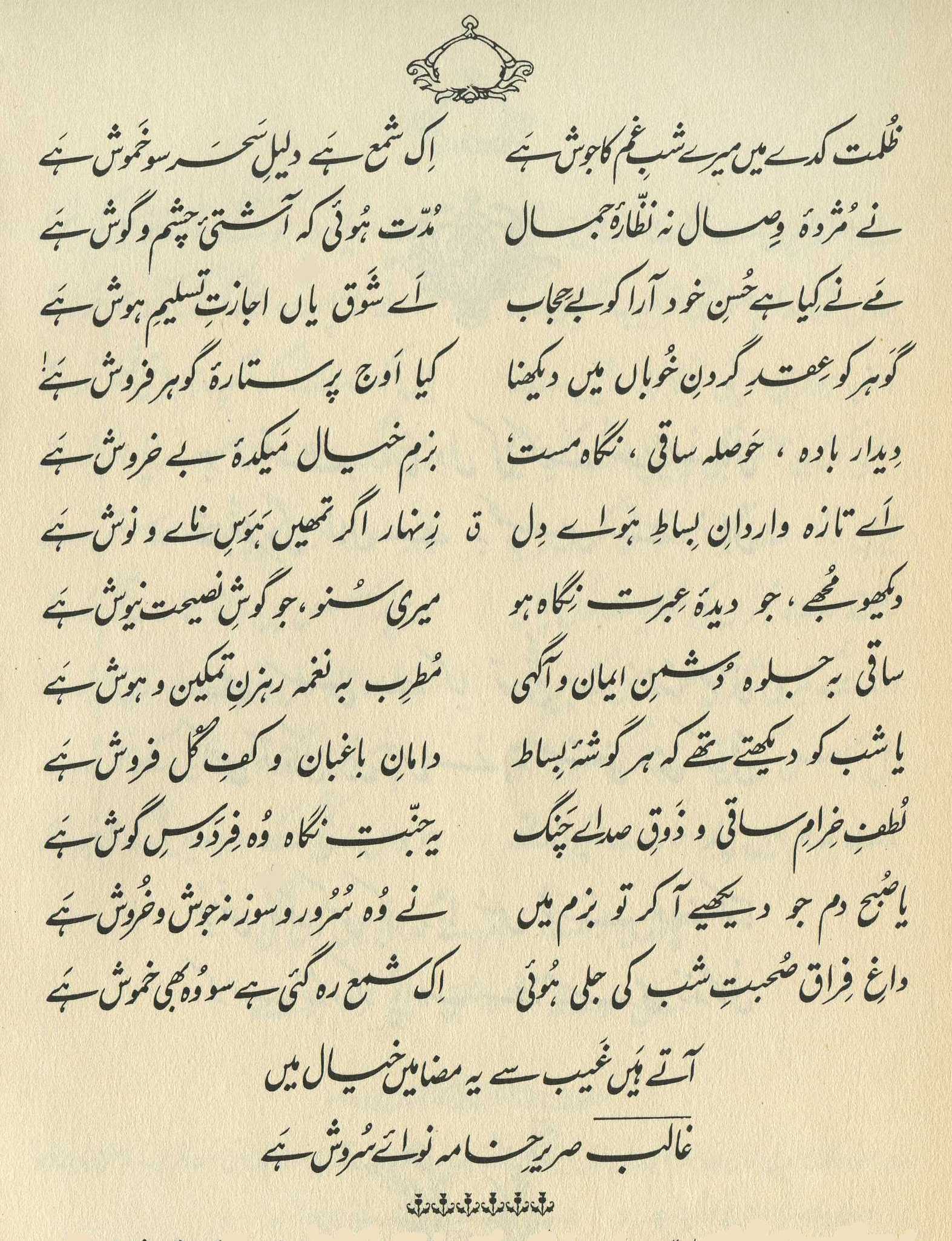
[1866?, to Shakir:] [The second line]-- this is an 'informative' []. The first line-- this is an 'inceptive' []. -- that is, darkness upon darkness; the darkness, dense; the dawn, unborn-- as if it had never been created at all. Indeed, there is one proof of the existence of the morning-- that is, an extinguished candle, through this path: that a candle and a lamp are always extinguished at dawn. The pleasure [] of this theme is that the thing that has been established as the proof of the dawn, is itself one among the causes of darkness. Thus it's worth seeing-- the house in which a symbol of dawn is a strengthener of darkness, how dark that house will be! (Arshi 302)
==Urdu text: Khaliq Anjum vol. 2, p. 843
==another trans.: Russell and Islam , p. 320
==another trans.: Daud Rahbar , pp. 274-75
[1866, to Shakir:] A verse of [the Persian poet] Maulvi Nizami Ganjavi, may God have mercy upon him, fell into the hands of students. They began to make objections to it, based on the rules of grammar. When those objections reached the Maulvi, he said, 'Friends, who took my poetry to school?' Those gentlemen who say that the whole first line cannot be an 'inceptive' []-- they should be asked, 'Out of this first line, do you declare to be an inceptive and to be an 'informative' []? Then if that's the case, even so the goal is attained. The second line is undoubtedly another informative. After all, it's also a part of the accepted rules of the art of grammar that one inceptive can have two, or rather a number of, informatives. Indeed, there's another rule, that what precedes a verbal phrase [] is not called an inceptive. The second line of this opening-verse is a nominal phrase []. It accepts an inceptive before itself. If we, with a view to this custom, call the first line inceptive, even then there's not necessarily any flaw. In any case, whatever these sahibs might call this first line, I accept it. But my verse does not support it. More than this, what can I write? (Arshi 302-03) ==Urdu text: Khaliq Anjum vol. 2, pp. 839-40 ==another trans.: Daud Rahbar , pp. 285-86
[1866, to Shakir:] A verse of [the Persian poet] Maulvi Nizami Ganjavi, may God have mercy upon him, fell into the hands of students. They began to make objections to it, based on the rules of grammar. When those objections reached the Maulvi, he said, 'Friends, who took my poetry to school?' Those gentlemen who say that the whole first line cannot be an 'inceptive' []-- they should be asked, 'Out of this first line, do you declare to be an inceptive and to be an 'informative' []? Then if that's the case, even so the goal is attained. The second line is undoubtedly another informative. After all, it's also a part of the accepted rules of the art of grammar that one inceptive can have two, or rather a number of, informatives. Indeed, there's another rule, that what precedes a verbal phrase [] is not called an inceptive. The second line of this opening-verse is a nominal phrase []. It accepts an inceptive before itself. If we, with a view to this custom, call the first line inceptive, even then there's not necessarily any flaw. In any case, whatever these sahibs might call this first line, I accept it. But my verse does not support it. More than this, what can I write? (Arshi 302-03) ==Urdu text: Khaliq Anjum vol. 2, pp. 839-40 ==another trans.: Daud Rahbar , pp. 285-86
Ghalib has called an extinguished candle a sign of the dawn because the whiteness of the candle has a similarity to the whiteness of the dawn. After writing this meaning, I looked at [the collection of Ghalib's Urdu letters called] . The author has written an extraordinary [] meaning and construction for this verse. He says, [the first passage given above]. (189)
== Nazm page 189

[Quotes the same passage from Ghalib's own letter from .] (244)
In my dark chamber, in my room of grief, the night of grief has spread tyranny/darkness []. If the candle had been burning, then through its gleaming and light it could be known that the night is over and the dawn has come. But it has been extinguished-- there's no way to tell whether it's day or night. (330)
../apparatus/txt_sets.html An elegant, complex verse-- one for which, in a piece of rare good fortune, Ghalib himself has provided some commentary, in the first of the two letters quoted above. An extinguished candle is an evidence or 'proof' of the dawn, Ghalib says, because people extinguish candles when dawn comes-- or, he claims, when dawn is expected, when it is just around the corner. Thus the extinguished candle, the extinguishing of which actually increases the darkness, is also a sign of hope of the coming of dawn.
Yet the basic metaphorical and actual quality of the extinguished candle as an image of darkness, burnt-outness, and despair, is by no means lost-- as can be seen in the final part of Ghalib's own analysis above, and also in the unforgettable 169,12 . Ghalib points out the paradox with pride and relish: the very thing that is a proof and sign of dawn, is also an increaser of the darkness-- so, how dark that house must be!
The multivalent contrasts between and are also enjoyable. A whole range of contrasts can be adduced: ebullition and liveliness vs. silence; heat vs. coldness; passion vs. burnt-out-ness; vitality vs. deadness. They all operate at once and together, and work perfectly within the context of the verse. Moreover, there's one more piquant reversal: the thing full of all this ebullience, all this vigor, all this , is something which is normally envisioned as dead, cold, dark, silent-- the night of grief. And the thing that's normally both a metaphorical and actual source of light, life, passion, warmth, ebullition-- the candle-- is 'silent' and dead.
Despite the relatively positive twist Ghalib gives this verse in his letter, deep down it still always reminds me of 138,7 .
The second of Ghalib's two letters quoted above, I found very confusing. Daud Rahbar calls Ghalib's use of grammatical terms 'idiosyncratic and somewhat obscure' (618); he himself translates as 'subject' and as 'predicate', which certainly doesn't work. The second letter is the only one I've seen that goes into such technical grammatical detail. I've translated the objectors as plural, but it could also be only one such sahib, who was consistently receiving the plural of respect.
S. R. Faruqi has kindly provided (Sept. 2005) his own thoughts on the second letter:
The objection made by the unknown critic was so jejune that poor Ghalib had difficulty in answering it. Any fool can ask a question that a wise man can't answer.
While in English we divide a sentence into subject and predicate, the matter is somewhat more complex in Urdu. Here we have the 'inceptive' []: the part of the sentence which (generally) occurs at the beginning and tells us that something or fact or event will follow; and the 'informative' []: the thing or fact or event, etc., that is introduced by the inceptive. Thus is an inceptive-- something is going to be narrated or reported about the . Then is the event or fact signalled by the inceptive. Ghalib's critic made the objection that that the first line was complete, with both inceptive and informative. Hence the second line was grammatically redundant.
Ghalib makes the following replies:
1. A sentence that begins with a noun-statement needs no inceptive, so my second line is complete in itself, being entirely informative. It begins: ; this is a noun statement and needs no inceptive.
2. An inceptive can have two or more informatives. Hence the inceptive mere has the following informatives: and , etc. Ghalib's answers were perfectly reasonable, but he could have said that ordinary rules of inceptive and informative do not apply on two-line verses. But he wanted to give a grammarian's reply.
If you know Urdu and want to stretch your mind, you should get hold of some of S. R. Faruqi's work .
graphics/burntcandle1.jpg