Verse 7after 1816aanhai
G3
1
even/also the confidence/belief in [its] existence, grief erased
2
to whom might/would I say that the wound/scar is a token/trace of the liver?
'Confidence, trust, reliance, faith, belief; respect, esteem, repute; credit, authority, credibility; weight, importance'.
'Grief, mourning, lamentation, sorrow, sadness, unhappiness, woe, solicitude, care, concern'.
'A mark burnt in, a brand, cautery; mark, spot, speck; stain; stigma; blemish; iron-mould; freckle; pock; scar, cicatrix; wound, sore; grief, sorrow; misfortune, calamity; loss, injury, damage'.
'Sign; signal; mark, impression; character; seal, stamp; proof; trace, vestige; —a trail; clue; —place of residence (of a person), whereabouts; —a scar, cicatrice'.
| References | |
|---|---|
| Arshi, Imtiyaz Ali | Ghazal# 135 |
| Raza, Kalidas Gupta | 297 |
| Nuskhah-e-Hamidiyah | 186-187 |
| Asi, Abdul Bari | 218 |
| Gyan Chand | 334 |
| Hamid Ali Khan | Open Image |
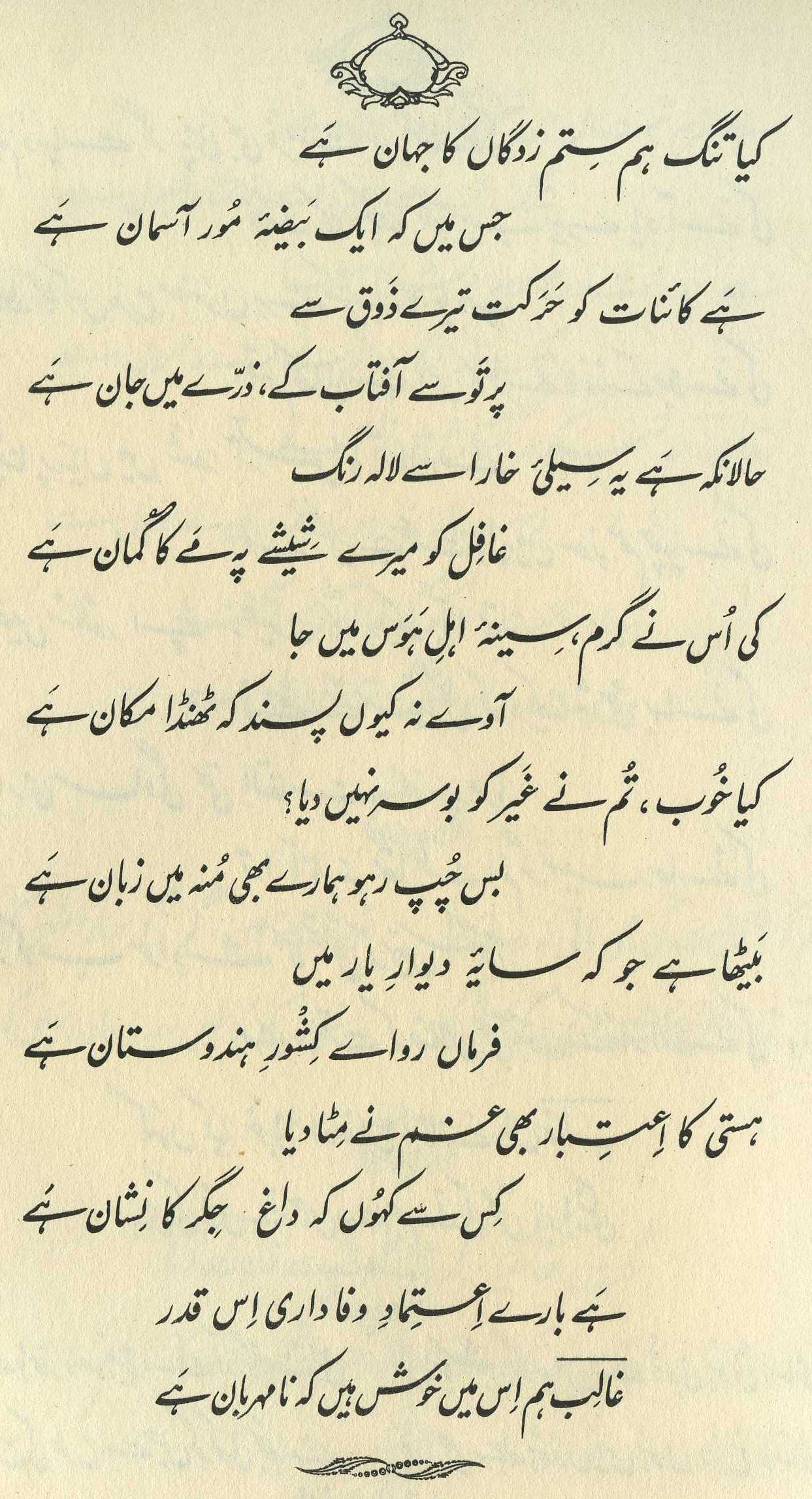
That is, due to grief a wound/scar occurred, and the wound has been called a 'liver'. If I would say to anyone that at one time we too used to have a liver, and its trace, the wound/scar, is still present, then no one would believe my statement. This theme is very new and is especially the result of the late author's reflection. (148)
== Nazm page 148

This theme is an absolutely untouched one. He says, the turmoil of grief had created a wound/scar on my liver. Gradually that wound/scar consumed the liver. Only the wound/scar itself remained. The existence of the liver was erased. Now if I say to anyone, 'At one time I too used to have a liver, and its trace-- that is, the wound/scar-- is still present in my breast', then no one believes my word. (204)
God, God, grief reached such an extreme that now people refuse to believe in the existence of my liver! That is, grief so erased the liver that where the liver was, there a wound/scar can now be seen. No matter to whom I might say that we too once used to have a liver, he doesn't believe me. That is, my situation has become absolutely bad. This verse is peerless. (271)
The scope of the deliberately abstract and unqualified first line is potentially total. Whose confidence, in the existence of whom or what, did grief erase? We are eager to find out.
And in the second line, of course, we don't (directly) find out; we are only given some clues, some symptoms of the direness of the problem. For we find a whole new question (Ghalib's favorite mode). It's an altogether doubt-filled line: it doesn't know to whom it might be addressed; it doesn't know whether it would actually be spoken or not; and it doesn't seem sure that what it might say is true, or even makes sense.
It thus depicts kind of cosmic erasure, an utter devastation by grief. Does the lover still believe that other people exist ('to whom')? Does he still believe that he himself exists ('might I say')? Does he still believe that he ever had a liver? At present he has merely a wound/scar, and he seems unable to assert with any confidence (though he wistfully hopes) that it is the mark or trace of a completely vanished, otherwise undetectable liver.
Thus the second line dramatizes or enacts the highly abstract situation described in the first line. Its loss of confidence, its sense of groping in vain for coherence, its radical aloneness and doubt, give it a real poignancy; surely that's why Bekhud Mohani calls it 'peerless'.
graphics/piningaway.jpg