Verse 5after 1816aanhai
G3
1
what a fine thing [to claim]-- you didn't give the Other a kiss!
2
enough, be quiet-- there's a tongue in our mouth too!
| References | |
|---|---|
| Arshi, Imtiyaz Ali | Ghazal# 135 |
| Raza, Kalidas Gupta | 297 |
| Nuskhah-e-Hamidiyah | 186-187 |
| Asi, Abdul Bari | 218 |
| Gyan Chand | 334 |
| Hamid Ali Khan | Open Image |
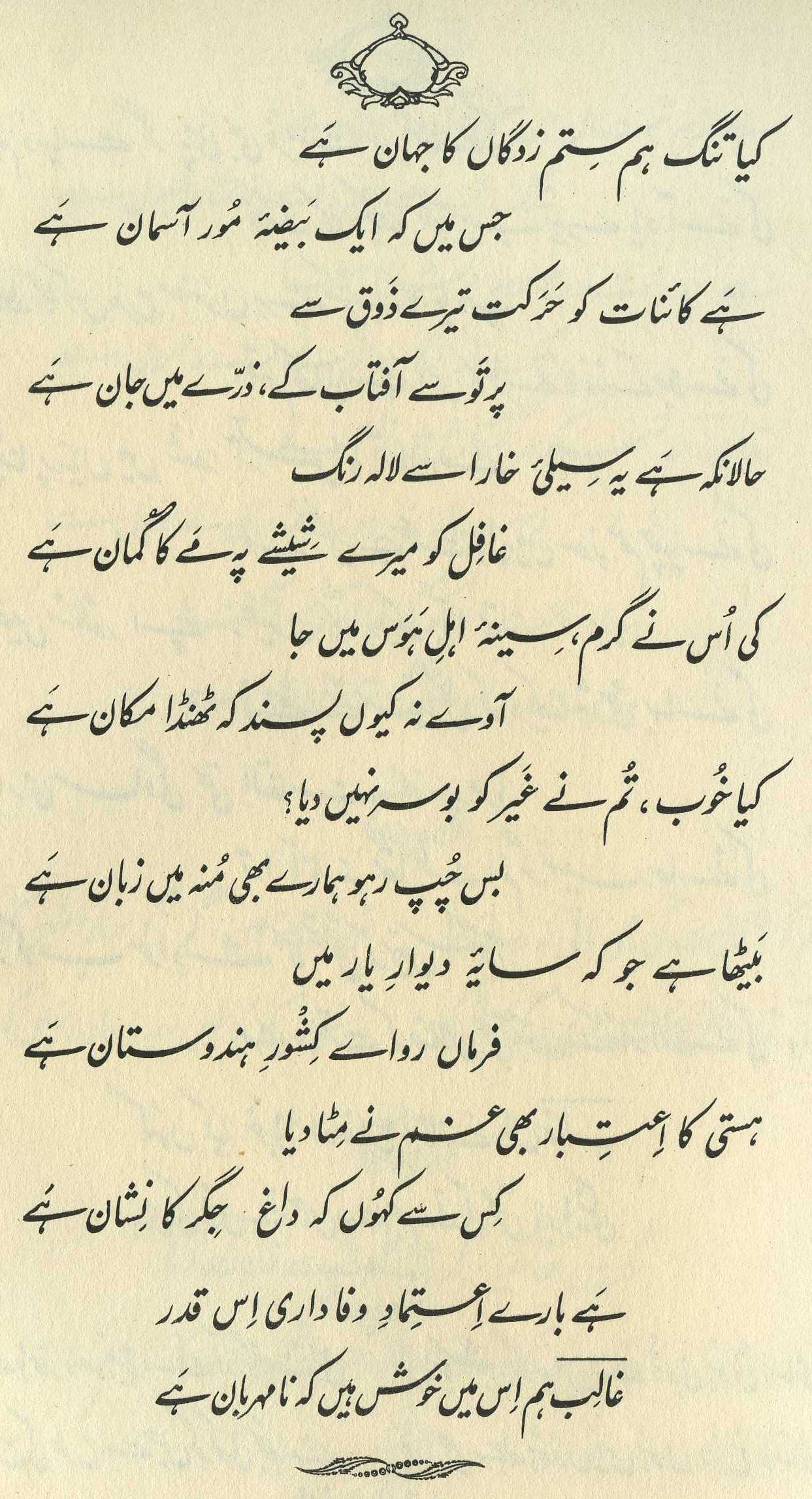
'There’s a tongue in my mouth too'-- this has two meanings. One is that I have such proof that if it comes to speech, I will convince you. And the second, mischievous meaning is that I can taste your mouth and tell whether the Other kissed you or not.
==Urdu text: Yadgar-e Ghalib , p. 133
That is, on being accused of kissing the Rival , the beloved has begun to quarrel; and from anger and wrath he doesn't want to discuss it further. (148)
== Nazm page 148

He made a complaint. The beloved rejects it. Now, in anger, he says, 'What a fine thing-- you didn't do it!' That is, you did kiss him, and for sure; enough, keep quiet. Otherwise we too will say some things that you won't want to hear. (270)
Like the equally amusing and delightful 116,1 , this verse relies on wordplay and meaning-play about the different uses of a mouth or tongue. Here are some of its enjoyable features:
=In the first line the beloved's spoken claim is repeated; in the second line she is told to keep her mouth shut, lest the lover should open his own mouth and speak.
=In the first line the beloved is (sarcastically) accused of speaking falsely; in the second line she is threatened with some kind of ominously true speech from the lover
=In the first line the beloved denies having given a kiss, and in the second line the of 'there's a tongue in our mouth too' amusingly and erotically evokes her misdeed. (Or: 'there's a tongue even in our mouth'-- not to speak of the one in hers.)
For more examples of such erotic suggestion, see 99,4 . The idiomatic, teasingly and suggestively ominous 'there's a tongue in our mouth too' perfectly fits all the levels of meaning in the verse, and since the 'tongue' is withheld until the last possible moment, it also provides an irresistibly punchy mushairah -verse ending.
Compare Mir's take on the possibilities of the 'tongue in the mouth': M 1123,2 .
graphics/tongue.jpg