Verse 1after 1816aanhai
G3
1 a
how narrow is the world of us oppressed ones!
1 b
is the world of us oppressed ones narrow?
1 c
what-- as if the world of us oppressed ones is narrow!
2 a
in which a single/particular/unique/excellent ant's egg is the sky
2 b
in which the sky is a single/particular/unique/excellent ant's egg
'Egg'.
'One, single, sole, alone, only, a, an; the same, identical; only one; a certain one; single of its kind, unique, singular, preëminent, excellent'.
(Persian) 'An ant'.
| References | |
|---|---|
| Arshi, Imtiyaz Ali | Ghazal# 135 |
| Raza, Kalidas Gupta | 297 |
| Nuskhah-e-Hamidiyah | 186-187 |
| Asi, Abdul Bari | 218 |
| Gyan Chand | 334 |
| Hamid Ali Khan | Open Image |
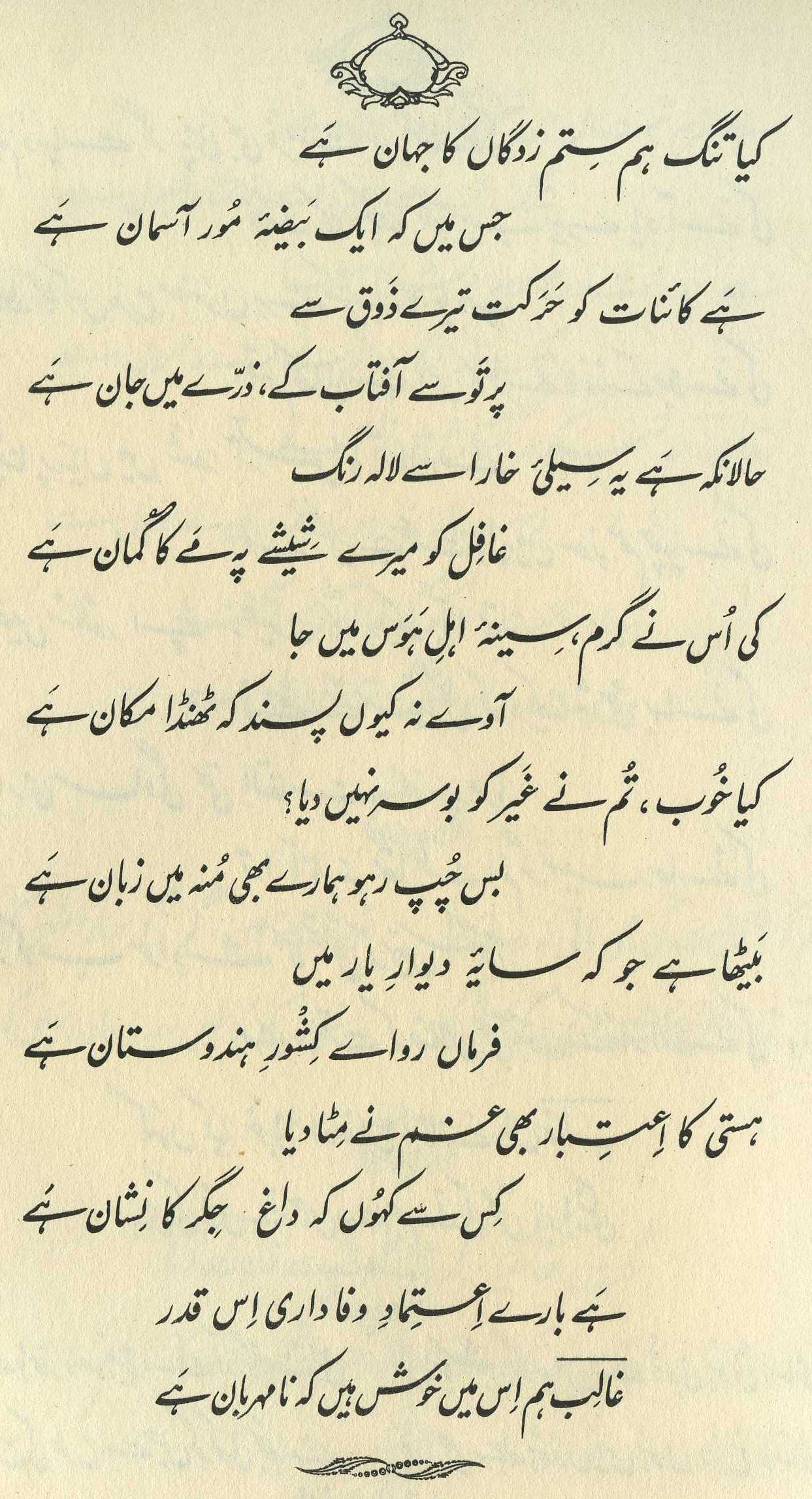
That is, the world of which the sky is an ant's egg. (147)
== Nazm page 147

He says, 'The world of us who are afflicted by oppression is so smallish that the sky of that world is only the egg of an ant.' The meaning is that an oppressed man considers that for him the world has become limited to an extremely narrow circle; that he has no helper, nor anyone to listen to his complaint. (203)
The world of us oppressed ones is so narrow that there the sky is equal to the egg of an ant. That is, for the oppressed, the world is not wide, but narrow. (269)
The second line of the verse is very much worthy of reflection, because its interpretation takes several forms, and all these forms revolve around the first line, of which the basic interpretation is that in the world many oppressions have been visited upon us. And with regard to the Sufistic resonance, the first line is also a picture of its own meaning. In the words , the mood of jerkiness/joltingness, step by step, gives the effect of disasters.
The sky is considered the source of cruelty and oppression, but we have experienced so many oppressions at the hands of the world that compared to them, the oppressions of the sky are nothing; and the sky, which is a fathomless ocean of oppression, in comparison to our world is equal to a single ant's egg. This seems to be great exaggeration; but this exaggeration, by means of the explication of human emotions, in a strange and remarkable way keeps becoming less. Like many other verses of Ghalib's, a single meaning in the mood of movement and progression is present. And not only in the second line, but in the first line too, this mood, which with regard to interpretation is smooth/flat, is present.
== ( 1973: 204-05 )
This verse can also be sarcastic. That is, the first line can have not a declarative, but a sarcastic interpretation. And the second line, in this sarcastic mode, is an answer to it. The world becomes narrow upon oppressed ones, so narrow that its sky seems to be equal to an ant's egg. Or an ant's egg too becomes oppressive and painful like the sky. In order to achieve this interpretation, in the first line he has asked a question:'Is the world of us oppressed ones narrow?' And the second line is an answer in the form of a question: 'That world in which one ant's egg is the sky?' That is, are you calling that world of which the sky is an ant's egg 'narrow'? In this way the meaning has been increased: to call the world of the oppressed ones 'narrow'-- that is, to use for it the attribute of being narrow-- is to turn something major into something minor. That world of which the sky would be an ant's egg-- for it the word 'narrow' is very insufficient. In order to make clear its narrowness, there ought to be some other word.
== (1989: 259) 2006: 283
In its richness of possibilities and undecideability of tone, this verse is one of the true 'meaning-machine' gems of the divan . It's the kind you could take to a desert island with you, and savor its every possible interpretive nuance. We know by now the excellently multivalent uses of a phrase like this one in the first line that is introduced by : it can be an exclamation, the way the commentators insist on taking it ('How narrow this world is!'); it can be a yes-or-no question ('Is this world narrow, or isn't it?'); or it can be a scornfully negative exclamation ('What-- as if this world is narrow!'). Right away we have a sufficiently intriguing set of possibilities to energize the whole verse; after the first line we are eager to hear (after the usual mushairah-performance delay) the evidence for the narrowness (or non-narrowness) of the world.
Then the second line opens up for us an even more undecideable and enjoyable display of 'symmetry': since Urdu is much less dependent on word order than English, to say 'A is B' is also to say that 'B is A'. As so often with Ghalib, both possibilities work intriguingly with the various permutations of the first line. And, as Faruqi points out, the tone too can vary: the possibilities include not only sarcasm but also wonder, despair, perplexity, indignation, and ruefulness.
Compare 165,2 , which offers a similar range of possibilities through exactly the same sequence of devices ( in the first line, symmetry in the second).
Who are the 'oppressed ones'? They are us, but who are we? We suffering lovers, no doubt; and more widely, we who are victims of injustice and tyranny. And ultimately, we human beings, living our cramped, oppressed, and all-too-limited lives under an ant's-egg sky. But then, maybe it's just the opposite, maybe our lives are not limited at all. It could be that our wide-ranging minds find ample freedom even in such a tiny ant's-egg space; or maybe the sky itself is a mere ant's egg to us in our boundless mental (and spiritual?) inner spaces (as in the similarly dismissive treatment of Rizvan's garden in 10,1 ). We oppressed ones, we readers, end up being allowed-- or required-- to invent the verse's tone and meaning for ourselves.
For another verse in which the sky is compared to an egg, see 217,4 . For another verse in which the ant provides a limit case of smallness, see 123,3 . Another enjoyable verse for comparison is the irresistible 68,5 , in which the round dome of heaven becomes not an ant's egg but-- even more dismissively-- a mere wastebasket. And what else is as small as an ant's egg? Why, an inner chamber of the heart of the Moth: 81,3 .
Compare Mir's own striking 'ant' verse: M 733,2 ; and another verse in which Mir's sarcasm (or is it?) is as tempting as Ghalib's: M 1056,2 . Here's one in which Mir uses as cleverly as Ghalib uses : M 775,4 .
And of course there's Hamlet: 'O God, I could be bounded in a nutshell and count myself a king of infinite space, were it not that I have bad dreams'.
Note for grammar fans: The Hindi-side , 'peacock', is ruled out because the is part of an phrase; Indic words can't be used in such Persian grammatical constructions.
graphics/antsegg.jpg