Verse 41816aataahai mujhe
G5
In this meter the first long syllable may be replaced by a short; and the next-to-last long syllable may be replaced by two shorts.
1
the lament-- a 'whole-world' wealth; and a/the world-- a handful of dust
2
the sky appears as the egg of a Ring-dove , to me
'Principal sum, capital, stock in trade; fund, funds, assets, means, resources; materials'.
'(rel. n. fr. , pl. of , 'of a dully or dusky white colour,' rt. ), s.f. A turtle-dove; a ring-dove'.
| References | |
|---|---|
| Arshi, Imtiyaz Ali | Ghazal# 170 |
| Raza, Kalidas Gupta | 253-54 |
| Nuskhah-e-Hamidiyah | 258 |
| Asi, Abdul Bari | 263-264 |
| Gyan Chand | 385-386,520 |
| Hamid Ali Khan | Open Image |
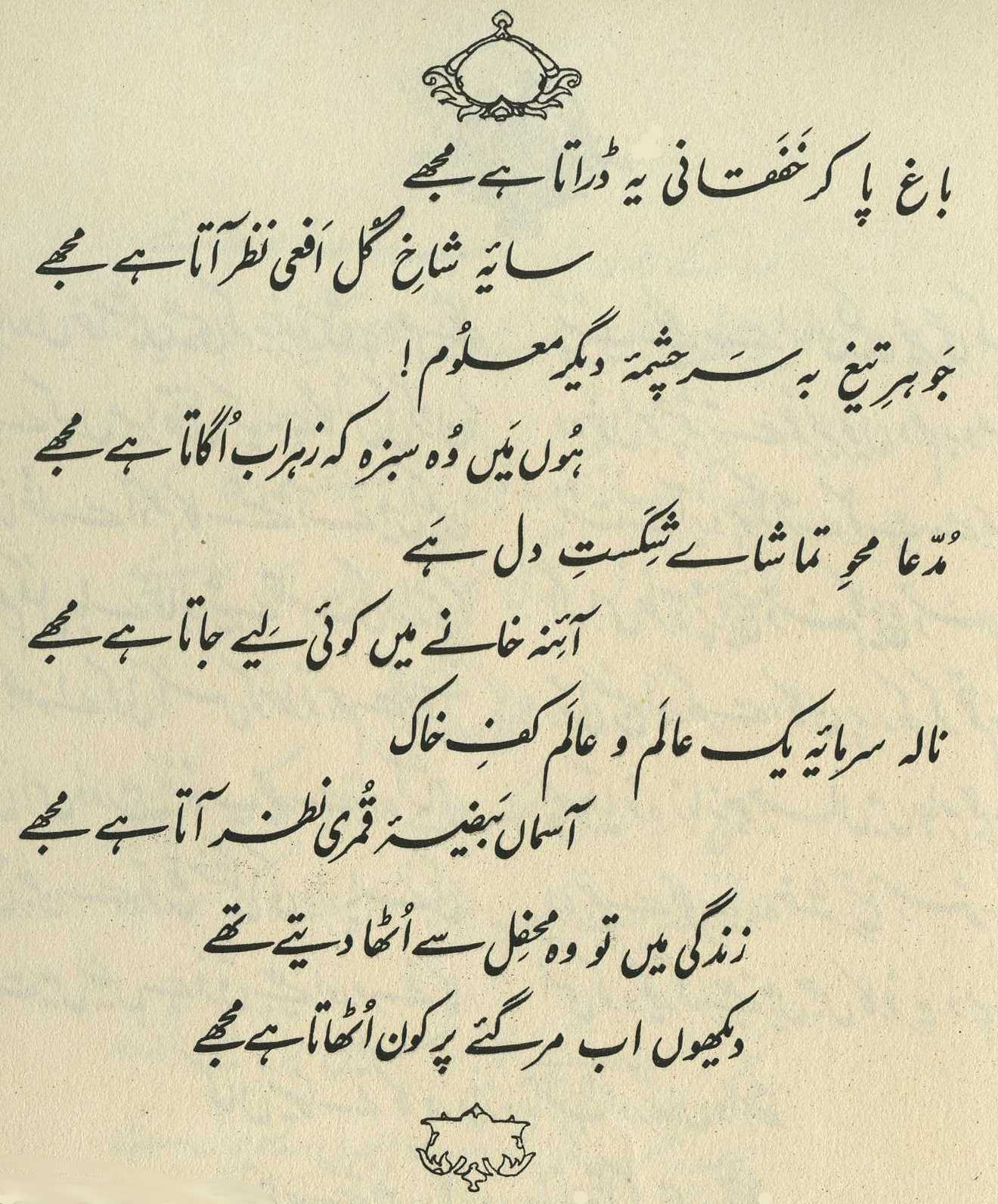
He has, as a jest [], called the sky a Ring-dove's egg, in which there's nothing at all but a handful of dust. And then, in the destiny of that handful of dust too there is written a lifetime of lamentation. If you ask why he used a Ring-dove's egg, when the nightingale too is a handful of dust and was born for lamentation, then the reason is that the Persian-users always versify the Ring-dove as a handful of dust, because it is dust-colored. [He gives an example from Sa'ib.]
Indeed, apparently with a subtle view one can say that if a lament is the wealth of a world, and a world is a handful of dust, this is an occasion for instruction and longing, and in such a case jest and pleasantry are inappropriate. [He goes on to discuss, in detail, various kinds and categories of simile s, with a number of examples.] (246-48)
== Nazm page 246 ; Nazm page 247 ; Nazm page 248


He says, the wealth of a whole world is only lament, and a world itself it a single handful of dust; and the sky is a Ring-dove egg. That is, the produce of the world is nothing except lamentation, as if the world is a place of affliction, and the sky is a producer of lament. To the extent that troubles and difficulties keep being produced in the world, the sky keeps producing them all. (306)
I consider a lament to be the wealth of a world, and a world to be a handful of dust; and the sky, in my view, is a Ring-dove-egg. The form of the sky is egg-like, and the color of the Ring-dove is dusty. In this connection, he has called the sky a Ring-dove-egg; and since in the world there's nothing but sorrow and suffering, in this connection he has called the world a handful of dust. And through this affinity , he has declared all the creations of this world to be only a lament. That is, the wealth of the world is only sorrow and sadness, and this is my belief, observation, and experience. (446)
On the idiomatic use of , see 11,1 . It's hard to translate, but surely part of the sense here is to make a world into a measuring rod (so that a 'one-world' measurement is like a 'one-meter' measurement), perhaps for wealth [], and to emphasize globalness or wholeness as part of the measurement. I try to show this by using 'whole-world', and surely in that initial clause the sense of 'a' world rather than 'the' world comes through clearly.
Then in the second half of the first line, 'world' is at once repeated, and this time without qualification. So it could still be 'a' world, in the sense carried over from the first half of the line; or it could be 'the' world, in our familiar sense of 'this' world. The first half of the line takes us from image one (lament) to image two (world-wealth), and the second half of the line takes us very explicitly from image two (world-wealth) to image three (handful of dust). We half-expect the next line to take us from image three (handful of dust) to some other image.
Instead, the second line starts afresh: the sky appears as a Ring-dove egg to the speaker. If we use the imagery-clues that the commentators point out, we have an obvious trajectory. The Ring-dove has a 'dusty' or 'dusky' or off-white color-- see the definition above, and also 230,5 , in which the Ring-dove is called a 'handful of ashes'. For such a bird's egg to be dusty and to contain something dusty seems very suitable. So if the sky, which often looks greyish or off-white, encloses the earth the way an eggshell encloses an egg, then the 'handful of dust' that is the world can be seen as a kind of futile travesty of an egg, with no possibility of ever hatching into anything fertile; not surprisingly, its whole 'wealth' is not anything creative or hopeful, but only a 'lament'.
There's also the size connection, which works through an extreme kind of reduction. A lament has no physical size at all, and yet it's the wealth or essence of a whole world; a world itself is equated with a mere handful of dust. On the same scale, it's not surprising that the sky would appear as a mere bird's egg.
But of course, all these things appear that way 'to me'-- to the speaker. There are several ways of reading this final, vital, but almost casual qualifier:
=The speaker fears that he's going mad; things look very morbid to him, and here are a few examples of his symptoms.
=The speaker is trapped inside a handful of dust stuck inside this puny, worthless egg-- he's lamenting and hoping for help, since it's horribly cramped in there!
=The speaker is so far beyond that handful of dust stuck inside that puny, worthless egg-- he looks down on it with disdain and pity (see 43,3 ); from the height where he is, one single lament is worth as much as the whole of it.
=Although it's painful to face the facts, the speaker has to report his best judgment: the human condition is both petty and miserable.
This is a surely a verse of mood ; and as so often, the verse allows (or compels) us to choose the mood ourselves.
Compare 400x,2 , another cosmically bleak verse about the Ring-dove and his egg.
For a brilliantly multivalent verse in which the sky is imagined as an egg-- an ant's egg, in this case-- see 138,1 . Also, compare this present verse's unpublished cousin, 217,7x .
graphics/dovesegg.jpg