Verse 6x1816aataahai mujhe
G5
In this meter the first long syllable may be replaced by a short; and the next-to-last long syllable may be replaced by two shorts.
1
the garden, without you, menaces me with the narcissus flower
2
if I would want a stroll in the garden, it menaces/'shows an eye to' me
'To look angry or threatening, to stare defiantly; to frown, scowl... ; to menace, brow-beat, deter'.
| References | |
|---|---|
| Arshi, Imtiyaz Ali | Ghazal# 170 |
| Raza, Kalidas Gupta | 253-54 |
| Nuskhah-e-Hamidiyah | 258 |
| Asi, Abdul Bari | 263-264 |
| Gyan Chand | 385-386,520 |
| Hamid Ali Khan | Open Image |
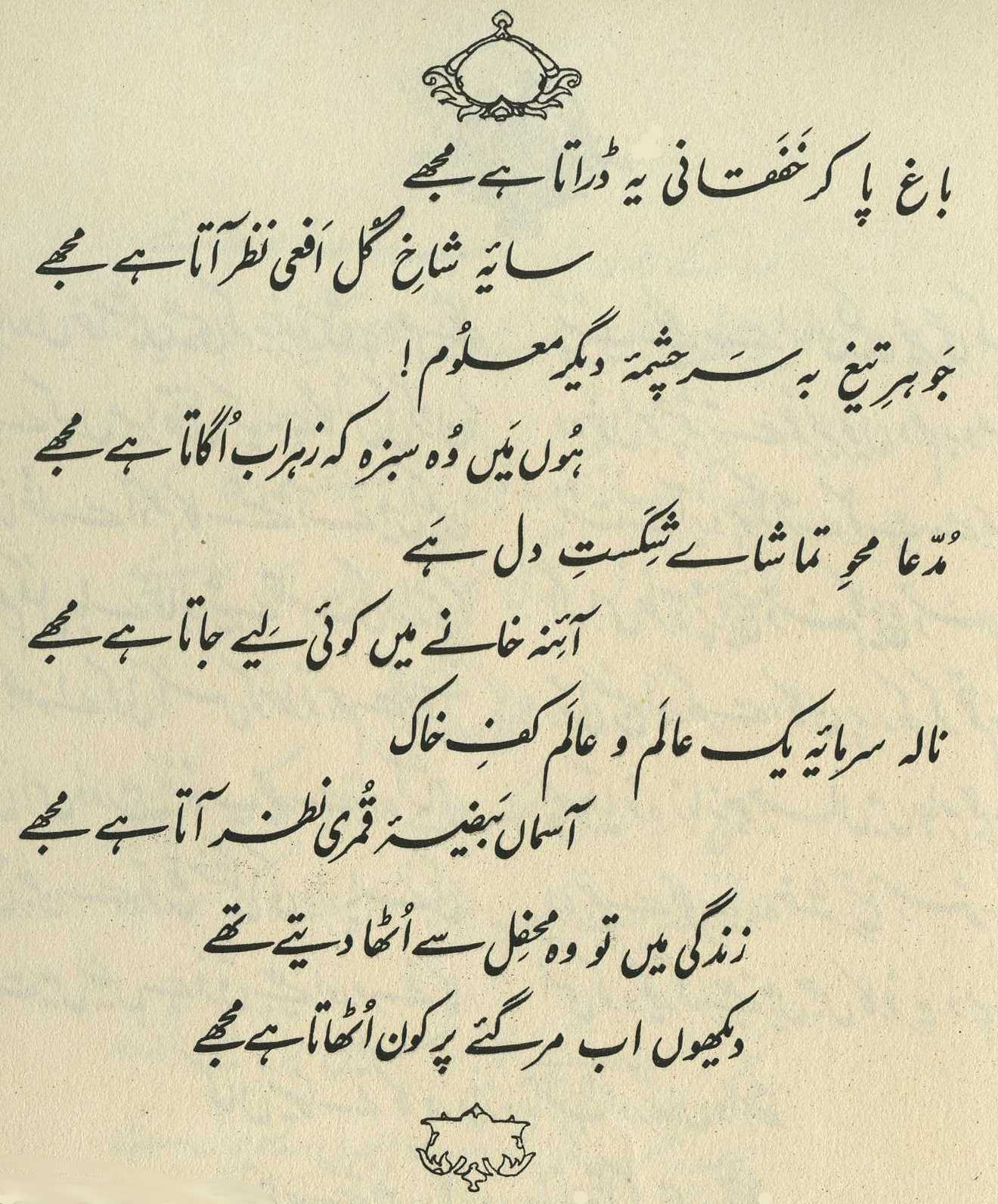
In the state of separation, without you, if I go for a stroll in the garden then the garden menaces me; and this menacing is by showing me the narcissus flower. When I see the narcissus flower, I understand that I am being 'shown an eye'. The idiom is not ; rather, the idiom is . Probably because of this defect Mirza passed over this opening-verse , and changed it into 217,1 .
== Asi, p. 263
The narcissus flower is an eye, and is to menace.
== Zamin, p. 382
'To show the eyes' is an idiom, the meaning of which is to menace someone. If I go into the garden without you, then the garden looks at me with a frown. The garden's eyes are the flowers of the narcissus. Thus the garden 'shows its eyes' with the flowers of the narcissus.
== Gyan Chand, p. 385
For background see S. R. Faruqi's choices . For more on Ghalib's unpublished verses, see the discussion in 4,8x .
Here's a classic ' mushairah verse'. The garden frightens the solitary lover with the narcissus flower; for more on the narcissus, see 56,4 . But why, and how, and where is the verse going with this idea? Under mushairah performance conditions, we of course have to wait as long as can reasonably be managed before we're allowed to hear the second line.
And even then, in the usual mushairah-verse style, the second line withholds its punch-word until the last possible moment. Not until we hear can we recognize the idiom, and fully savor it. For of course the narcissus with its central 'eye' is visible to anyone strolling in the garden, so it's unexceptionable to report that it shows itself that way. But the idiomatic use of to mean 'to intimidate, to menace' is the real delight of the verse. We hearers 'get' the verse all at once, with a little burst of pleasure-- and then, also in characteristic mushairah-verse style, we also perceive that there's nothing more there to 'get', and we're ready to move on to the next verse.
Why does the garden frighten the hapless lover? Perhaps because it resents the absence of the beloved, and his presence without her is a fresh reminder of that loss. Perhaps because it loves the beloved too, so that it seeks to intimidate a rival. And of course, perhaps the lover is just paranoid and hypersensitive, so that in the beloved's absence everything seems to him evil and ominous. That 'to me' keeps the possibility of idiosyncrasy and error very conspicuously open.
graphics/narcissus.jpg