Verse 8x1816aataahai mujhe
G5
In this meter the first long syllable may be replaced by a short; and the next-to-last long syllable may be replaced by two shorts.
1
I am the amazement of a mirror (-) outcome of madness-- like a candle
2
to what an extent the wound of the liver kindles me into flame!
'End, termination, completion, accomplishment, conclusion; result, upshot; accident; vexation'.
| References | |
|---|---|
| Arshi, Imtiyaz Ali | Ghazal# 170 |
| Raza, Kalidas Gupta | 253-54 |
| Nuskhah-e-Hamidiyah | 258 |
| Asi, Abdul Bari | 263-264 |
| Gyan Chand | 385-386,520 |
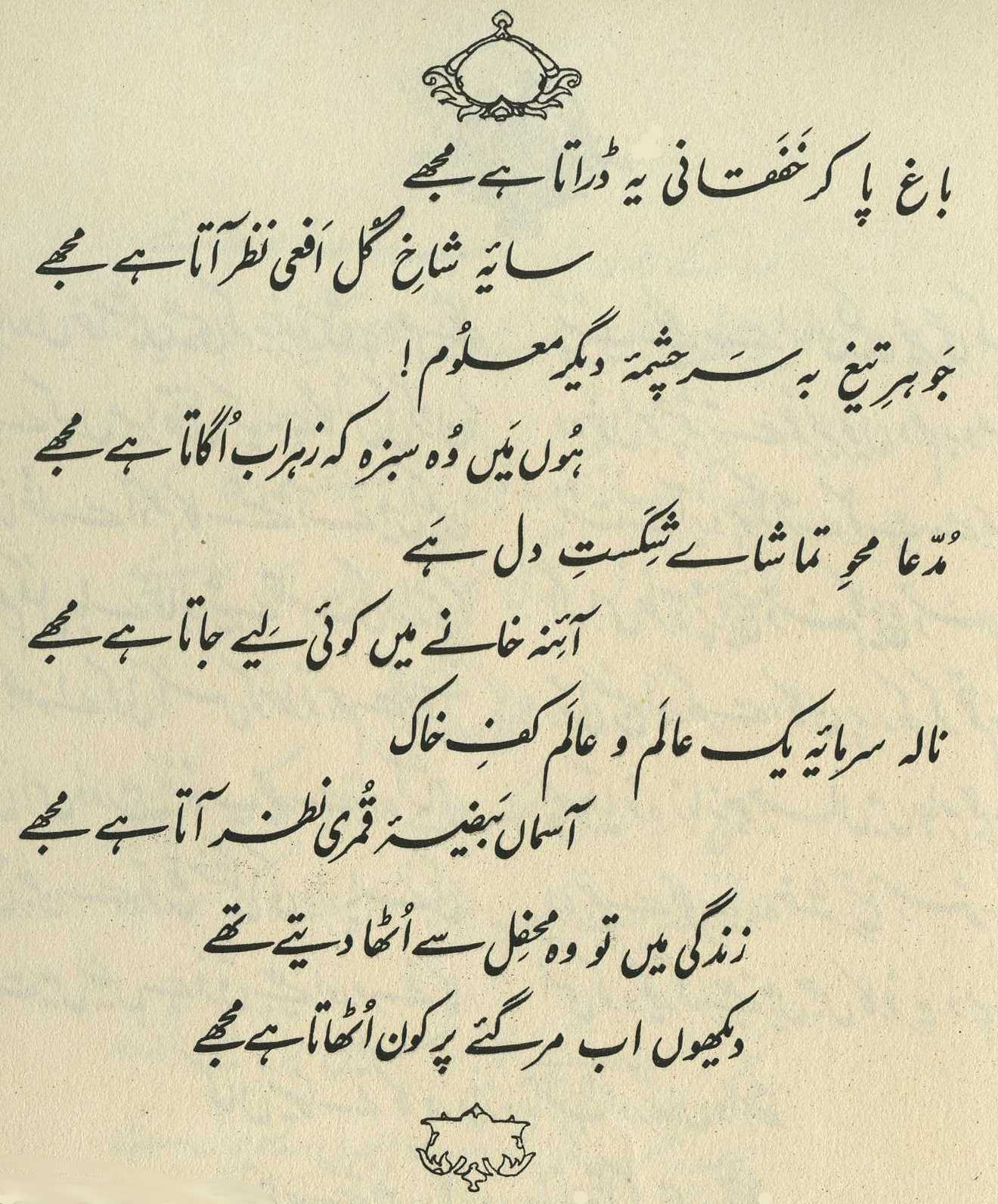
| Hamid Ali Khan | Open Image |
The meaning is that the outcome of my madness was that I have become the mirror-outcome of amazement, through which the wound in the liver can be seen flaring up like a flame. The point is that madness caused my hidden burning to flare up and made it manifest; that is, it revealed the secret of passion.
== Zamin, p. 384
= of which the outcome would clearly appear. = that amazement of madness of which the outcome is manifest. The liver-wound produced in passion is enclosing [] the flame within me. The madness of passion has immersed me in amazement, and my outcome is clearly apparent to me, the way a candle burns in the madness of passion and is aware of its outcome.
== Gyan Chand, p. 385
For background see S. R. Faruqi's choices . For more on Ghalib's unpublished verses, see the discussion in 4,8x .
In the first line, the two constructions are metrically required. But what's the relationship between the two resulting phrases? Gyan Chand proposes to take as a noun compound, 'mirror-outcome', meaning 'having an outcome as clearly visible as the image in a mirror'; for more on such noun compound forms, see 129,6x .
But it's also possible to read them as two separate phrases describing the speaker. He is 'the amazement of a mirror' perhaps because his behavior is so extraordinary that the mirror itself is stupefied when it beholds/reflects him, or perhaps because his behavior itself displays the stupefied 'amazement' characteristic of a mirror (on see 51,9x ). And he is the 'outcome of madness' because the madness of his passion has now reached an advanced stage, like a fatal disease.
In any case, the speaker is 'like a candle' in the self-consuming nature of his fiery passion. The inflamed wound of the liver is doing something deadly to him. But the imagery feels conventional and thrown-together; it doesn't integrate itself into the kind of brilliant, strange synthesis characteristic of Ghalib at his best. If S. R. Faruqi hadn't chosen this one, I certainly wouldn't have chosen it myself.
There are some sound effects: can hardly fail to grab the reader's attention.
Note for grammar fans: The grammar of is clear: the liver-wound' causes flame to rise up'. But then normally instead of 'to me' [] we'd expect something like 'inside me' [ or or the like]. Whereas if we were to see 'causes me to rise up' [] we'd expect a single subject-- either the liver-wound or the flame, but not both. Compare the normal usage of , 'causes me to rise up', in 217,5 . Perhaps in the present verse the tyranny of the rhyming elements has simply proved more oppressive.
graphics/candleflame.jpg