Verse 51816aataahai mujhe
G5
In this meter the first long syllable may be replaced by a short; and the next-to-last long syllable may be replaced by two shorts.
1
in life, she used to eject me from the gathering
2
let me see, now, upon my having died, who ejects/lifts me!
'To lift, take up, raise, raise up, elevate, hoist; ... to withdraw, remove (from, - ); to bear or carry forth or away, make off or away with, to steal; to cause to disappear or vanish, ... ; to take away or remove (from the world) ... ; to efface, erase, expunge; to abolish, do away with; to eject, expel'.
| References | |
|---|---|
| Arshi, Imtiyaz Ali | Ghazal# 170 |
| Raza, Kalidas Gupta | 253-54 |
| Nuskhah-e-Hamidiyah | 258 |
| Asi, Abdul Bari | 263-264 |
| Gyan Chand | 385-386,520 |
| Hamid Ali Khan | Open Image |
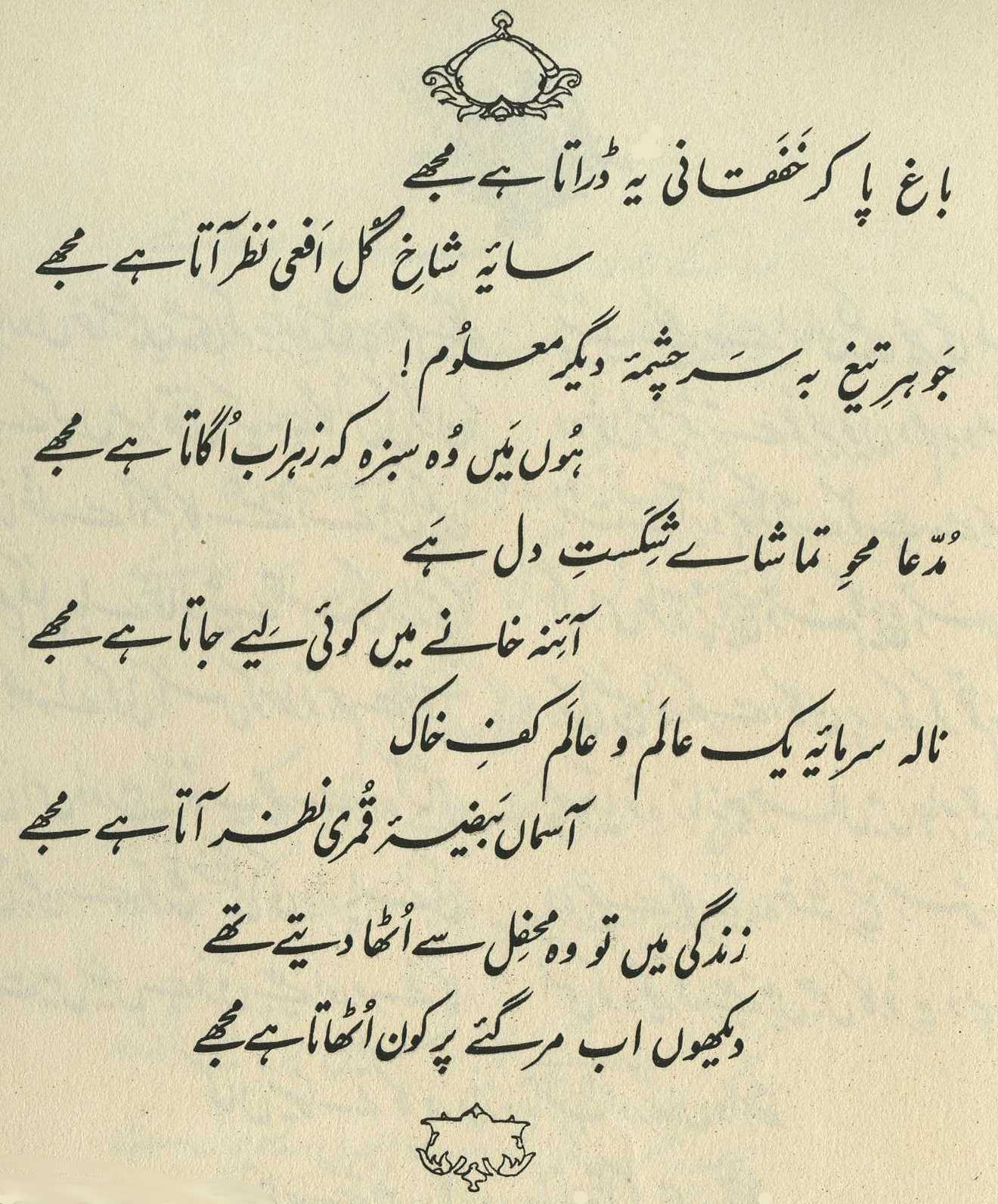
has two meanings. One is that in life, you used to eject me from the gathering; now after my dying, let's see who ejects me from there. And the second meaning is that you used to eject me from the gathering, now let's see who lifts up my bier.
==Urdu text: Yadgar-e Ghalib , p. 133
For this very reason I gave my life: that now they will not be able to eject me. In the word is an , for they also call the lifting of a dead person's bier . (248)
== Nazm page 248

[Disagreeing with Nazm:] What a way to describe the meaning of the verse! It's impossible to understand what it means to say that after my dying they won't be able to eject me. (337)
Here's a quintessential mushairah -verse. The first line is clearly poised to go somewhere, but we can't tell where. Probably there will be a contrast. Now that the speaker is in the grave, he's allowed to stay there? Now she, or someone else, will eject him from the grave? Now he's beyond caring about gatherings? Naturally, we're made to wait, under mushairah performance conditions, as long as is conveniently possible, before we get to hear the second line.
And even then, the second line withholds its 'punch'-word until the last possible moment. Only at the very end of the line do we realize that the real key to the verse is the verb , the causative of 'to rise, to get up' []. To 'cause someone to get up' is an obvious idiomatic expression for kicking someone out, ejecting someone from wherever he was seated (see the definition above). Thus it works excellently in the first line; it's just what the beloved would enjoy doing to the hapless lover (as in 116,6 ).
Only at the end of the second line do we realize, as Hali observes, that , to 'lift up, cause to rise', is also what people do to biers, when preparing to carry a dead person to a grave. This secondary meaning is elegantly triggered by the reference to the speaker's 'having died'. Nazm calls this abrupt shift in the meaning of an , but strictly speaking I don't think it is one, because the poet definitely intends both meanings. Rather, it's a case of 'double activation': the meaning of 'to eject' is required by the first line, and the meaning of 'to lift up' is required by the second line. Here are some possible readings:
=The beloved used to eject the lover from the gathering when he was alive; let's see who ejects him now that he's dead! (That is, no one will: in the grave at least he is secure against ejection; see 115,2 .)
=The beloved was the one who used to eject the lover when he was alive; let's see whose turn it is to eject him now that he's dead (since to be ejected is his obvious and predestined fate).
=The beloved used to eject the lover when he was alive; let's see who lifts his bier now that he's dead. (She's so indifferent and disdainful-- let's see if she even bothers to give him a decent burial.)
This verse clearly is one of the 'dead lover speaks' set; for others, see 57,1 .
graphics/sirsayyidtomb.jpg