Verse 6after 1816aakih yuu;N
G15
1
I said, 'The gathering of coquetry ought to be empty/devoid of [any] stranger/ Other '
2
having heard [this], the tyranny-jester caused me to get up [and leave]-- 'Like this?'
'Empty, void, vacant'.
zariif>> : 'Clever, ingenious; elegant, polite, gallant; excellent, good; --witty, facetious, jocose, arch, comical, waggish'.
zariifii : '>>Exquisiteness or ingeniousness in tyranny'.
| References | |
|---|---|
| Arshi, Imtiyaz Ali | Ghazal# 85 |
| Raza, Kalidas Gupta | 294 |
| Nuskhah-e-Hamidiyah | 142-143 |
| Hamid Ali Khan | Open Image |
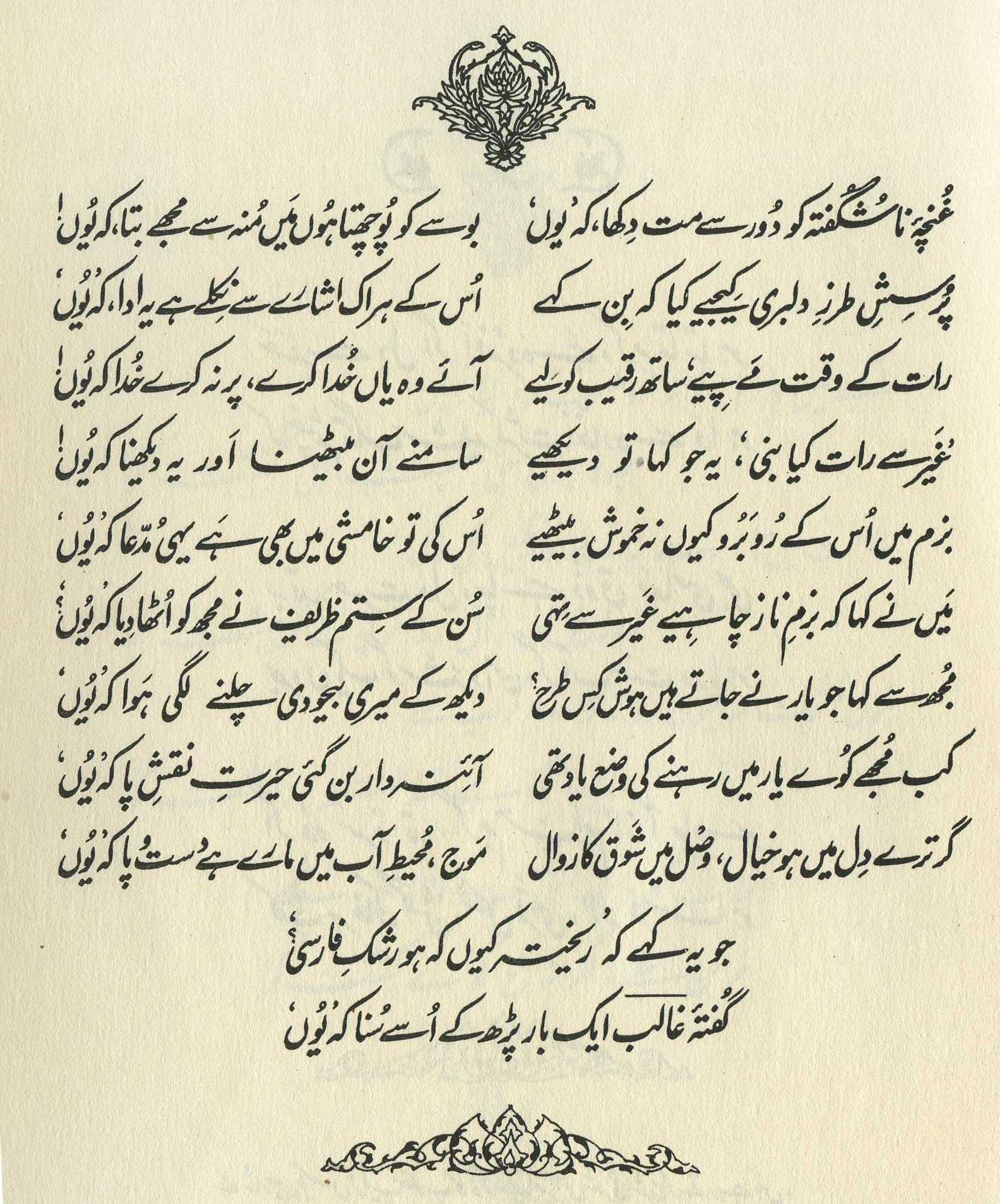
A 'tyranny-jester' is that jester in whose humor tyranny too is blended. The meaning of the verse is that considering the Rival a stranger/other [], I had said, 'Your gathering ought to be free of strangers'. Hearing this, she had me sent away from the gathering--that is, 'You are the only stranger to be seen here'.
==Urdu text: Yadgar-e Ghalib , p. 151
That is, 'There-- now the gathering has become empty [of Others]!' (125)
== Nazm page 125

A 'tyranny-jester' is that person who outwardly would make a joke, but its purpose would be cruelty.... From this one more secret was revealed. He had thought that if he had obtained entry to the beloved's gathering, then the beloved must hold him dear. But today he learned that she considers nobody else an Other except him. (236)
-- Master jester; quite a card; master of irony. This compound consists of two words: , which literally means 'cruelty; torture' but which in such compounds or as a modifier to an adjective simply means 'extreme; utmost'; and the adjective , which means 'comedian; joker'. Thus the compound should mean 'master jester' but in fact carries a strong connotation of irony and twist of fate, of ruefulness on the part of the speaker.
== Naim 1972, pp. 16-17
This is the fourth and last of the 'cute' verses referred to in 116,1 . Perhaps it's the most self-consciously 'cute' of them all. In 116,3 the situation is equally humiliating, but at least it's only hypothetical; while this one is reported verbatim by the victim. Both situations, however, would be completely at home in a sitcom.
What a radical contrast to the previous verse, 116,5 , with its brooding, mysterious silences! Anybody who thought that ghazals were single, unified poems would surely have to abandon the idea when confronted with juxtapositions like this one.
And what a winner of a mushairah verse this one must have been!
Mir has a verse along enjoyably similar lines: M 1112,8 .
[we said, 'to speak a great deal is not well'
our friend/beloved now says nothing at all to even/also us!]
graphics/goodbye.jpg