Verse 9after 1816aakih yuu;N
G15
1
if in your heart might be the thought, [that] 'in union is the decline/downfall of ardor'
2
the wave in the embrace/confluence of water flails its hands and feet-- 'like this!'
'Desire, yearning, deep longing, predilection ... ; ardour, zeal, eagerness, avidity; alacrity'.
'Declining (as the sun from the meridian); declination; setting (of the sun, &c.); decline, wane, decay; fall; cessation; defect, deficiency, failure; harm, loss, injury'.
t>> : 'Surrounding, encompassing, enclosing, encircling... embracing, comprehending'.
is a variant form of, here, ( GRAMMAR )
'Effort, painstaking'. (Steingass p.524)
'To be convulsed (as in death-struggle); to sprawl'. (Steingass p.521)
'To beg with impunity; to give up the ghost'. (Steingass p.521)
'To throw about the hands and legs; to work the hands and legs; to sprawl; to flounder; —to strike out (in swimming); —to throw the arms about and jump about (in agony); —to be agitated; —to strive hard, struggle, endeavour, strain, toil, labour'.
| References | |
|---|---|
| Arshi, Imtiyaz Ali | Ghazal# 85 |
| Raza, Kalidas Gupta | 294 |
| Nuskhah-e-Hamidiyah | 142-143 |
| Hamid Ali Khan | Open Image |
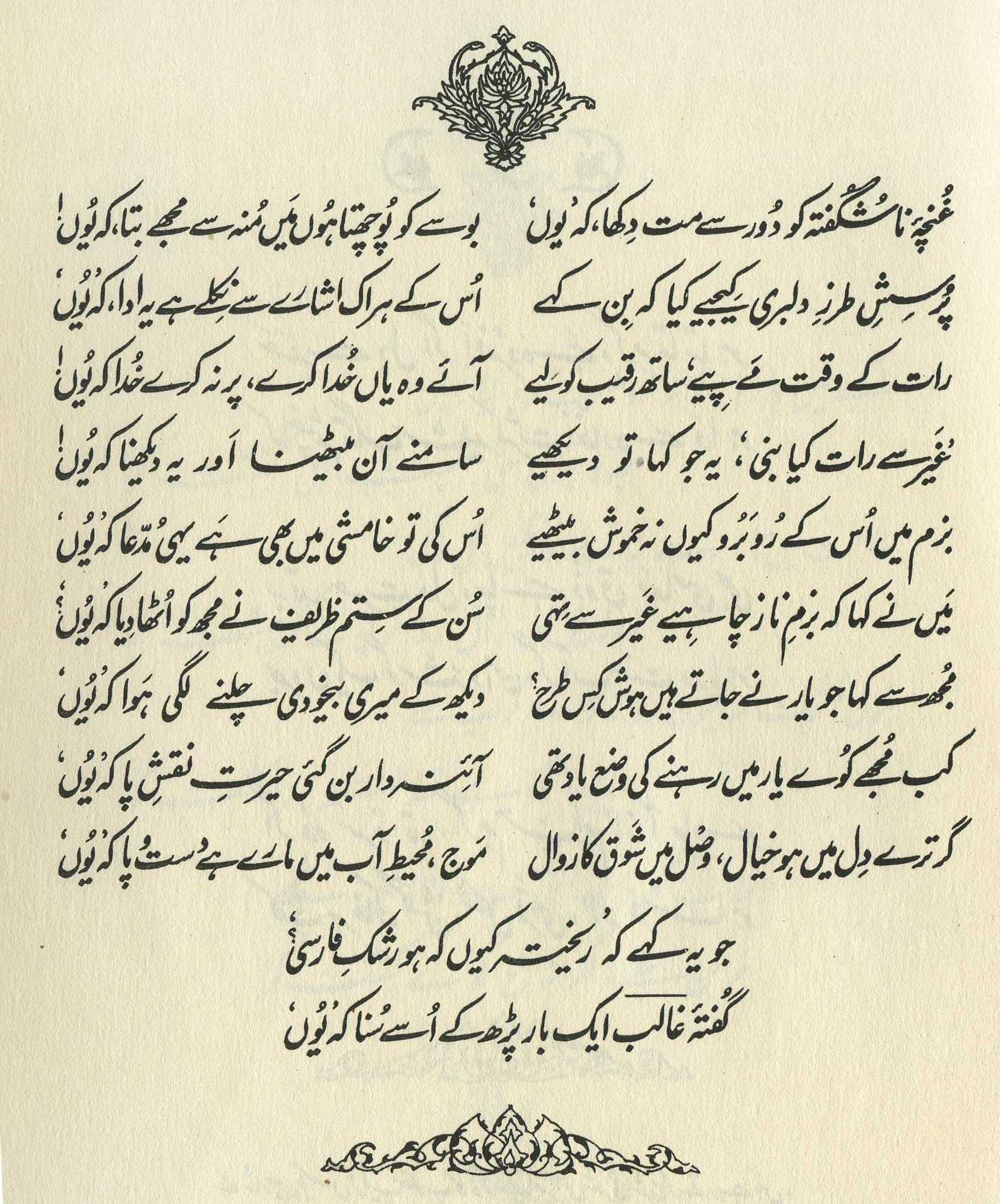
That is, if you have the thought, 'Having reached the True Source, why would ardor decline, and how would oneness be created?', then look at the wave in the sea: it is telling you, 'In this way, flailing with hand and foot, finally oneness comes about, which is a state of assurance and peace'. (126)
== Nazm page 126

He says, if in your heart might be the thought, 'Having attained union, how would ardor decline, and how can the lover and beloved achieve oneness?', then look at the wave in the confluence of water: it is telling you, 'Like this, flailing with hand and food, the desired result of unity is created, from which the form of assurance and peace emerges'. (177)
Ardor is not erased by union. Haven't you seen the wave, in the embrace [] of the waters? But the wave's restlessness is not erased. (236)
Well-brought-up young women used to be urged by their mothers to remember that men only wanted One Thing-- and if they got it, they Wouldn't Respect You Any More. In this verse, the lover fears that his beloved may have some such notion, some idea that 'union' would lead to the decline or lessening of ardor. Fortunately, he has a truly smashing disproof to offer, to disabuse her forever of that foolish fear.
Just look, he urges, at how the waves behave in the confluence or 'embrace' of the water-- the , which is also specifically used for the mouth of a river. In the more general sense, we notice that waves don't by any means stop 'waving' just because they're embraced by, and merged with, the sea. (For every time waves 'decline' into troughs, they then at once rise to another crest.)
And in the specific sense, we notice that the mouth of a river, where the river empties into the sea and two currents converge, is the choppiest, most tumultuous, 'waviest' part of the coastal waters. Naturally, the lover argues, 'union' would be like this. An excellent metaphor-- appropriate, lyrical, perfectly chosen, even amusing. Just what we would expect from a fine poet.
But then, Ghalib goes a step further. He deliberately disrupts his own metaphor. Instead of saying the wave in the sea's embrace goes right on 'waving' [], or 'moving', or something of the sort, he deliberately translates from the Persian an idiomatic phrase that applies only to humans-- , literally, 'to strike [with] hand and foot'. In Persian it has several evocative idiomatic relatives; see the definitions above. In Urdu, a directly translated form (see the definition above) is still in use today, as for example in (cited by S. R. Faruqi, in M 874,3 ).
Why does Ghalib do this? Why does he suddenly turn the innocently illustrative waves into human-like swimmers-- or drowners, 'flailing' or 'floundering'? Perhaps because the shock of his suddenly giving the waves human 'hands and feet', and the urgent use of them, intensifies the subtle but powerful erotic charge of the verse. We can't tell exactly why or how the waves are striking out (purposefully?) or flailing around (desperately?) with their 'hands and feet'-- but the first line certainly gives us some possible ideas. (For more on his erotically suggestive verses, see 99,4 .) Nor is this the only time he practices such metaphorical disruption; for another prime example of this device, see 21,10 . And doesn't this disruption make the verse far more arresting, far more likely to linger in the memory and demand further attention?
Nazm conveniently (and prudishly?) misreads the verse by imagining a question-word of some sort in the first line. This sets him up for a dutifully Sufistic answer to the 'question', with no uncomfortable sexual overtones. He has a surprising number of followers in this view: not only Bekhud Dihlavi, but also Baqir (302), Shadan (304), and Josh (221). Bekhud Mohani also has supporters, however, including Hasrat (99), Asi (quoted in Baqir 303), Chishti (580), and Mihr (401).
For a much grimmer reading of the waves' agitated behavior, see 165,2 . For a less impressive treatment of the same general idea (that satisfaction increases desire), see 142,3x .
The internal rhyme at the quasi-caesura in the first line is particularly flowing and effective. Maybe this is because and echo each other's structure and syllable patterns; and both contain the extra final short 'cheat syllable' (not formally scanned) that helps give them additional resonance.
graphics/wildwave.jpg