Verse 10after 1826aakyaa
G7
1
listen, oh plunderer of the merchandise of faithfulness, listen--
2 a
what is the echo/sound of the breaking of the value/price of a heart?
2 b
as if there's an echo/sound of the breaking of the value/price of a heart!
2 c
what an echo/sound there is, of the breaking of the value/price of a heart!
'Goods, merchandise, commodities, wares; moveables, articles, things'.
'Breaking, breakage, fracture; a breach; defeat, rout; deficiency, loss, damage'.
'Price, value, worth'.
'Echo; sound, noise; voice, tone, cry, call'.
| References | |
|---|---|
| Arshi, Imtiyaz Ali | Ghazal# 38 |
| Raza, Kalidas Gupta | 369-370 |
| Hamid Ali Khan | Open Image |
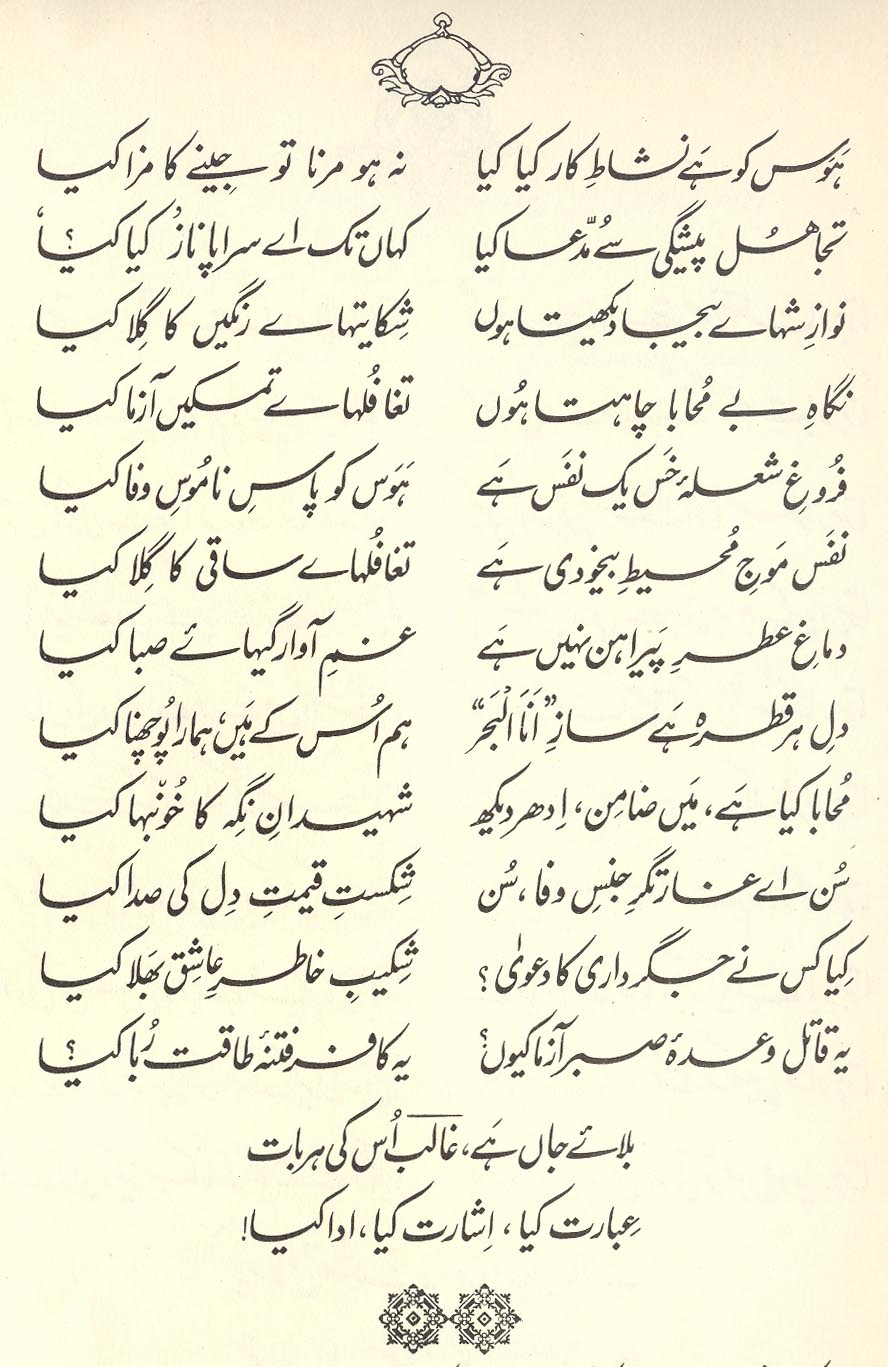
That is, since you say you know nothing about the breaking of a heart-- does the breaking of a heart ever make any sound, that you would hear it? The author has described the breaking of a heart as 'the breaking of the value of a heart', and thus has mentioned words with affinity , 'looter' and 'merchandise'. Another aspect of this construction turns out to be that if the sound of the breaking of a heart pleases you, go on breaking it and listening. What importance does this diversion have, and does the breaking of a heart have, that you should hesitate? (23)
== Nazm page 23

Urdu text: Vajid 1902 {21}
My heart was considered valuable, because in it was the 'merchandise' of faithfulness. You broke open the heart and looted it, so now listen to me.... The sound of the breaking of a heart is a lament, which you fear and do not want to hear. Don't be afraid, you didn't break a heart; rather, you broke the value of a heart [which happens silently]. (46)
I don't have the ability to understand Ghalib's poetry, and look at my rashness, that I've sat down to write a commentary! There's no doubt an affinity of sounds, but I'm unable to understand the use of the word 'value'. Only the breaking of the heart ought to be mentioned. In this way the line would become clear of itself.... but this isn't Ghalib's style. (149)
Is the beloved being exhorted to listen to the lover's words, or to listen for the sound? Or is the beloved already listening for the sound, and being taunted by the lover for listening for something inaudible? Or we could decide that the first was a demand for attention, and the second an injunction to listen. To listen for a sound that was perhaps extraordinary (what a sound!)-- or possibly inaudible (what-- a sound?!). Or perhaps somehow both?
In the second line, as usual in this ghazal, we have the multiple possibilities opened up by ; see 21,1 for more on these.
This verse also offers, as Shadan plaintively points out, an odd use of . What is the sound of the breaking of the value of a heart, as opposed to the heart itself? But the insertion of does have the notable effect of disrupting the commonplace metaphor of the 'breaking' of a heart, as something that might be compared to the breaking of glass or china, and thus might readily (though not necessarily of course) have a sound. Whatever Ghalib meant by the disruptive , he obviously liked the effect, for he used it in two more (unpublished) verses as well: 212,5x , and 416x,2 .
Let's put it this way: if the breaking of a (glassy, delicate) heart does have a sound, we can easily imagine why, and we know what kind of sound it might be-- like the breaking of glass, full of the terrible, irrevocable tinkling of tiny shards as they clash and fall against each other. By contrast, the sound (?) of the breaking of the value of a heart is so far gone in abstractness as to be opaque to the imagination. Ghalib is here disrupting his own metaphor. This insertion pushes us much farther away from the physical world, and makes far more piquant and thought-provoking both the injunction 'Listen!' in the first line, and the multivalent interpretations possible in the second line. For another such wild example, see 116,9 .
Gyan Chand claims in his discussion of 212,5x that one meaning of is 'to make the value/price less'. This meaning would enhance the commercial wordplay of the verse, while reducing its paradoxicalness (why then the injunction to 'listen'?). Clearly some earlier editors and commentators didn't know this claimed meaning; in other cases, from the way they paraphrase the line itself it's hard to tell whether they recognize this meaning or not. The way Ghalib uses the same image in {212,5x} in an explicitly commercial context ('self-sellings') certainly suggests that he is taking advantage of this particular sense of . I asked Faruqi for his view, and he replied (Feb. 2010):
About : GC is right. It does have the sense of 'reducing, or even nullifying, the value of something'. Where he's wrong is in suggesting or implying that in and of itself means 'reducing, or even nullifying the the value of something'. Sometimes, when used as a phrasal verb, it does mean what GC says; for example, in , , and a few others. And this meaning doesn't have anything to do with bargaining or negotiating. It suggests an abstract situation. You'll recall Ghalib's marvellous wordplay in {21,10}. This meaning of , or , is not in Urdu. In Urdu this meaning of can be deployed only in a Persian .
graphics/breakableheart.jpg