Verse 12after 1826aakyaa
G7
1 a
oh murderer, why this fortitude-testing promise?!
1 b
why this murderous fortitude-testing promise?!
2 a
oh infidel, what is this strength-stealing mischief/torment?!
2 b
what is this infidel strength-stealing mischief/torment?!
'A promise; vow; --an agreement, a bargain; an assignation, appointment'.
'Patience, self-restraint, endurance, patient suffering, resignation'.
'Infidel, impious; ungrateful; --one denying God, an infidel, an impious wretch; ... (met.) a mistress, sweetheart'.
'Trial, affliction, calamity, mischief, evil, torment, plague'.
| References | |
|---|---|
| Arshi, Imtiyaz Ali | Ghazal# 38 |
| Raza, Kalidas Gupta | 369-370 |
| Hamid Ali Khan | Open Image |
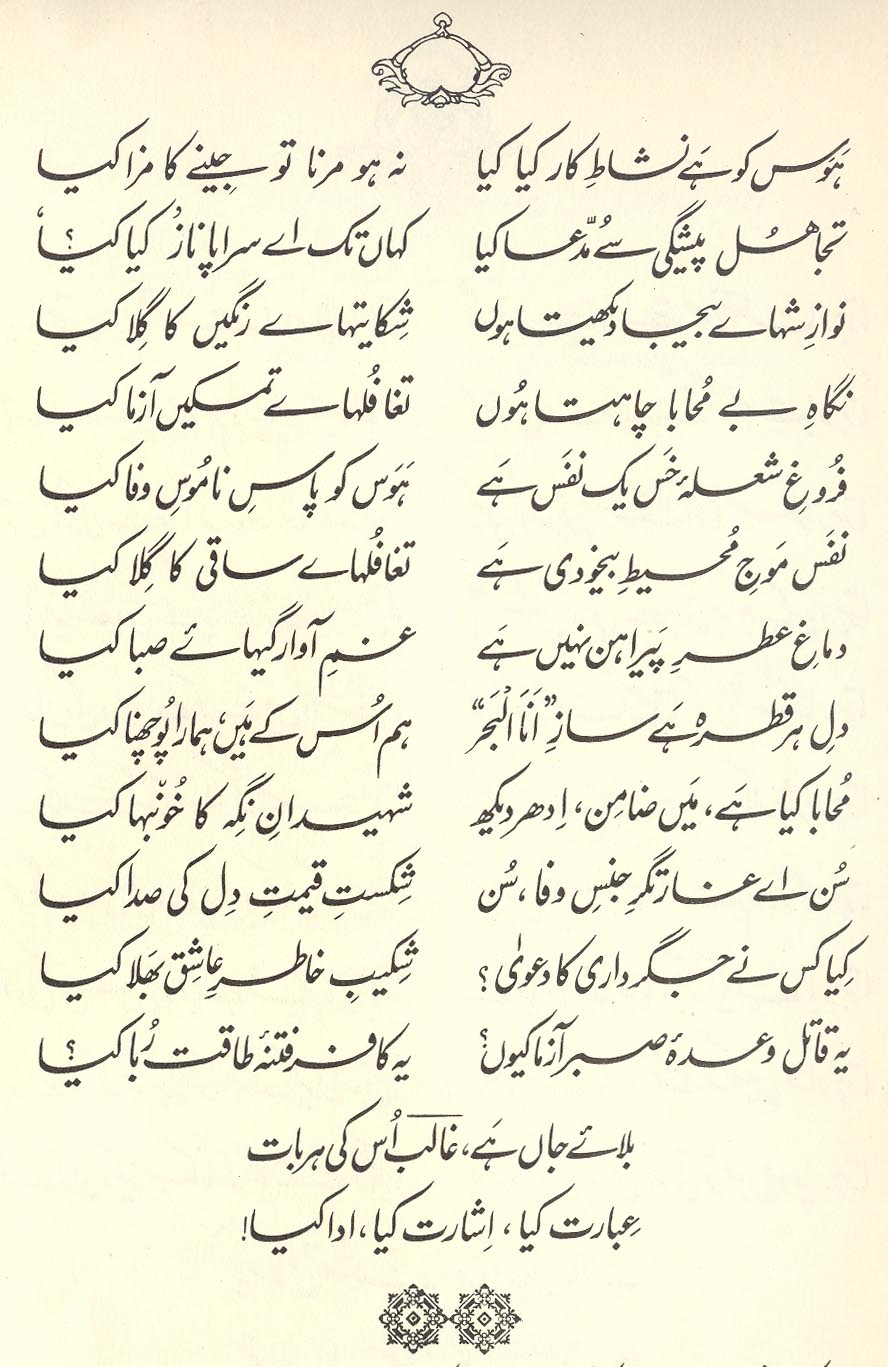
He has interpreted this fortitude-testing vow in the second line as strength-stealing mischief. The style of construction used in this verse is the author's special mode [], and in it he is unique. (23)
== Nazm page 23

The meaning is, why is a fortitude-testing vow made to me? And this theme of the first line is rearranged in different words in the second line. The construction of the words is worthy of praise. (46)
We can also take to be an attribute of the 'fortitude-testing vow'. (23)
The multivalence and pleasure of the verse are generated by the careful 'midpoints' placement of and , such that they can be read either as in (1a) and (2a), as vocatives addressed to the beloved; or else as in (1b) and (2b), as adjectives describing the behavior she's been indulging in. Ultimately, of course, it comes to much the same thing. She's a 'murderer' because of her cruelty, and an 'infidel' because of her generally impious and untrustworthy behavior (on this see 34,8 ).
Both these epithets, but especially the epithet , can also be teasing and intimately affectionate, like caressingly calling a loved one 'you wretch!'. See for example 25,3 , which has nothing to do with untrustworthiness or promises, and everything to do with appropriately beloved-like temperamentalness. And in 9,9x , the lover himself becomes a strange kind of infidel.
In the present verse, what sort of 'promise' or 'vow' is it that provokes such a vigorous reaction? We might tend to think of a negative one: 'I swear I won't speak to you until/unless...' or something of the sort. But in an even more piquant way, it's probably a positive one: 'I'll meet you in the garden next Tuesday', or something of the sort. That's where the 'fortitude-testing' and 'strength-stealing' qualities come in. Does he believe her? Dare he believe her? Is there even the smallest possibility that she'll keep her word? Can he even endure the deadly suspense long enough to find out? And if he actually believed her, that would be the most fatal thing of all: see 20,2 .
There's also the 'A,B' question: do the two lines, with their exclamatory (rhetorical?) questions, refer to the same situation, or are they two separate reproaches, one specific (about a promise or vow), and one general (about 'mischief, torment')? As usual, Ghalib leaves it up to us to decide for ourselves. Since the two lines have such tight connection already through their extremely parallel structure, to read them as semantically independent wouldn't at all weaken the verse.
graphics/promise.jpg