Verse 2after 1847aarhotaa
G6
1 a
if we lived on your promise, then know this-- we knew [it to be] false
1 b
if we lived on your promise, then this, dearest/'life', we knew to be false
1 c
we lived on your promise-- know [reading ] this: we knew [it to be] false
2
for would we not have died of happiness, if we had had trust/confidence [in it]?
'A promise; vow; --an agreement, a bargain; an assignation, appointment'.
'Confidence, trust, reliance, faith, belief; respect, esteem, repute; credit, authority, credibility; weight, importance; regard, respect, view, consideration, reference'.
| References | |
|---|---|
| Arshi, Imtiyaz Ali | Ghazal# 43 |
| Raza, Kalidas Gupta | 397-398 |
| Hamid Ali Khan | Open Image |
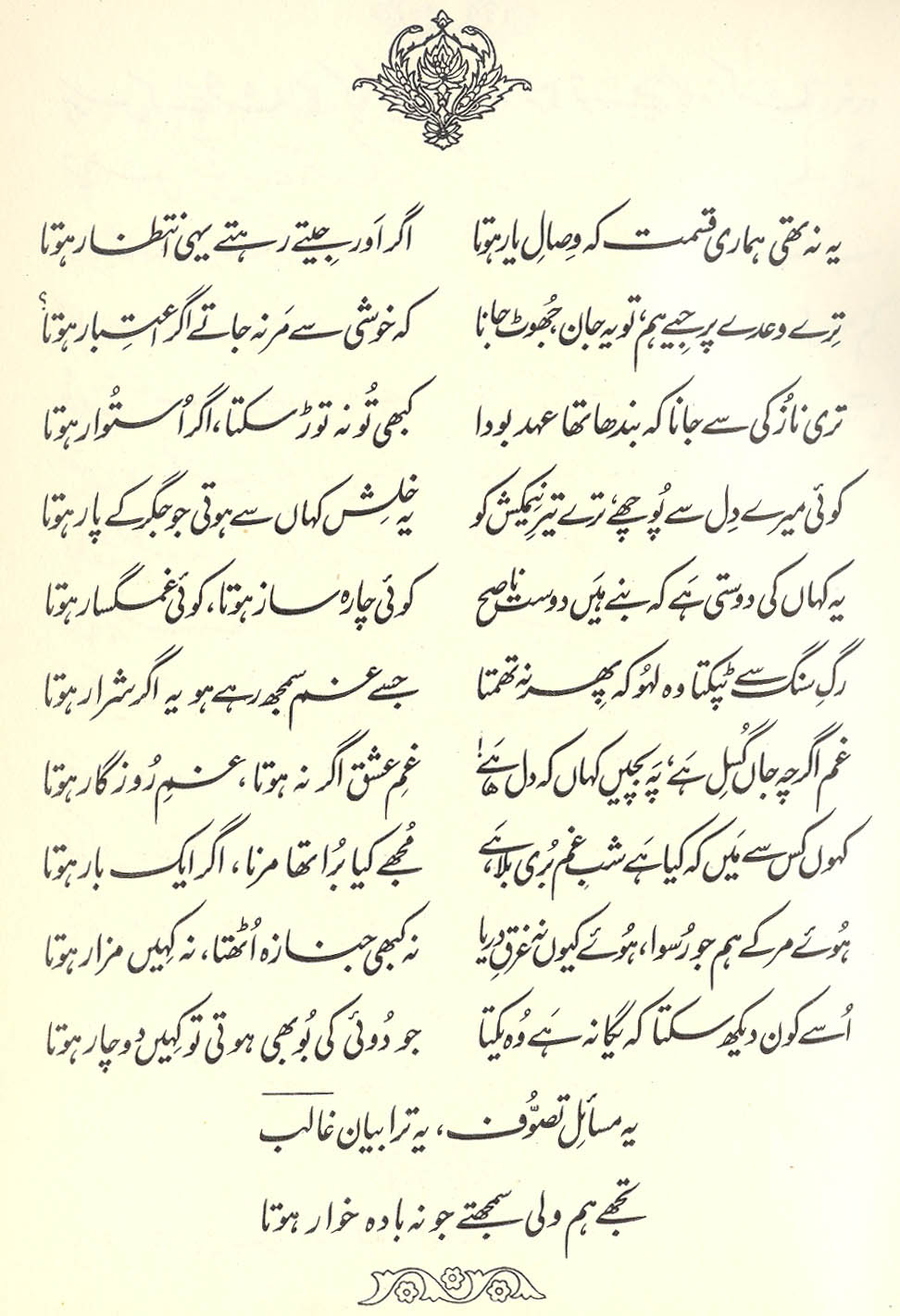
That is, when we said, 'We have escaped dying only because of hearing the promise of union', you knew it was false. The second interpretation is that, having heard your promise, if we kept on living, the reason was that we considered it a false promise. (20)
== Nazm page 20

Urdu text: Vajid 1902 {20}
When you reproach us for hearing a promise of union and not dying, this is right. But the reason we kept on living was that we considered your promise false. (42)
We didn't die of happiness at your promise of union. The reason for this was exactly that we didn't trust your promise. The beloved has said, what kind of a lover are you-- that we promised union, and you didn't die of happiness? This verse is the answer. (48)
Another classic verse full of wordplay and sound-play, with a carefully contrived nest of confusions in the second half of the first line. Is it or since , 'then', can also be read as , the intimate 'you' (1c)? And to what does refer? And is the intimate imperative of , 'to know (1a)? Or is it a feminine noun meaning 'life', and metaphorically 'dearest', as an epithet for a loved one (2b)?
I think reading (1a) is the best, followed by (1b) and (1c) in that order; but none of them can be ruled out.
The general logic is clear enough, though of course paradoxical. And the direct, intimate address to the beloved makes it feel like a (rare) moment of oneupsmanship in what is always a radically unequal relationship. After all, the basis for even this small moment of triumph is the question of whether the lover lives because of the beloved's promise (of union), or dies because of it. These seem to be the only two possibilities.
Yet the perversely triumphant riposte in the second line adds a note of humor and self-mockery that makes the verse a delight. 'Aha!' says the lover, 'I've got you! You think you have all the power, but I've scored a small triumph of both logic and insight. The very fact that I've gone on living shows that I never did trust your promise! So now that it has proven false, you can't claim that you ever fooled me-- I know you too well!'
And yet perhaps the lover did somehow live on it-- otherwise why and how is he alive at all? The same paradoxical effect, that the lover both lives and dies through the beloved, is expressed in 219,8 as well.
graphics/promises.jpg
From a privately printed collection by Kamil Hyderabadi, with thanks to Mansoor Khan