Verse 11after 1847aarhotaa
G6
1 a
these problems of mysticism! this description/expression of yours, Ghalib!
1 b
these problems of mysticism-- this [is] your discourse, Ghalib
2
we would consider you a saint-- if you weren't a wine-drinker
'Questions; propositions; problems; —the precepts of Mohammad'.
'Declaration, assertion, affirmation; explanation, exposition, description, relation, disclosure, unfolding, circumstantial indication or evidence; perspicuity, clearness'.
'A friend, a favourite (of God, or a king); a saint'.
| References | |
|---|---|
| Arshi, Imtiyaz Ali | Ghazal# 43 |
| Raza, Kalidas Gupta | 397-398 |
| Hamid Ali Khan | Open Image |
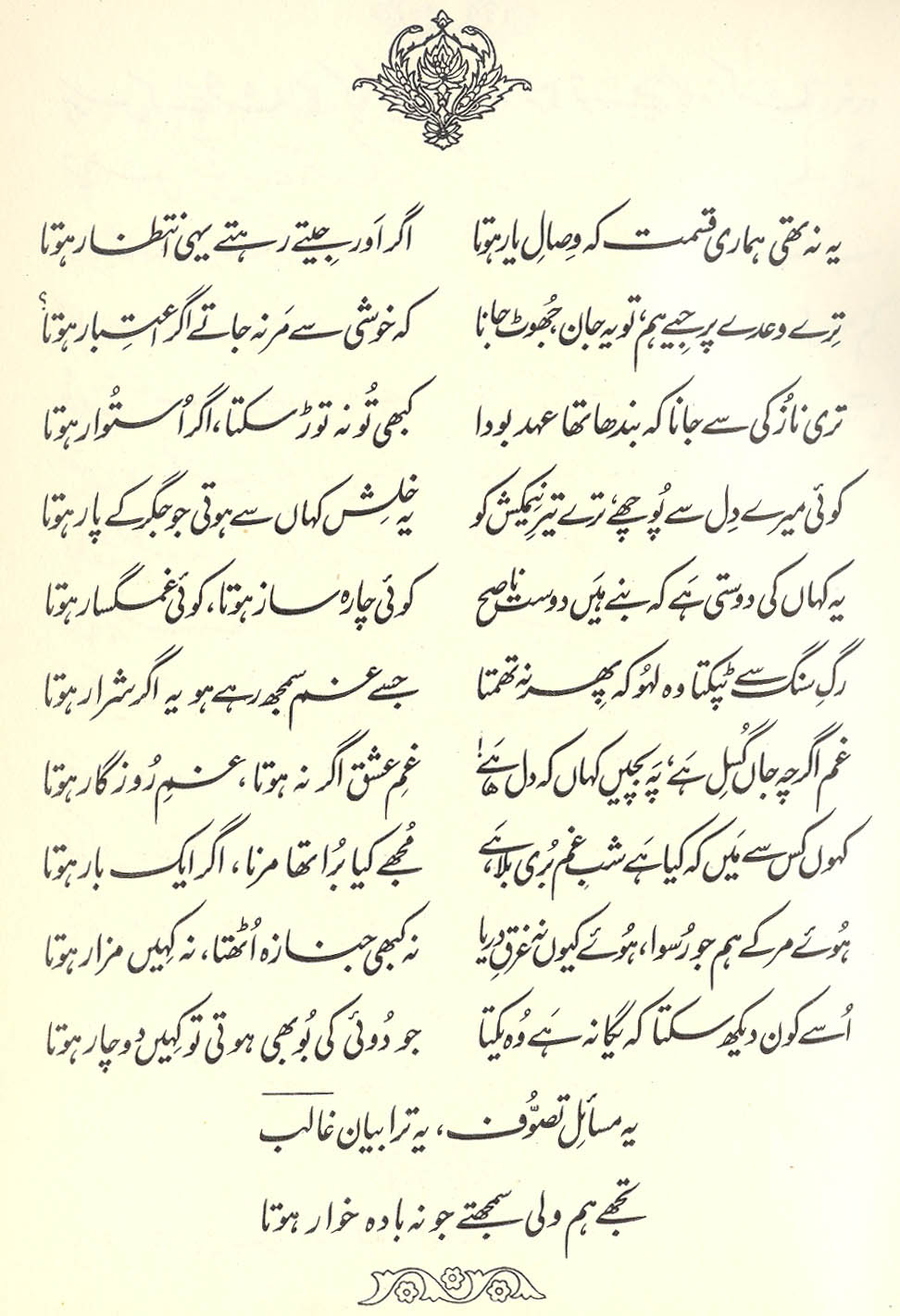
For knowledge of Sufism-- about which they say [in Persian], 'it's good for composing poetry'-- he had a special affinity , and numerous books and treatises on mysticism and Sufism had been examined by him. And the truth is that those same Sufistic ideas had made Mirza distinguished not merely among his contemporaries, but also among all the poets of the twelfth and thirteenth [Islamic] centuries.
==Urdu text: Yadgar-e Ghalib , p. 59
I have heard that at the time when Mirza recited this ghazal to the King, then the King said, 'My friend, even then we would not have considered you one'. Mirza said, 'Your Excellency considers me one even now, but you’ve made this remark so I wouldn't become proud of my saintliness'. ==Urdu text: Yadgar-e Ghalib , p. 140 ==another trans: Russell and Islam , pp. 101-02
I have heard that at the time when Mirza recited this ghazal to the King, then the King said, 'My friend, even then we would not have considered you one'. Mirza said, 'Your Excellency considers me one even now, but you’ve made this remark so I wouldn't become proud of my saintliness'. ==Urdu text: Yadgar-e Ghalib , p. 140 ==another trans: Russell and Islam , pp. 101-02
It is not necessary to comment on this closing-verse ; it is clear. But here this point should definitely be understood, that compared to information [], there is more pleasure in non-informative speech . If the first line had been like this: 'Ghalib, from your lips emerge secrets of mysticism', then this verse would have been a utterance. The author's mischievousness of temperament left behind the aspect of information, and presented this theme in the guise of astonishment, and now this verse is an entirely utterance. (21)
== Nazm page 21

Both these things are among Mirza Sahib's specialties: one, style of speech, and the other, a mood of mysticism. (44)
Mirza's wine-drinking is no hidden matter; thus this
closing-verse
is based on the reality of his situation. (79)
A productive tension also comes from the meanings of
as 'questions' and
as 'explanation'. If we take the two lines as parallel, we see that these questions of Sufism may in fact be Ghalib's answers. That is, he often leaves various sides of a discourse available for readers to make of what they will. It can be both charming and vexing for questions to be answers, which speaks nicely to Ghalib's preferred mode of engagement with the world as a thinker and a moral being. Certainly, anyone who looks for didactic assertions about Sufism in his verse, will find more questions than answers, or conversely multiple answers that beg certain questions.
The question/explanation tension also suggests a possible exasperated tone from the speaker of the first line. We could perhaps imagine that Ghalib has been asked about his wine-drinking and has replied with questions about Sufism. To which the speaker replies: 'These questions of Sufism?! This is your explanation, Ghalib?! We would have considered you a saint, if you hadn't been a wine-drinker!' (January 2010)
This is a truly beloved and extremely famous verse; it was one of those often quoted to me by ordinary people in Delhi and Lahore when they heard that I was studying Ghalib. It was always recited with relish, with a smile at least, and often with laughter.
The two readings of the first line are equally plausible: are the two clauses parallel (1a), or does the second describe the first (1b)? We can't tell, because the whole utterance is not logically structured, but is , as Nazm points out. As he also observes, the exclamatory quality is a great part of its charm.
Another part of its charm is the patronizing tone of the second line, spoken as it is apparently either by a group of representative listeners, or by a single patron-like person (male or female) using the first person plural pronoun . Complimenting Ghalib on either his mystical tendencies, or his mystical tendencies and his poetic abilities both, the knowledgeable observer finds his work almost enough to make him plausible as a saint.
But of course, the observer remarks in a candid and superior tone, Ghalib's being a wine-drinker (not necessarily a drunkard) prevents any such illusion from developing. The use of the intimate for 'you' increases the effect of condescension. And of course it amuses us readers, since we know how long Ghalib's poetry will live, and how little the observer's strictures will matter over time.
Since a closing-verse must contain the poet's pen-name , it is commonly self-referential or self-addressing. Sometimes, as in this case, it seems to represent words spoken to the poet by others. But rarely does this common device appear to such advantage, so subtly humorous on several levels, as it does in this verse. The observer condescends to the poet, while we condescend to the observer, and both processes amuse and delight us. And who's to say the poet is not condescending to us as well?
Mr. Mat Ansari suggests that I should also note here, for comparison, a neat verse from a ghazal that Ghalib incorporated into an ode (Hamid p. 199, Arshi p. 157; it is 249x,9 ):
[watch out, if anybody tangles with Ghalib!
the saint is hidden and the infidel, revealed].
For another account of the power of the lover's , see 43,1 .
Compare Mir's own equally wry version of this theme: M 84,4 .
'The Saintly Imbiber', by Chughtai, an illustration of this verse (courtesy of Satyanarayana Hegde):
graphics/chughtai.jpg
graphics/winecomplaintsmet.jpg