Verse 1Feb. 1848aa;Napnaa
G4
1
the mention/account of that Fairy -faced one; and then-- my description/expression!
2
he became a Rival finally-- {he who / since he} was my confidant/'secret-knower'
'Remembering, remembrance; memory; commemoration; --mention, telling, relating, relation, recital, report, account; praise, eulogy, fame'.
'Declaration, assertion, affirmation; explanation, exposition, description, relation, disclosure, unfolding, circumstantial indication or evidence; perspicuity, clearness'.
'Acquainted with secrets or mysteries; --one who is acquainted with a secret'.
| References | |
|---|---|
| Arshi, Imtiyaz Ali | Ghazal# 42 |
| Raza, Kalidas Gupta | 406-407 |
| Hamid Ali Khan | Open Image |
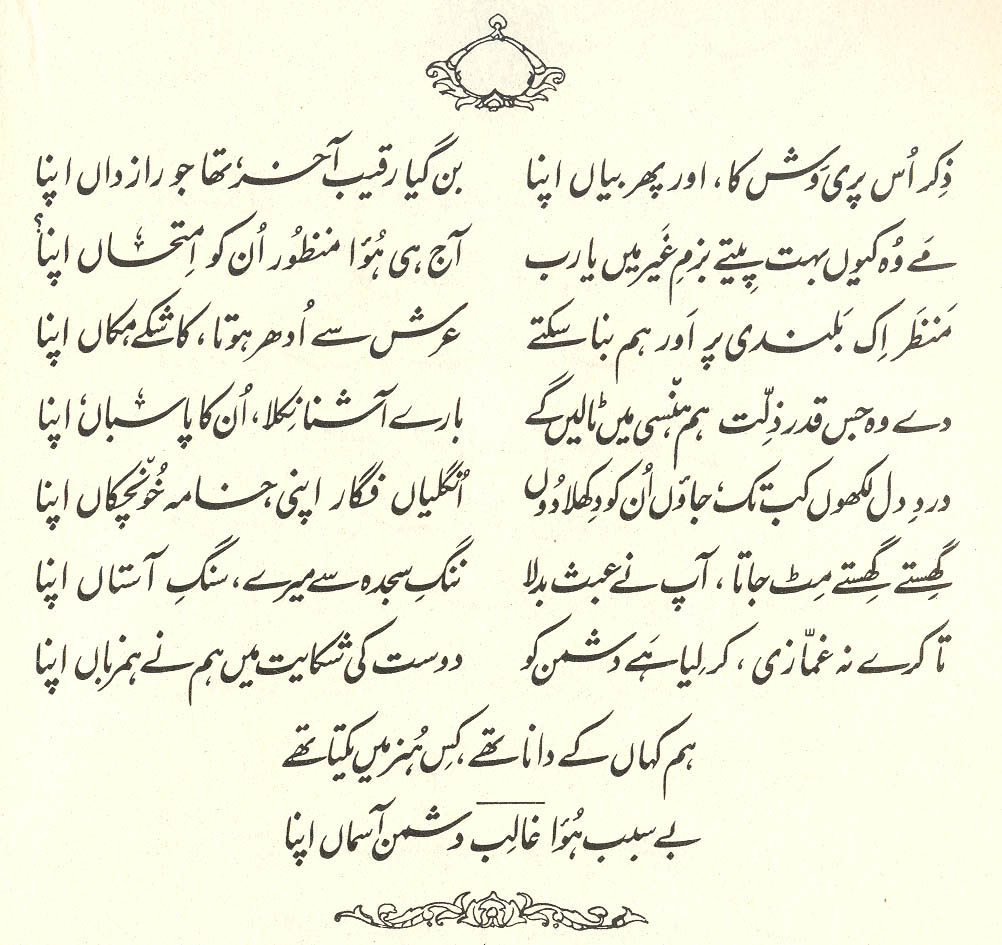
The person whom I made my intimate companion and confidant in praising the beloved's beauty-- after hearing it he became my Rival; because first it was the praise of such a Fairy-faced one, and that too in the language of a magical speaker like me. The second half of the first line, 'and then, my description'-- this is among Mirza's special characteristics.
==Urdu text: Yadgar-e Ghalib , p. 142
That is, he too became a lover-- first, because the mention itself is heart-alluring, and second, from the lips of a person who's becoming infatuated. And then, this is 'magic of speech'. (40)
== Nazm page 40

Again that sense of humor. Again that subtle insistence on one's own greatness. It is not just the beauty of the beloved that causes the transformation; it is (to top it all) that fine eloquence of the poet which brings him to grief. But what was indeed a tragedy (that the confidant himself became a rival) is treated lightheartedly. There is pride as well as self-mockery.
The use of the word suggests that this event had to happen and that the poet was perhaps aware of it.
== Naim 1970, p. 23
../apparatus/txt_sets.html This is one of his very famous ghazals; verses from it are often memorized and often sung.
This must have been a great mushairah verse: from the first line, we have no idea where the thought will be going. Only in the second line do we learn what those two items named in the first line really are. They turn out to be two things that suffice to turn a confidant into a Rival: the mention of the irresistibly beautiful beloved, and (as the commentators enjoy pointing out) the speaker's 'description/expression' []. What is it about his that's so compelling? The poet mischievously leaves it up to the reader to decide. No doubt it's the lover's passion, as Nazm somewhat waspishly points out. But of course, it's also the verbal magic of a great poet.
Here the little word is surely more of a 'then' than an 'again'. How well it rebalances the line! It enforces a small pause for reflection ('there was X... and then, there was Y'), before the deadly power of that is actually mentioned. Just the right pause for a show of feigned humility, of contrived understatement. For in retrospect we notice that it's not the beloved's beauty in itself that has assured the confidant's downfall, but the lover's 'account' [] of her beauty-- so right from the beginning it's really all about the power of that .
In any case, it's clear that the poor confidant's goose is cooked-- how could he have resisted? The is cleverly arranged so that it can be read either as merely identifying the confidant ('the one who'), or else as offering a cause-and-effect sequence: 'since, in that'. So it all comes back, as always, to the effect of the speaker's .
Compare 20,11 , which provides even more amusing and extravagant praise of such a power of .
On the use of to mean , see 15,12 .
graphics/bayan.jpg