Verse 8Feb. 1848aa;Napnaa
G4
1
what kind of a sage were we?! in what skill were we unique/incomparable?!
2
without reason/cause, Ghalib, the sky became our enemy
'Wise, learned; --a wise man, a sage'.
| References | |
|---|---|
| Arshi, Imtiyaz Ali | Ghazal# 42 |
| Raza, Kalidas Gupta | 406-407 |
| Hamid Ali Khan | Open Image |
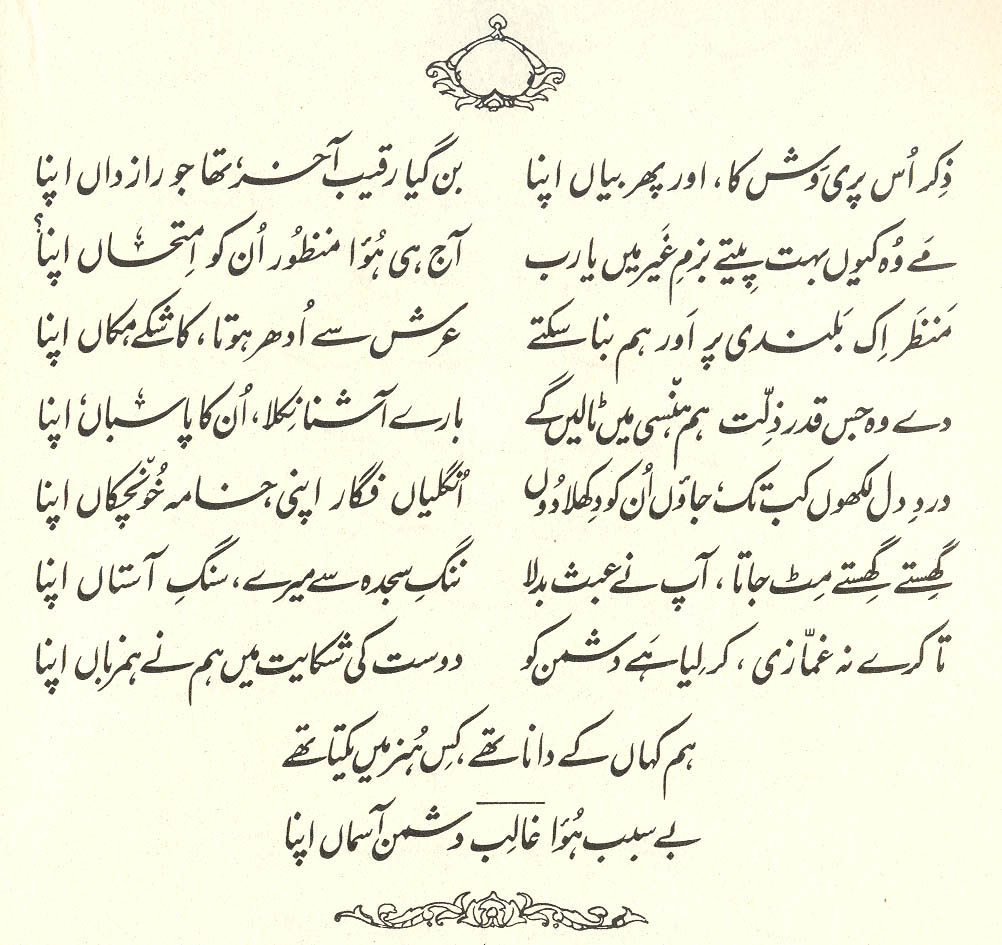
What excellent reasons he has given for the sky's enmity, and how beautifully he has proved his wisdom and skilfulness.
==Urdu text: Yadgar-e Ghalib , pp. 142-43
The point is that wisdom and skill are always the cause of the enmity of the sky. (41)
== Nazm page 41

Thus, the excellence with which he has made his wisdom and skill manifest-- it is impossible to praise it enough. (81)
What can I say of the informality of language in the first line! (114)
As Nazm observes, human wisdom and skill are proverbially likely to bring down the enmity of the heavens. The 'sky' becomes jealous and sends down disasters on the too-lofty figure; the idea goes back at least to Aeschylus. By protesting that he has no special wisdom or skill, Ghalib points out with apparent wistfulness that others at least were blasted by the heavens for a reason, while he himself had the worst of both worlds: he was blasted not even for cause, destroyed meaninglessly and for nothing.
Yet of course that's not the end of the story. By asking the questions in the first line, the poet sets us up to answer them. After all, we know perfectly well how sharp his literary mind is, and exactly 'in what skill he is unique/incomparable'. So we are aware that his claim in the second line is false. But that only makes it more effective as an expression of complete wretchedness and despair. The voice of someone who has abandoned even his legitimate claims to excellence, who claims no attributes but that of receiving injustice from the heavens-- such a voice makes a great, haunting, sweepingly melancholy ending for a ghazal.
On the use of to mean , see 15,12 .
graphics/darksky.jpg