Verse 13after 1826aakyaa
G7
1
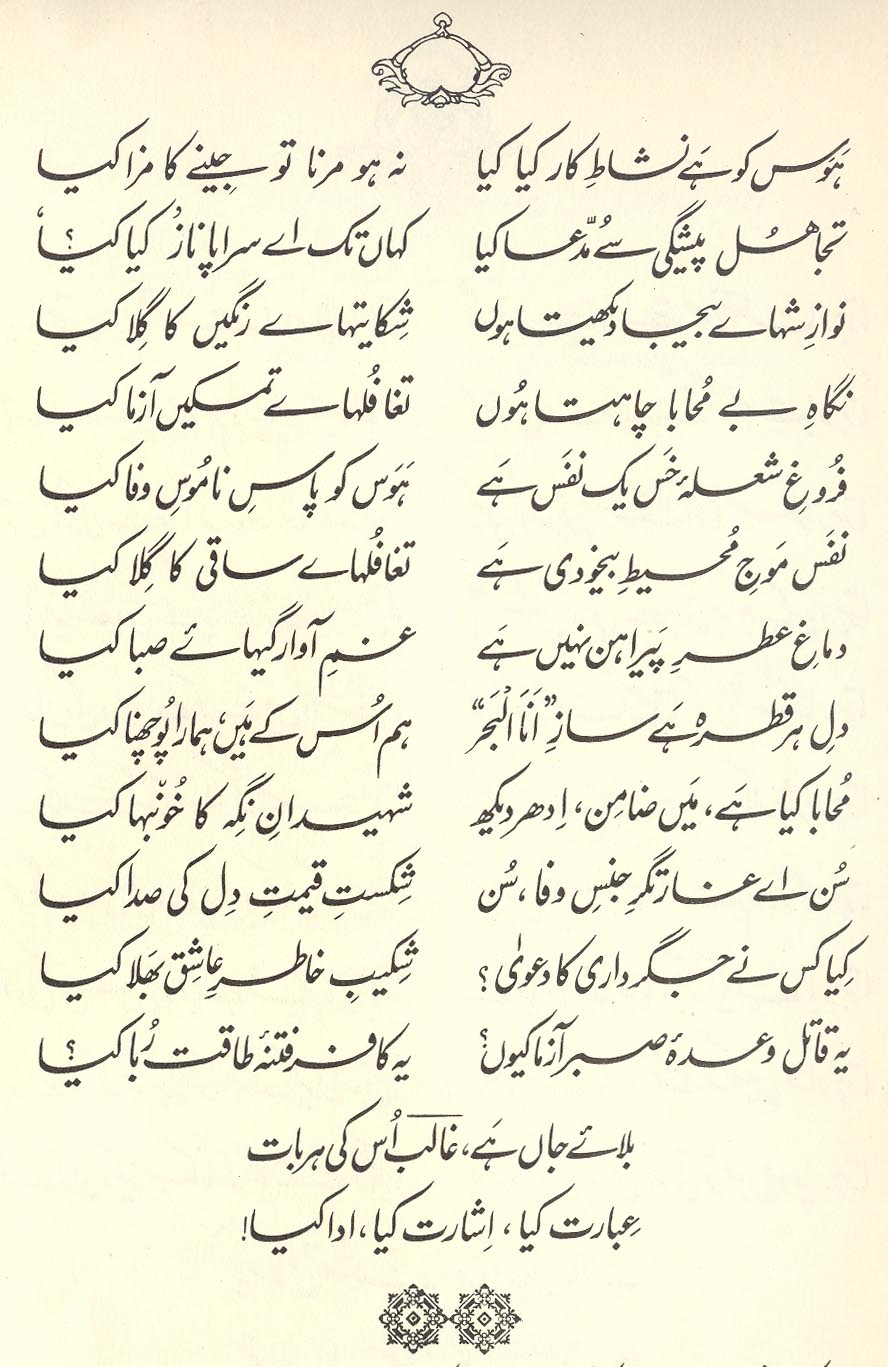
it's a mortal disaster, Ghalib-- her every word/speech/idea
2 a
whether speech/expression, or gestures, or style/grace
2 b
what speech/expression! what gestures! what style/grace!
2 c
what is the speech/expression? what are the gestures? what is the style/grace?
2 d
is it the speech/expression? is it the gestures? is it the style/grace?
'Speech, language, word, saying, conversation, talk, gossip, report, discourse, news, tale, story, account; thing, affair, matter, business, concern, fact, case, circumstance, occurrence, object, particular, article, proposal, aim, cause, question, subject'.
'Speech; a word, an expression, a phrase; a passage (in a book or writing); an explanation, interpretation; a word, or an expression, or a phrase for, or denoting (such a thing); diction; style, mode of expression; the construction or structure of sentence, composition; a trope or figure'.
'Sign, signal; beck, nod, wink, nudge, gesticulation; pointing to, indication, trace, mark; allusion, hint, clue; insinuation, inuendo; love-glances, ogling; dumb-show'.
'Grace, beauty; elegance; graceful manner on carriage; charm, fascination; blandishment; amorous signs and gestures, coquetry'.
| References | |
|---|---|
| Arshi, Imtiyaz Ali | Ghazal# 38 |
| Raza, Kalidas Gupta | 369-370 |
| Hamid Ali Khan | Open Image |
In this verse is a particle of connection. (23)
== Nazm page 23

The meaning is: Oh Ghalib! every single of hers is deadly, whether it be expression, or gestures, or style. (46)
Her speech, her gestures, her glance-- in short, everything is a mortal disaster; that is, it is heart-stealing. (56)
What a matchless way to end a ghazal like this one. The verse exclaims that the beloved's every is a life-threatening disaster, one likely to put an end to the lover completely. The word is one of the most common and flexible in the language; the set of 'word/speech/idea' is about as close as I could come to its central meaning; for more about its capabilities, see 59,2 .
In this closing-verse , Ghalib extracts even more ambivalence from the supply that he's been using throughout (see 21,1 for more on this). In the second line, however, he additionally invokes the idiomatic usage , 'whether it be this, or whether it be that' (2a). And he adorns the second line with no fewer than three phrases, all exclaiming at, or questioning, or enumerating, aspects of the beloved's presence.
As so often, we can't tell what the relationship is between the two lines. Do the three wide-ranging qualities enumerated in the second line constitute separate attributes in their own right, or are they presented chiefly as examples of 'her every ', as in (2a)?
In addition to its other virtues, the second line also develops beautiful sound effects: an absolutely perfect rhythmic flow in which the semantic units exactly follow the metrical feet, with the end of each foot corresponding to an occurrence of . For the meter is: - = = = / - = = = / - = = . Even if you don't know or care much about Urdu meter, you can feel and admire the effect.
graphics/adakya.jpg