Verse 9after 1826aakyaa
G7
1
what concern/caution is there? I am responsible-- look this way!
2 a
for martyrs of a gaze, what is the blood-price?
2 b
for martyrs of a gaze, as if there's a blood-price!
2 c
for martyrs of a gaze, what a blood-price there is!
'Partiality (for); lenient or gentle treatment, kind behaviour; respect, regard, friendship, affection; --caution, care'.
'One who is responsible or accountable (for), a surety, guarantee; security, sponsor, bail, bondsman'.
'The price of blood, blood-money, a fine for blood-shedding: -- , To shed blood'.
| References | |
|---|---|
| Arshi, Imtiyaz Ali | Ghazal# 38 |
| Raza, Kalidas Gupta | 369-370 |
| Hamid Ali Khan | Open Image |
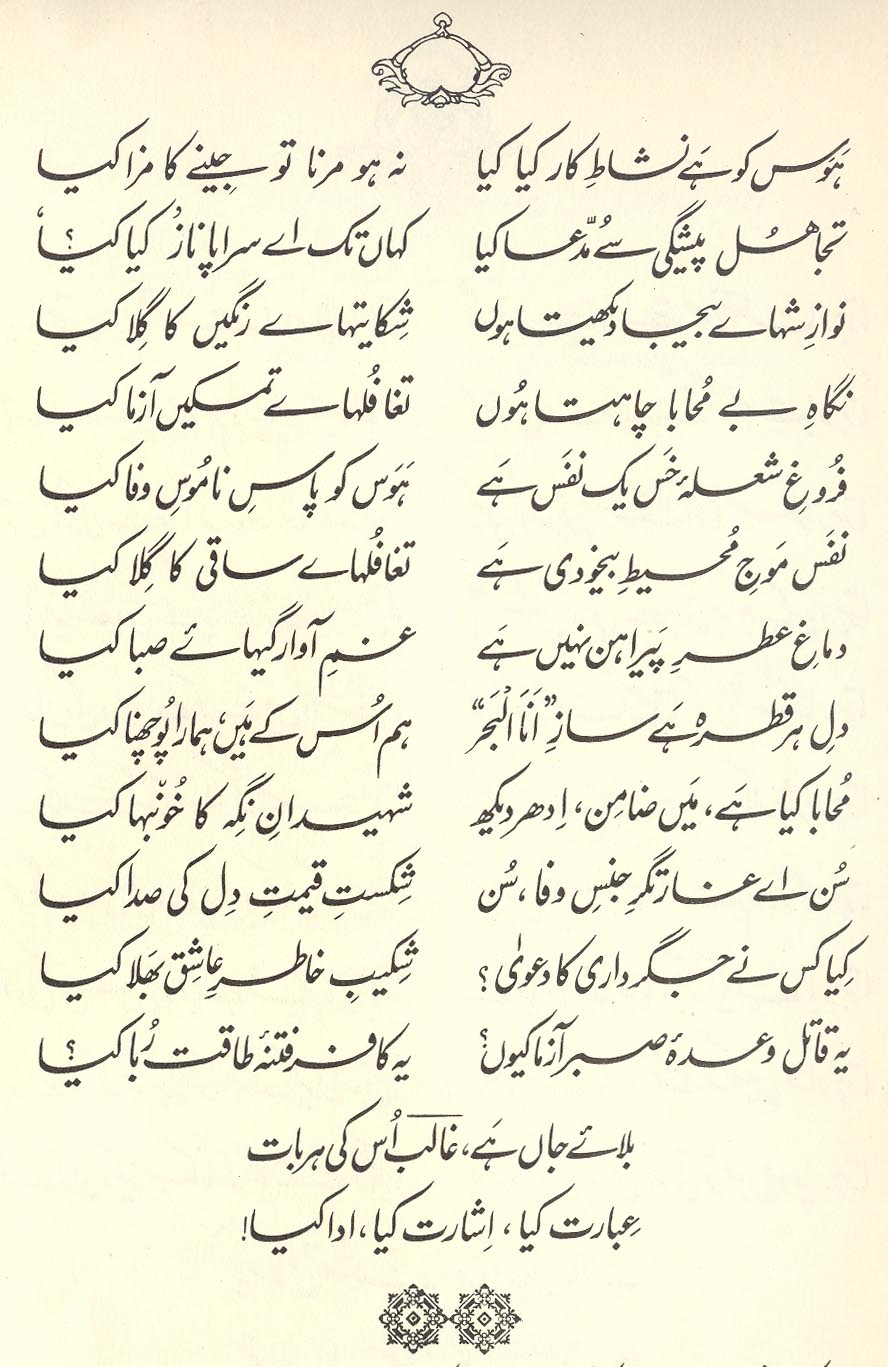
'Look this way' has two meanings. One, that he says this in a context of reproach; the other is, 'Come on, look in my direction'. (23)
== Nazm page 23

It is contrary to custom for a blood-price to be taken for martyrs of a glance. So why are you afraid? Cast off fear and look toward me; if I die, I take responsibility for it, no questions will be asked of you. The excellence and supremacy with which Mirza Sahib has presented this theme is manifest. (46)
The phrase 'Look this way' is the life of the verse. (54)
ABOUT THE 'BLOOD-PRICE': The ' blood-price ' was a payment traditionally exacted from a murderer (or the murderer's family or clan), to satisfy the claim of the victim's family or clan, so as to remove their right or duty of killing the murderer (or a member of the murderer's family or clan) to avenge the victim's death (see Platts's definition above). Other 'blood-price' verses: 4,11x ; {21,9}; [ 24,4 ]; [ 64,6 ]; 79,3x ; 209,8 // 307x,5 ; 348x,2 ; 360x,5 ; 361x,2 ; 434x,11 .
We assume in this verse that the beloved's glance is deadly and would be fatal to the lover. The beloved may be concerned, either humanely or coquettishly or (more probably) prudentially, to avoid slaying him. The lover reassures her: she shouldn't fear being made to pay a 'blood-price' to atone for the murder. The lover takes all the responsibility on himself, absolving her of guilt, and only urges her to look in his direction.
To crown his argument he says, or exclaims, the words in line two, in one (or two, or three) of its possible readings. (See 21,1 for more on this multivalence.) Any of the three readings might serve to advance his argument, and the form opens up a variety of tones in which the question might be posed or the exclamation made:
(2a) What is the blood-price, by the way? I don't know, says the lover, but in any case I've already bound myself to pay it. (Or, alternatively, a yes-or-no question: Is there a blood-price?)
(2b) As if there's a blood-price! That would be absurd-- certainly that is not a valid reason for the beloved to hesitate!
(2c) What a blood-price there is! By the lover's pledge (in the first line) he is bound to pay the blood-price for his own death! What a strange and paradoxical situation-- but surely one that yields insight into the mystic's urgent longing for escape at all costs from this finite world.
This verse develops to a more extreme point the implications of 21,4 ; it even includes the same important word . See also 64,6 , which takes another approach toward the blood-guilt incurred by the murderously charming beloved.
graphics/medusa.jpg