Verse 41816aa))iikaa
G2
1
you didn't kill [me], considering [me] guiltless-- oh heedless one, on your neck
2
remained, like the blood of an innocent, the right/claim of relationship
'Acquaintance, friendship, intimacy, familiarity; connection, relationship; connection by marriage; illicit love, carnal intercourse'.
| References | |
|---|---|
| Arshi, Imtiyaz Ali | Ghazal# 11 |
| Raza, Kalidas Gupta | 149-150 |
| Nuskhah-e-Hamidiyah | 50-53 |
| Asi, Abdul Bari | 61-62 |
| Gyan Chand | 87-90 |
| Hamid Ali Khan | Open Image |
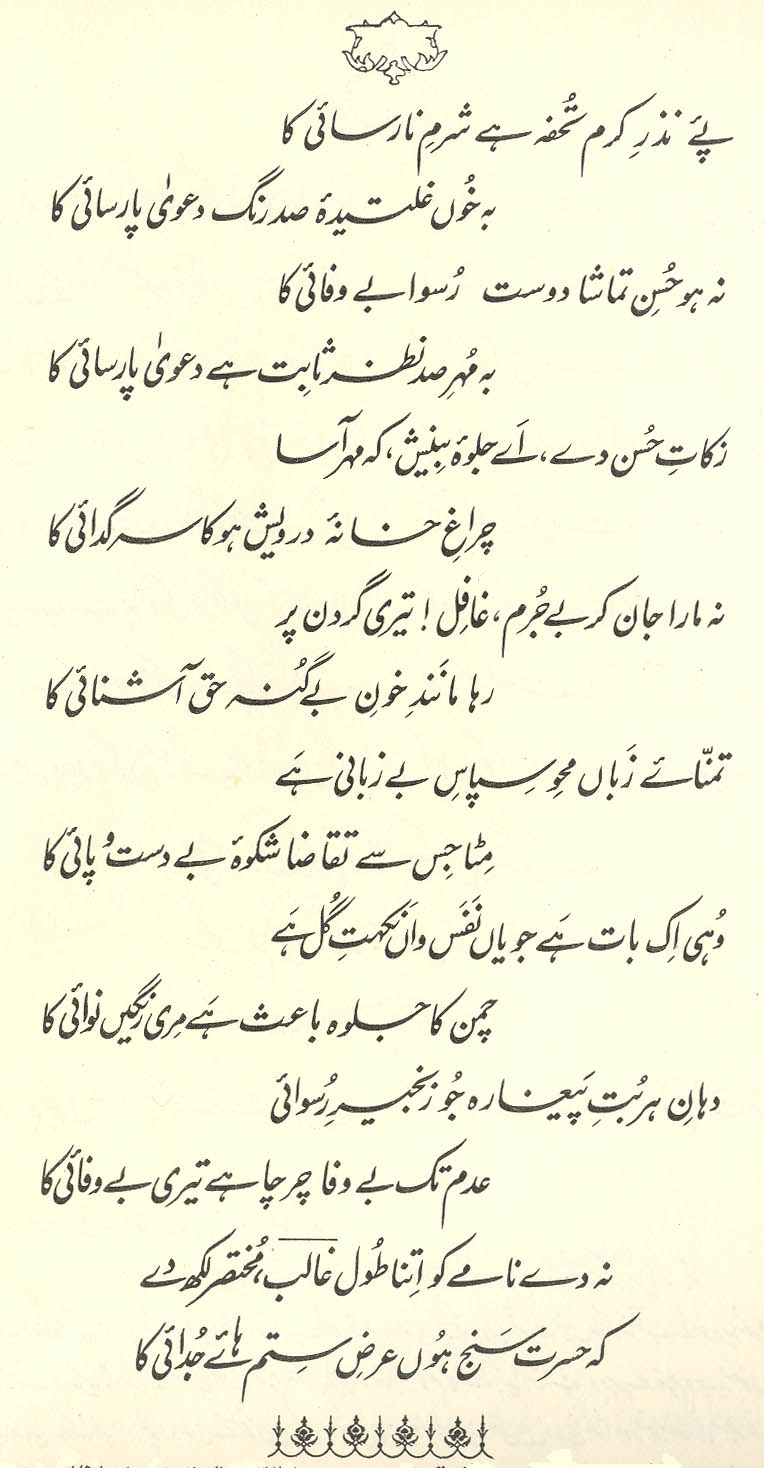
He says that you, considering him unoffending, did not kill that one who was eager to be murdered, so that you would not take the blood of the innocent on your neck. But now on your neck, instead of the blood of the innocent, the right/claim of relationship will remain.
==Urdu text: Yadgar-e Ghalib , p. 140
He blames her: the claim of relationship was that you should have killed me. You considered me innocent, and so turned aside from my murder. But you didn't know that the right/claim of relationship is on your neck the way the blood of an innocent would have been. (25)
== Nazm page 25

You didn't consider me to be one who longed for you, and you kept me deprived of airs and graces. This was your error. I was ardent for coquetry; you didn't fulfill the claim of relationship, and this indictment has remained on you forever. (60)
The idea that blood can be on one's 'neck' is as commonplace in Urdu as the counterpart idea in English that someone's blood can be on someone else's 'head'. Both idioms use blood as a metaphor for guilt, like the 'burden' of guilt that the sinner carries on his 'shoulders'. The same kind of guilt can result in one's owing a 'blood-price'; on this see 21,9 .
At the center of the verse is the strange idea-- hardly a visual image, it's too abstract-- that the 'right/claim of relationship' is something that can be on someone's neck like blood, as though relationship had been slain and the beloved could be reproached for having the blood of 'the right of relationship' on her head (or neck, in Urdu). This does put the unfortunate beloved in a difficult position: her choice seems to be only between two kinds of blood-guilt. Presumably she is called 'heedless' because she didn't realize the problem: she thought, wrongly, that by refusing to kill an innocent person she would escape blood-guilt.
For a better, more complex verse about the beloved's unwillingness to slay the lover, see 19,4 .
graphics/swordwielder.jpg