Verse 61816aa))iikaa
G2
1
it is that same single/particular/ unique/excellent thing that here is breath, there is the scent of the rose
2
the glory/appearance of the garden is the cause/reason of my colorful-voicedness
'One, single, sole, alone, only, a, an; the same, identical; only one; a certain one; single of its kind, unique, singular, preëminent, excellent'.
'Breath, respiration; --the voice or sound from the breast; --a moment, an instant'.
'Smell of the breath; odour, perfume'. (Steingass p.1423)
'Occasion, cause, reason, motive, incentive; subject, author'.
'Voice, sound; modulation; song; air; --a certain musical tone or mood'.
| References | |
|---|---|
| Arshi, Imtiyaz Ali | Ghazal# 11 |
| Raza, Kalidas Gupta | 149-150 |
| Nuskhah-e-Hamidiyah | 50-53 |
| Asi, Abdul Bari | 61-62 |
| Gyan Chand | 87-90 |
| Hamid Ali Khan | Open Image |
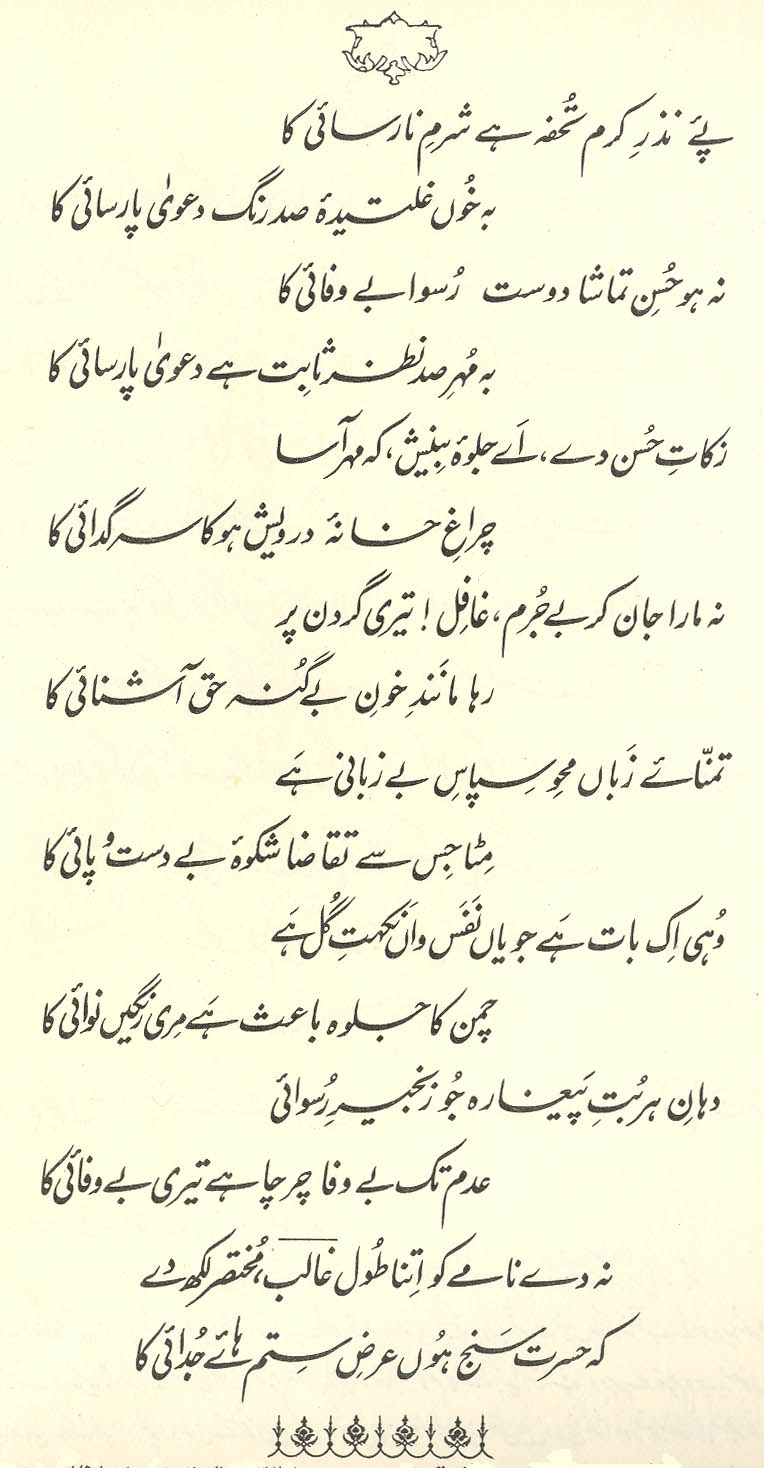
The conclusion is that my breath is not less than the scent of the rose, for the cause of both is identical. (25)
== Nazm page 25

He says, between my breath and the scent of the rose there's no difference. It's just the same thing-- that is, they both achieve the rank of identity. And The cause of this is the radiance of the garden, the spring season, and the enthusiasm of the rose. In the garden, the scent of the rose is created by the enthusiasm of the rose, and I, seeing the spring/flourishing of the garden, begin composing colorful-voiced ghazals. (50)
In the radiance of spring, color and scent in the flowers, and colorful-voicedness in the wine-flagon, are born. The flower gives off scent, and the nightingale (poet) warbles.
[Or:] By the power of the Lord, scent in the flower and poetic imagination in the heart of the poet appear. Professor Iqbal composes just such a one:
yih chaa;Nd aasmaa;N kaa shaa((ir kaa dil hai goyaa
jo chaa;Ndnii vahaa;N hai yaa;N dard kii kasak hai
[this moon of the sky is the poet's heart, so to speak
what there is moonlight, is here the aching of pain]. (61)
Compare 202,8 . (301)
On the subtleties of , see 15,6 (which happens also to use the , though in a very different context).
The verse evokes and plays on all the senses. The perfume of the rose, the radiant appearance of the garden, and the speaker's colorful-voicedness are all somehow connected, or at least analogized. The scent or 'smell of the breath' (see the definition above) of the rose, borne by the metaphorical 'breath' of the breeze, is equated with the poet's breath in line 1. And the sight of the garden's glory leads directly to sound: to the poet's voice and recitation, in line 2. The irresistible glory of spring blurs categories and causes an overflow and outflow of spirit, a diffusing of self into the world.
The result is song-- or (what else?) poetry, as is made clearer in 202,8 , the verse that Arshi points out. In that verse the coming of spring is specifically linked with , the madness of ghazal-recitation; but is it a joyous madness? The overtones in that verse are much more ambivalent.
This sensual springtime verse that exults in the expressive 'colorful-voicedness' of song follows immediately upon the abstract and paradoxical 24,5 , which was a praise of 'tonguelessness'. There could hardly be a clearer illustration of the autonomy of the individual verse and the ghazal's disdain for Aristotelian 'organic unity'.
graphics/rosegarden.jpg