Verse 31816aa))iikaa
G2
1
give [religious] alms of beauty, oh glory/appearance of sight, for like the sun
2 a
a begging bowl would be the lamp of the Darvesh 's house
2 b
the lamp of the Darvesh 's house would be a begging bowl
'A cup, goblet, bowl; a plate'.
| References | |
|---|---|
| Arshi, Imtiyaz Ali | Ghazal# 11 |
| Raza, Kalidas Gupta | 149-150 |
| Nuskhah-e-Hamidiyah | 50-53 |
| Asi, Abdul Bari | 61-62 |
| Gyan Chand | 87-90 |
| Hamid Ali Khan | Open Image |
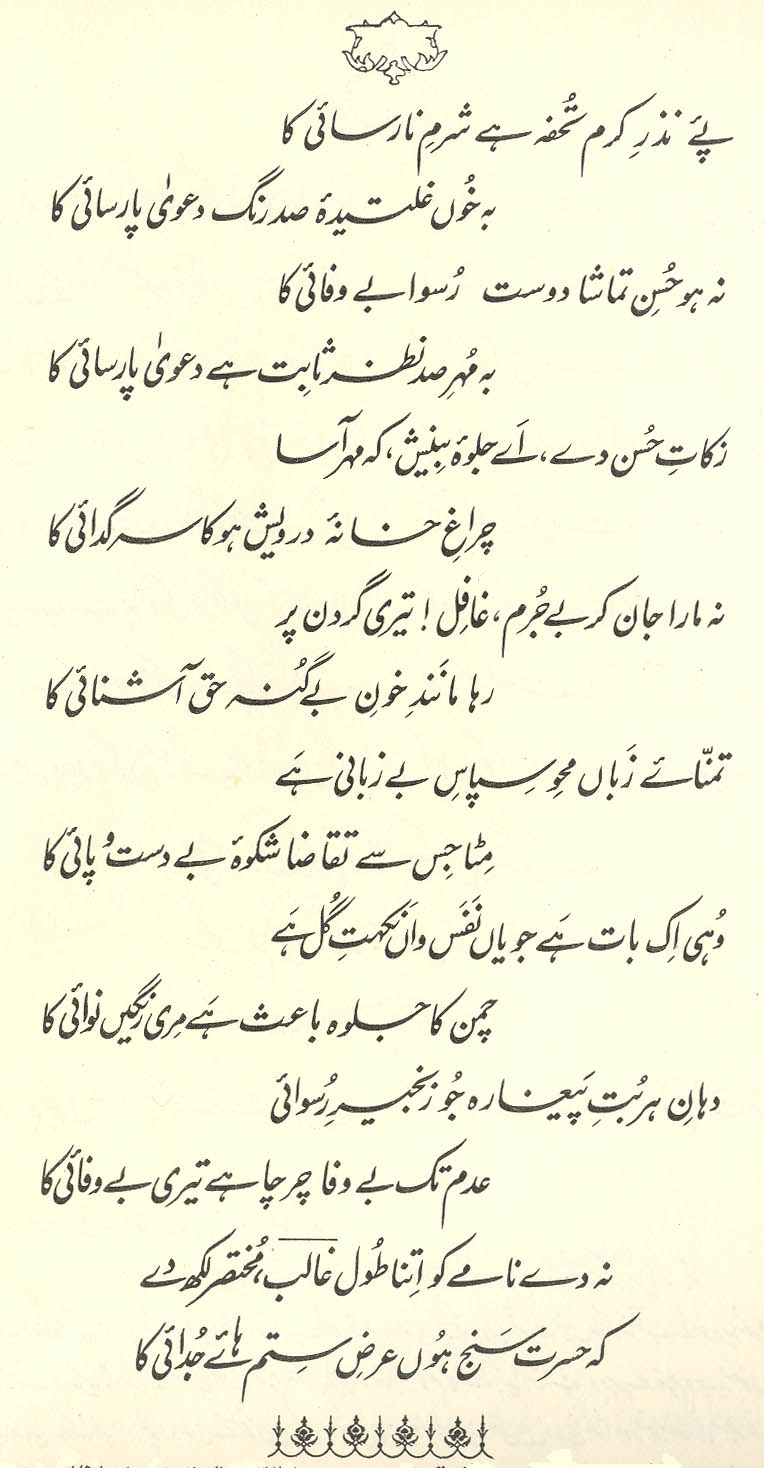
The begging bowl is a metaphor for the heart. He says, 'Oh locus of the glory/manifestation of sight, illumine the begging-bowl of my heart with alms of mystical knowledge, so that it would become a lamp for this mendicant [] and would, like the sun, turn the dark night of ignorance into day'. (25)
== Nazm page 25

Urdu text: Vajid 1902 {24}
It's addressed to the Divine Beloved. Mirza Sahib says, Give [alms] of beauty; that is, if even one-fortieth part of beauty would reach me in a whole year, then like the sun, the begging bowl would be illumined and would become the lamp of the Darvesh's house. (50)
That is, just as you have given of beauty to the sun and made it brimful of light, in the same way be generous to the eyes of the lover's ardor. (60)
[See his discussion of Mir's M 299,13 .]
Is it a begging bowl, or a lamp, that is like the sun? (Thanks to the 'symmetry' of Urdu grammar, both readings are equally legitimate.) Both are round (we're thinking of an oil lamp of course). If the begging bowl is like the sun as in (2a), then their common feature is that after the beloved has given alms of her radiance to the bowl, it will glow with light like the sun and illumine the Darvesh 's house like a lamp. If the lamp is like the sun as in (2b), then their common feature is they've both assumed the form of a begging bowl, pleading for alms of the beloved's radiant beauty-- the sun is a large bowl of her charitably-given radiance, and the Darvesh's lamp is a small one.
Isn't that clever, and isn't that simple and also lovely? Oil lamp and begging bowl are made reversible, and 'like the sun' is positioned is a 'midpoint' phrase positioned to go either way: it's placed at the end of the first line, so that its proper insertion into the grammar of the second line is left for us to decide. Urdu grammar can be an exceptionally versatile tool, and here it's being wielded by a master.
For another request (much less elegant, but very amusing) to the beloved for 'alms' of favor see 162,9 . And for a less benign look at the beloved's supernaturally fiery nature, see 178,2 .
Compare 312x,4 , another verse about the lover, the sun, and the beloved as an alms-giver of radiance.
Compare a verse of Mir 's about the reflection of the beloved's glory: M 1330,2 .
graphics/sunbowl.jpg