Verse 9after 1847aakyaa hai
G8
In this meter the first long syllable may be replaced by a short; and the next-to-last long syllable may be replaced by two shorts.
1
indeed, 'Do good-- good will come to you!'
2
what else is the call/cry of the Darvesh ?!
| References | |
|---|---|
| Arshi, Imtiyaz Ali | Ghazal# 215 |
| Raza, Kalidas Gupta | 401-02 |
| Hamid Ali Khan | Open Image |
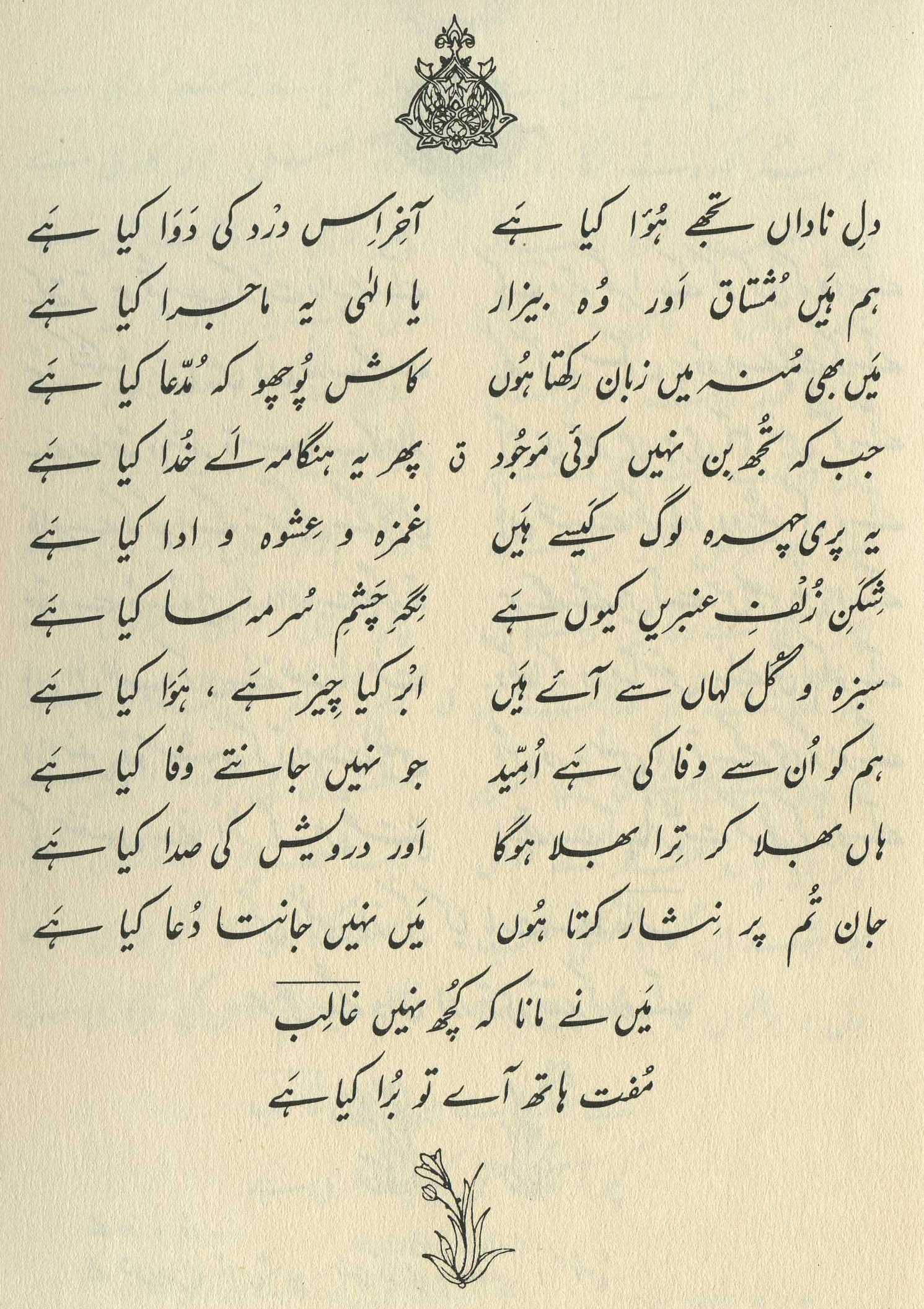
That is, he speaks truly, what doubt can there be that the one who does good will experience good. (175)
== Nazm page 175

He says, whatever he says, he says truly, what cause is there for anyone to doubt it? The Faqir 's call is that the one who would do good-- that is, who would bring benefit to anyone in the world-- benefits will reach him in both worlds. (232)
The Faqir-- that is, I myself-- say to you that 'indeed, do good-- then good will happen to you'. That is, I say to you truly that if you show mercy to me, then the Lord will show mercy to you....
[Nazm's] commentary is incomplete. The Faqir's call has come. At that point, the lover called the beloved's attention to it, that he says truly. The intent of which is 'if you show mercy to your lovers, then the Lord will show mercy to you'. (313)
How much Bekhud Mohani must have enjoyed gloating! Nazm has clearly missed the point (taking the imitative Bekhud Dihlavi along with him), and Bekhud Mohani loves nothing more than scoring points against Nazm. This is a disarmingly simple, platitudinous-looking little verse that you either get at once or (apparently) don't get at all, and Nazm didn't get it. (Which is excusable, since the 'it' to be gotten is really a context or situation, not any complexity in the verse itself.) Nazm's brief commentary, which I've translated in its entirety, is stiff and awkward. You can almost feel him wondering why in the world Ghalib has bothered to quote and affirm, with an apparently straight face, a sort of primitive, popular, pious truism-- the kind of thing religious mendicants go around calling out when they want people to give them alms.
But of course, once you imagine the lover saying this to the beloved, the relish of it comes all at once, and how can you not laugh? The lover is wittily using a pious platitude for erotic purposes. He's mischievously implying that God Himself will reward the beloved for any favors she may generously show to her lover. After all, isn't charity a great virtue, and don't those who have ample goods (such as beauty) have a religious duty to share some of them with humble beggars who are desperately in need?
For another request-- more sophisticated, but less amusing-- to the beloved for 'alms of beauty', see 24,3 . There's also the enjoyable and witty appeal to deafness in 59,8 .
And what of someone who gives not alms, but trouble? Compare Mir 's treatment in M 1457,5 ; and his very famous M 605,1 .
graphics/darveshcoote1760.jpg