Verse 1after 1847aakyaa hai
G8
In this meter the first long syllable may be replaced by a short; and the next-to-last long syllable may be replaced by two shorts.
1
ignorant/naive heart, what has happened to you?!
2
ultimately, what's the medicine for this pain?!
'Ignorant, unlearned; simple, silly; innocent'.
'In the end; at last; after all; ultimately; eventually; once for all, finally'.
| References | |
|---|---|
| Arshi, Imtiyaz Ali | Ghazal# 215 |
| Raza, Kalidas Gupta | 401-02 |
| Hamid Ali Khan | Open Image |
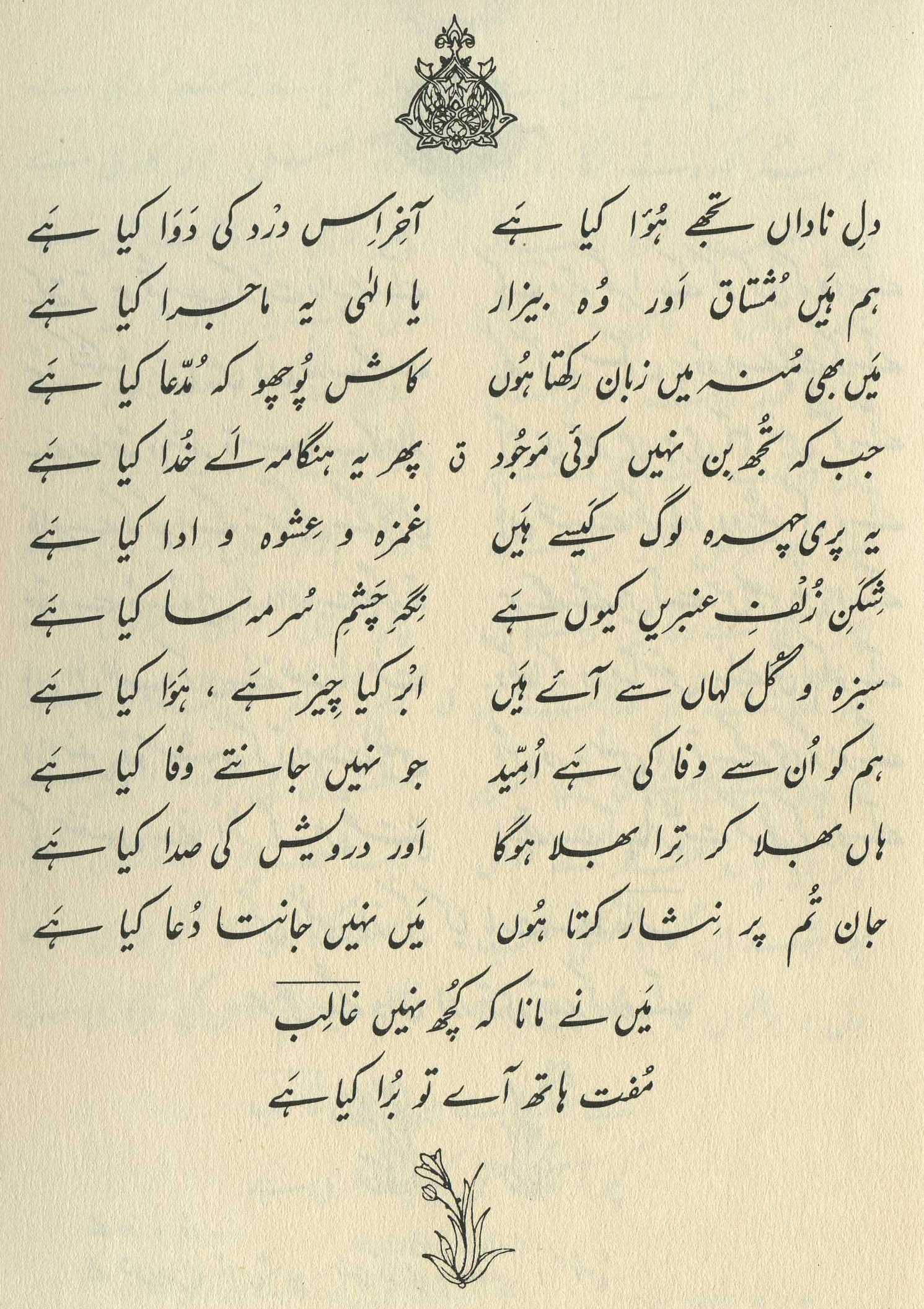
Here, the point of the question is not that someone ignorant of the situation wants to inquire about it; rather, here the intent of the question is only reproach and blame. (174)
== Nazm page 174

He says, 'Foolish heart, what has happened to you? You don't by any means leave off your pranks! After all, what is the medicine for this pain-- that is, the pain of passion? How would I straighten you out, so that you leave off those mischievous tricks?' (232)
He says to the heart, 'Oh tyrant, after all, what has happened to you? You long for a thing that would be absolutely impossible to obtain. Give up this longing...'. The expression tells us that the longing is such that its fulfilment is impossible. From this there also emerges the idea that the beloved is so modest and of such high rank that even the thought of access to her is madness. (311)
Since its refrain is , this whole ghazal is a superb example of Ghalib's favorite interrogative and/or exclamatory mode of speech. The meter is so short, and the words so simple, that the verses look almost childishly plain and naive. But a faux-naïf look of feigned ignorance is, after all, one of Ghalib's enjoyable rhetorical devices. (Remember how Socrates begins his speech in the ' Apology ' by claiming to be just a simple, humble man with only everyday speech at his disposal, and with no command over rhetorical tricks.) The greater part of the ghazal takes full advantage of the rhetorical possibilities of ; only toward the end of the ghazal are 162,8 and the three verses that follow it content to use more simply.
In this opening-verse , both lines are interrogative. And they're about as open-ended as it's possible to be. To ask 'what has happened to you?' can invite an answer involving evil or good, criminality or victimization, volition or helplessness, an event or a mood or an anecdote or a long string of any or all of them, or even a denial that anything has happened at all. Thus it's an elegant further ambiguity to address the heart as -- an adjective that allows for it to be either an innocent, simple-minded victim, or a foolish, wrong-headed maker of bad choices. Or it might merely be an unduly involved observer-- one who naively suffers over the human condition without having the slightest power to control it.
And then, as so often, we're forced to make our own connection between the lines, since none is provided or even suggested. Most crucially, is either of the two questions rhetorical, or both, or neither? Nazm to the contrary, all possibilities are open here. Either or both questions are the kind that could be asked out of genuine ignorance, or rueful sympathy, at least as readily as sarcastically or scoldingly.
Are both lines addressed, as a set, to the heart, or is the second line an independent, private meditation? The presence of suggests a kind of distancing, a kind of summing up, that might imply a separate status for the second line. But what is it summing up, what kind of experience or story or evidence? We're left to imagine it for ourselves. Is 'this pain' one inflicted by the heart, or one inflicted on the heart, or simply one that the heart observes with a painful degree of compassion?
Of course idiomatically means something like 'after all'-- it works as a rhetorical summation or persuasive appeal. But its literal meaning is 'finally' or 'in the end', so that the second line also inquires about the ultimate cure for such a pain-- a cure that, in the ghazal world, can only be death. Thus the first line can be read as reacting to the pain of the beginning of love, while the second line already looks ahead to its only possible end.
Thus with every reading of this verse, we're forced to give it a tone, and that tone is one possible instantiation of its wildly multivalent range of possibilities. We might beg for closure, for guidance-- but we know we aren't going to get any 'cure' for the pain of this particular kind of angst.
graphics/heart.jpg