Verse 3after 1847aakyaa hai
G8
In this meter the first long syllable may be replaced by a short; and the next-to-last long syllable may be replaced by two shorts.
1
even/also I have/'keep' a tongue in my mouth--
2
if only you would ask, 'What's the idea/intention?'!
'What is claimed, or alleged, or pretended, or meant; desire, wish; suit; meaning, object, view; scope, tenor, drift'.
| References | |
|---|---|
| Arshi, Imtiyaz Ali | Ghazal# 215 |
| Raza, Kalidas Gupta | 401-02 |
| Hamid Ali Khan | Open Image |
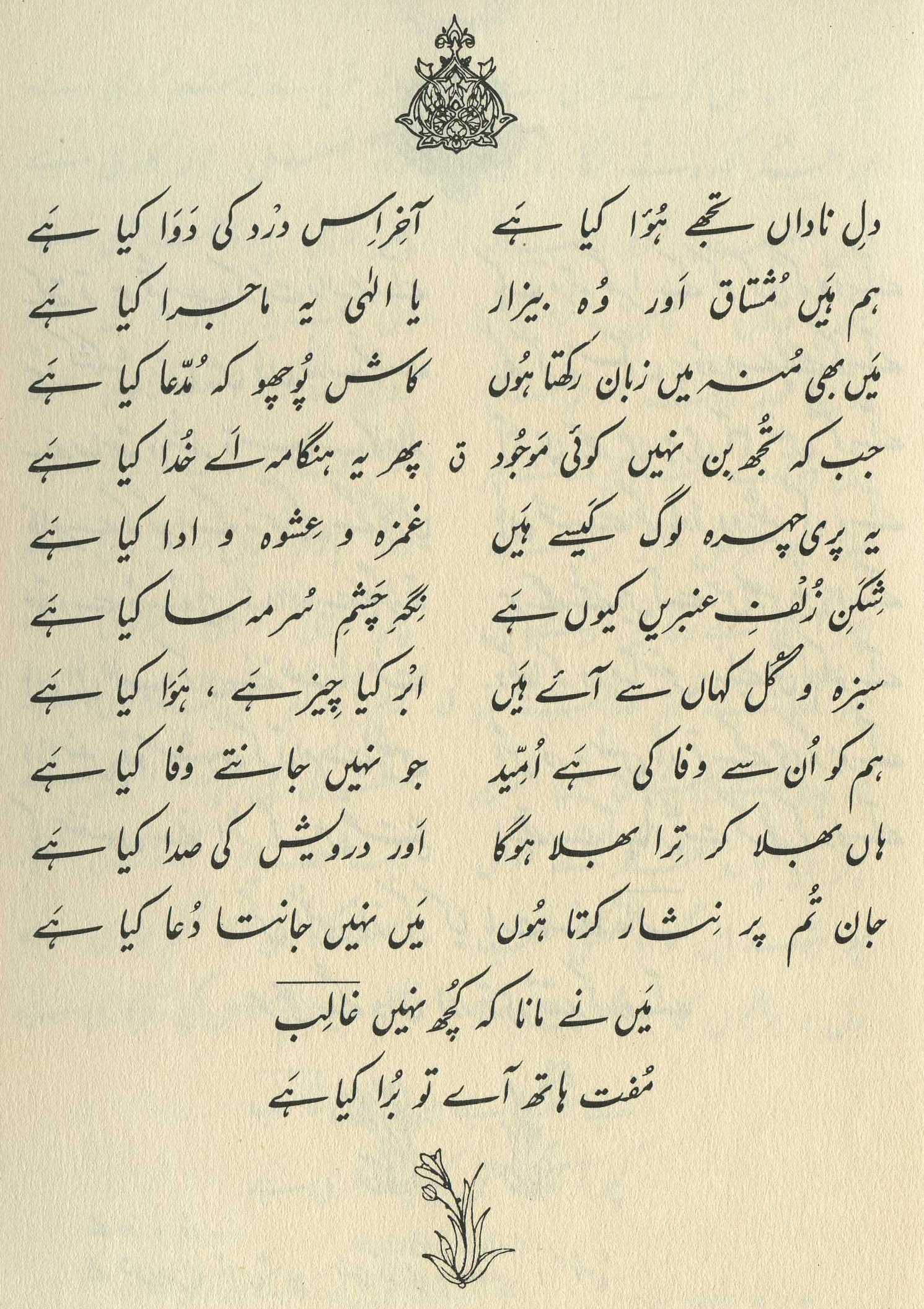
[1865, to Majruh:] The light of my eyes, Mir Mahdi [Majruh], and Mir Sarfaraz Husain, must probably be unhappy with me and must have a complaint against me, and must say, 'Look, you don't write us a letter!':
[even/also we have a tongue in our mouth
if only you would ask, 'What's the situation?']
==Arshi p. 315
==Urdu text: Khaliq Anjum vol. 2, p. 543
From the word the meaning emerges that if you ask the Other s about their situation, the Lord has given me a tongue too-- ask me too, and find out. (174)
== Nazm page 174

He says, you keep on asking the Others about their state. On me too God Most High has bestowed a tongue-- ask me too sometimes, 'What do you want?', and see what reply I give to this. (232)
Anger and blame drip from this verse. (312)
Nazm points to in its additive sense-- the speaker 'too' has a tongue. The verse, however, leaves us to decide for ourselves on the comparison set. He 'too'-- like the Others? Like the beloved? Like human beings in general? This is certainly the more amusing meaning, since it has sarcastic (or ominous?) overtones and opens up richer narrative possibilities. But also contains the sense of 'even', which offers its own pleasure-- 'even' the speaker has a tongue, though the beloved might not have expected to find the power of speech in one so lowly and hapless.
Justin Ben-Hain observes (Apr. 2013): 'Perhaps on some level Ghalib was attuned to linguistics, for the first line uses, in , four consecutive labial syllables. Then breaks this repetition, enacting the line's statement that the mouth is not merely a pair of lips, but the vessel for the tongue/speech.'
The verse is exclamatory, but as usual, we have to decide for ourselves the tone in which it's exclaimed. Bekhud Mohani finds it dripping with anger and blame, which is certainly a possible tone. But it could be meek, helpless, wistful, so that the contrafactual expresses a mere utopian fantasy ('If only she'd ask!-- but of course, she never will'). Or it could be world-weary and sardonic ('Why let all these morons talk, when I could show them up with a word?').
And then in the second line, whose-- and what-- is the ? The commentators unhesitatingly assume that it's the lover's, but the word's range of meanings (see the definition above) certainly opens the possibility that it might be somebody else's intention, desire, claim, etc. that the lover wishes to explain or reveal. Most obviously, he could wish to reveal to the beloved the false, lustful ambitions of the Other(s). Even if it's his own intentions, he might have more to say than just a humble profession of his passion. Who knows-- maybe he wants to talk about the larger, mystical meaning of life, or say a few last (first?) words before going off into the desert.
As usual, the versatility is striking, and the colloquial energy is a delight. For an even cleverer use of the 'tongue in the mouth' image, see 138,5 .
graphics/tongue.jpg