Verse 2after 1847aakyaa hai
G8
In this meter the first long syllable may be replaced by a short; and the next-to-last long syllable may be replaced by two shorts.
1
we are ardent; and she, disaffected
2
oh God , what is this state of affairs?!
'Full of desire, desirous, wishful, longing, yearning (for); ardent, eager, keen; —s.m. A lover'.
'Displeased, vexed, annoyed, out of humour; disgusted'.
| References | |
|---|---|
| Arshi, Imtiyaz Ali | Ghazal# 215 |
| Raza, Kalidas Gupta | 401-02 |
| Hamid Ali Khan | Open Image |
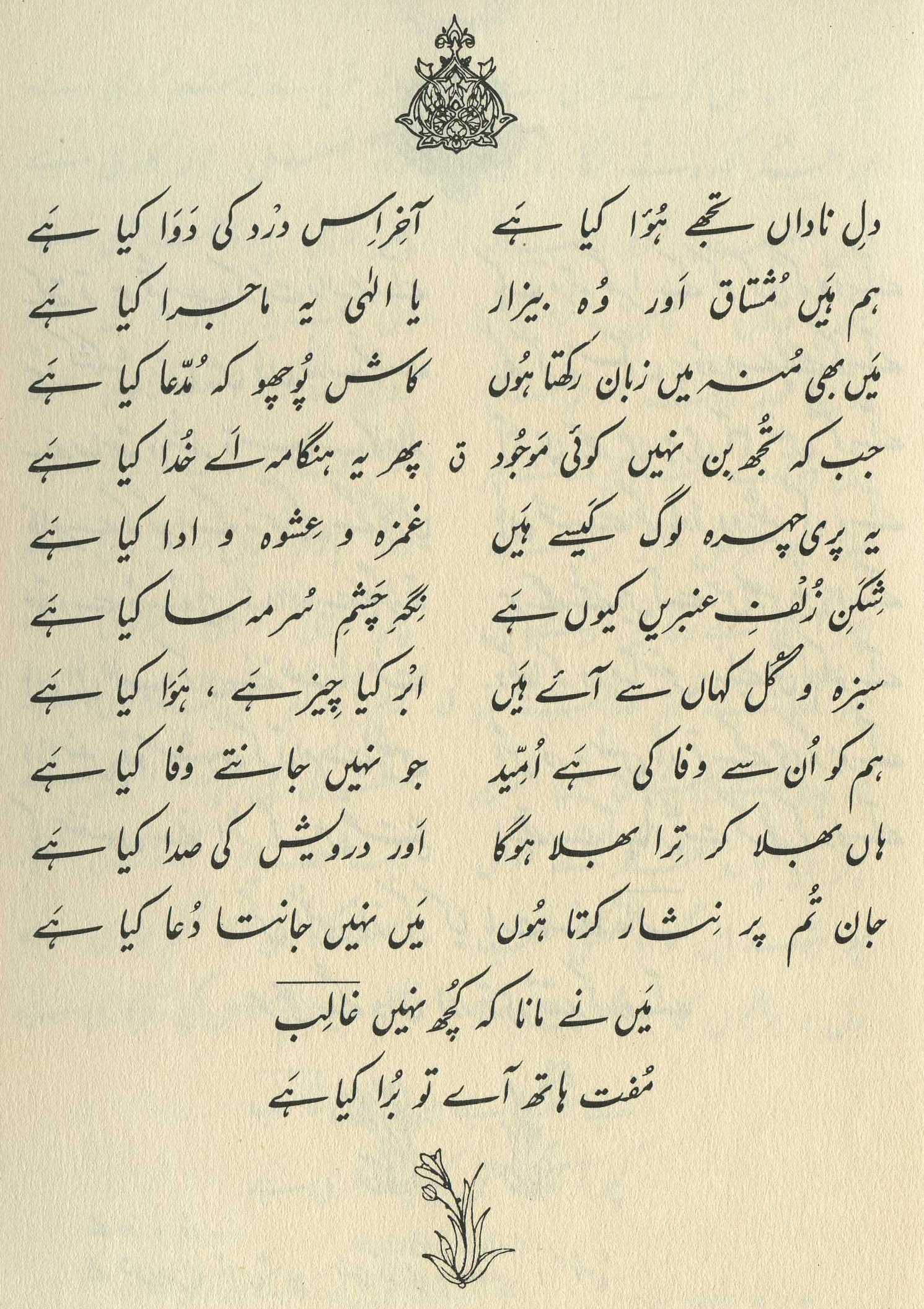
It's as if he has just set foot on the path of love, and is unacquainted with the affairs of coquetry and humility that take place between beloved and lover; for this reason he's surprised that, although he is ardent, the beloved is indifferent.
==Urdu text: Yadgar-e Ghalib , p. 157
The idiom that the author has used in the second line-- to the person who doesn't know the appropriateness of its use, the verse will seem limp and the line devoid of connection . The appropriateness of its use is that when somebody wishes to express scorn or reproach or distaste for someone's insipid affectations, he says it in this way. And from this affinity the author has created the line, and reproached the beloved. (174)
== Nazm page 174

[Objecting to Nazm's reading:] If in place of there were , then that would be another thing. This meaning [of which Nazm speaks] is obtainable by pulling and stretching, but the delicacy/enjoyableness [] of the verse is brought down into the dust. Indeed, the meaning he has presented undoubtedly begins to make the verse seem low and devoid of connection. But within the lines, lack of connection is even then not apparent. (311-12)
Here's another example of the beauty of speech. The first line presents the basic problem of the ghazal world-- a problem which is also of course the precondition of its existence. It's the rock-bottom classical problem, stated baldly and without nuance: the speaker adores the beloved, the beloved doesn't at all adore him. So in our own experience and appreciation of the verse, the tone is going to be everything. But is the tone ruefully amused, calmly analytical, rationally argumentative, mildly melancholy, wildly despairing?
If we look to the second line for some interpretive guidance, we get none whatsoever. Instead, we get sheer exclamatory vigor, in a wonderfully colloquial question. Is it the naive question of a newcomer to love, as Hali maintains, or the sarcastic rhetorical question of a veteran, as Nazm argues? Is it even a question at all, or should it be read as an exclamation ('My God, what a situation this is!')? Every time we read the verse-- especially if we read it aloud-- we're obliged to pick and choose among the possible permutations, and create the whole emotional tone of the verse for ourselves. And whatever tone we choose lives always surrounded by a penumbra of other possible tones and readings.
Ghalib is a great poet of course, but doesn't the ghazal also give him remarkably clever tools? This particular verse-- and indeed, this whole ghazal-- is a textbook case of the creation of maximal effects out of minimal means.
graphics/twohearts.jpg