Verse 8after 1847aakyaa hai
G8
In this meter the first long syllable may be replaced by a short; and the next-to-last long syllable may be replaced by two shorts.
1
we hope for faithfulness from that one
2
who doesn't know what faithfulness is
| References | |
|---|---|
| Arshi, Imtiyaz Ali | Ghazal# 215 |
| Raza, Kalidas Gupta | 401-02 |
| Hamid Ali Khan | Open Image |
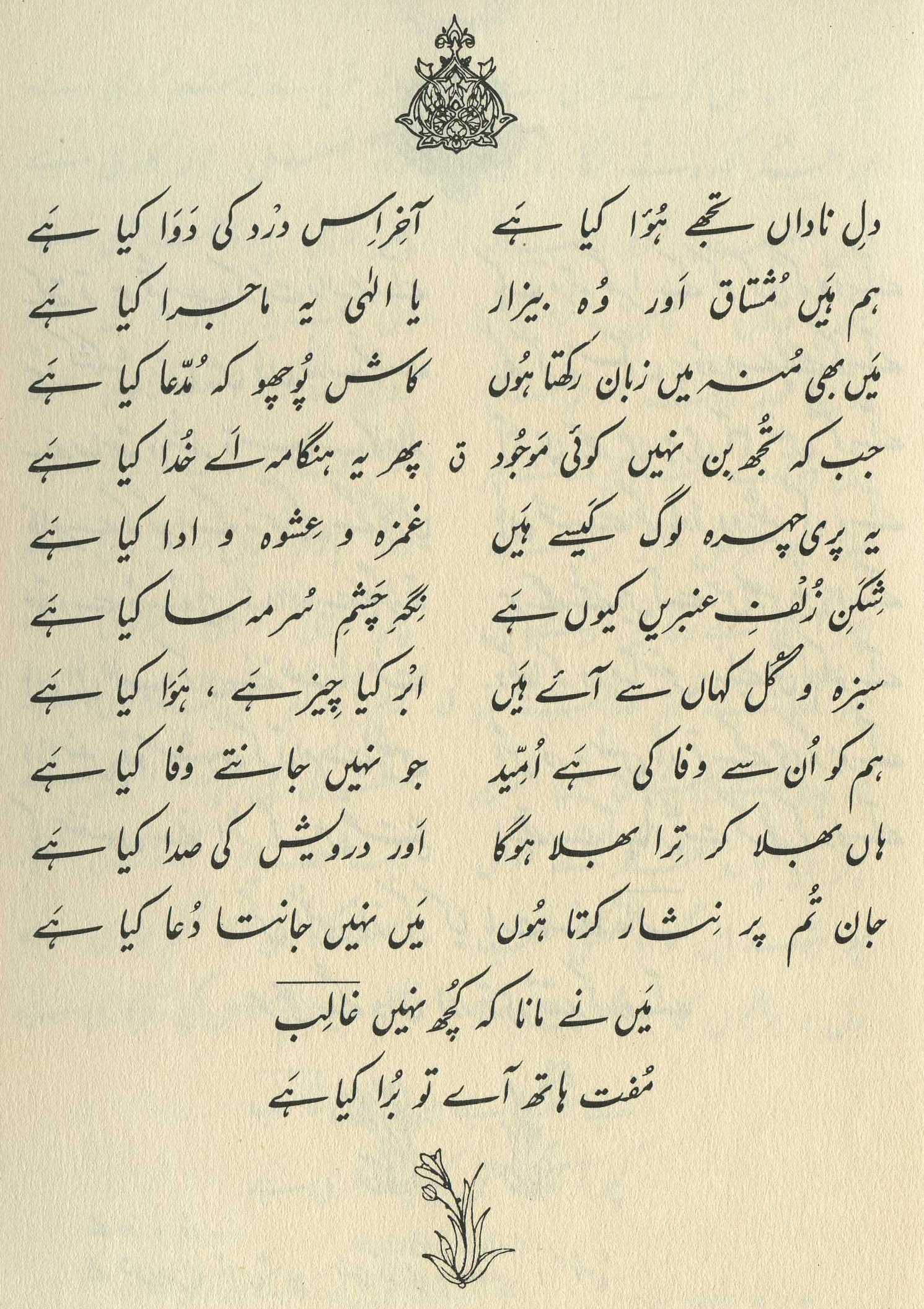
That is, because of her youth, she is so ignorant that she doesn't even know what kind of a thing faithfulness is. And I, through excess of passion, am such a fool that I hope for faithfulness from her. (175)
== Nazm page 175

He says, she is still so young and ignorant that she doesn't even know at all of what creature faithfulness is the name. And we, ensnared in the net of passion, have become such a fool that despite this we hope for faithfulness from her. (233-34)
Because of her youth, she doesn't understand faithfulness at all-- and we're becoming so mad in our passion that we hope for faithfulness from her.
[Or:] Our simplicity is worthy of praise! We hope for faithfulness from a beloved who isn't acquainted with even the name of faithfulness-- that is, she's the limit of faithlessness. (313)
The idea of a sort of uneducated child-beloved who literally doesn't know what 'faithfulness' means (because she has a limited vocabulary?) seems ridiculous to me, but it's surprisingly popular among the commentators. Presumably her childlikeness is meant to have an effect of charming naiveté.
Bekhud Mohani alone goes on to propose a much more attractive and plausible reading: that the beloved 'doesn't know what faithfulness is' because she's so radically devoid of the quality that she can't even imagine it. For a wonderfully indirect and witty treatment of the same idea, see 104,1 .
It's also possible to take the plural forms not as the plural of respect, but as actually referring to the whole group of beloveds.
It's also conceivable that 'faithfulness' itself may not even have a meaning at all, as seems to be the case in 9,1 .
News flash (with thanks to Tanvi Bikhchandani):
* March 6, 2013 *: While accusing the BJP of making unwarranted attacks and using "choicest abuse" to belittle his government's achievements, the PM [Manmohan Singh] said, "Humko hai unse wafa ki umeed, jo nahi jaante hain wafa kya hai (We hope for loyalty from those that do not know the meaning of the word)."
graphics/betrayal.jpg