Verse 51816aa))iikaa
G2
1
the longing of/for the tongue is absorbed in the praise/thanks of/for tonguelessness
2
through which was erased the claim/demand of/for the complaint of helplessness/'hand-and-footless-ness'
'Praise, thanksgiving'.
'Demanding or exacting payment (of a debt), dunning; pressing the settlement of a claim; demand, requisition, claim; exigence, urgency, importunity'.
| References | |
|---|---|
| Arshi, Imtiyaz Ali | Ghazal# 11 |
| Raza, Kalidas Gupta | 149-150 |
| Nuskhah-e-Hamidiyah | 50-53 |
| Asi, Abdul Bari | 61-62 |
| Gyan Chand | 87-90 |
| Hamid Ali Khan | Open Image |
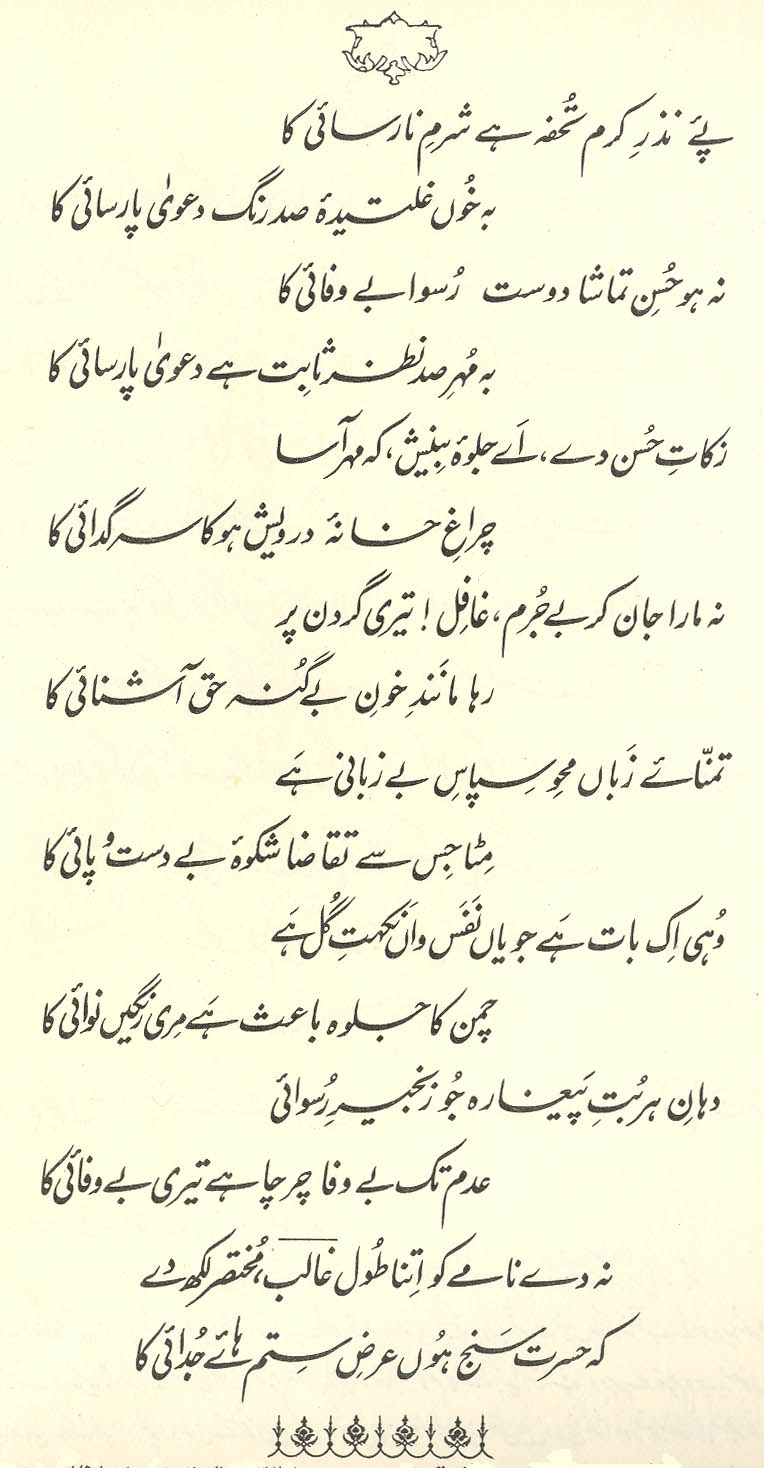
The poet mentions two matters of his heart: first, the longing for self-expression, and second, the complaint of helplessness. The claim of the complaint was that it should be mentioned. But when because of tonguelessness its claim was erased, it was as if this was a kindness on the part of tonguelessness. The longing for self-expression is absorbed in thanks for this kindness. The result is that my level of endurance is now so much elevated that I don't complain about my helplessness, and having seen this benefit of tonguelessness even the longing for self-expression has vanished from my heart. (25)
== Nazm page 25

He says, my longing is this too: that I would ask from you a tongue such that I would be able to use it in your court for expressing my situation. But before this plea or prayer, my tongue became absorbed in the praise of tonguelessness. That is, because I didn't receive that special tongue, there was the benefit that I wasn't able to present in your court the complaint of helplessness. And from that there was the benefit that in place of a tongue of complaint, the rank of acceptance and contentment was bestowed upon me. (50)
First the longing was that a speaking tongue would be bestowed upon me, so that I would be able to complain of my oppressions. But now, constantly remaining silent, I have become absorbed in thankfulness for that same longing for tonguelessness. Because its blessing was that the longing to complain of oppression did not remain. (60)
There are remarkable permutations lurking in this verse, generated by the rich possibilities of (semi-)personification. In the first line, it appears that the 'longing' itself, as an active entity, is 'absorbed in praise', so it's clearly at least semi-personified. And once we know that the verse is moving in that direction, where do the semi-personifications stop? Consider the following permutations:
= might be the longing for a tongue; or it might be the longing felt by a tongue.
= might be the praise of tonguelessness; or it might be the praise/thanks expressed (or at least felt?) by tonguelessness itself.
= might be a complaint about limblessness; or it might be a complaint made by limblessness itself.
= might be a claim/demand to make a complaint of limblessness; or it might be a claim/demand made by the complaint of limblessness itself.
All these possibilities are undeniably latent in the grammar, but I don't want to spend a lot of time drawing them out, because the grammar itself is so vague that the process quickly becomes uninteresting. (How much can we care about exactlywhat abstract entity is making a 'claim of a complaint' about something else abstract?) Certainly with enough ingenuity some readings could be put together, but somehow the whole verse isn't enticing enough to make the project seem worthwhile.
Nazm's reading is the one that would leap to mind at once; it's hard to believe it wasn't in the forefront of Ghalib's own mind. I would add to Nazm's explanation a tribute to the word/meaning play. To make 'tonguelessness' (or by extension, 'speechlessness') the cure for 'limblessness' (literally, 'hand-and-foot-lessness') is a morbidly ingenious and striking contrivance. The idea that the 'longing for a tongue' should be extremely grateful for being rescued (by tonguelessness) from expression (of a complaint) is another fascinatingly twisted idea. It's a kind of 'catch-22' situation: one wants to complain of one's deprivation, but that very deprivation is exactly what prevents one from complaining.
What I see at the bottom of it is that fundamental Ghalibian ideal of radical independence, of refusing to be beholden to anyone for anything (for more on this see 9,1 ). To complain of one's limblessness would seem to express discontent with one's own resources, and perhaps even to beg for relief (from God?). Thanks to tonguelessness, the speaker is saved from such humiliating self-abasement.
For another example of the possibilities of , see 27,6 .
graphics/silence.jpg