Verse 3x1816aanah maa;Ng
G3
1
oh longing martyr of faithfulness-- don't ask for a blood-price!
2
except for the sake of the slayer's hand and arm, don't ask [for anything else] in prayer
'On account of, for the sake of, for'.
| References | |
|---|---|
| Arshi, Imtiyaz Ali | Ghazal# 79 |
| Raza, Kalidas Gupta | 194-95 |
| Nuskhah-e-Hamidiyah | 130-131 |
| Asi, Abdul Bari | 146-148 |
| Gyan Chand | 240-242 |
| Hamid Ali Khan | Open Image |
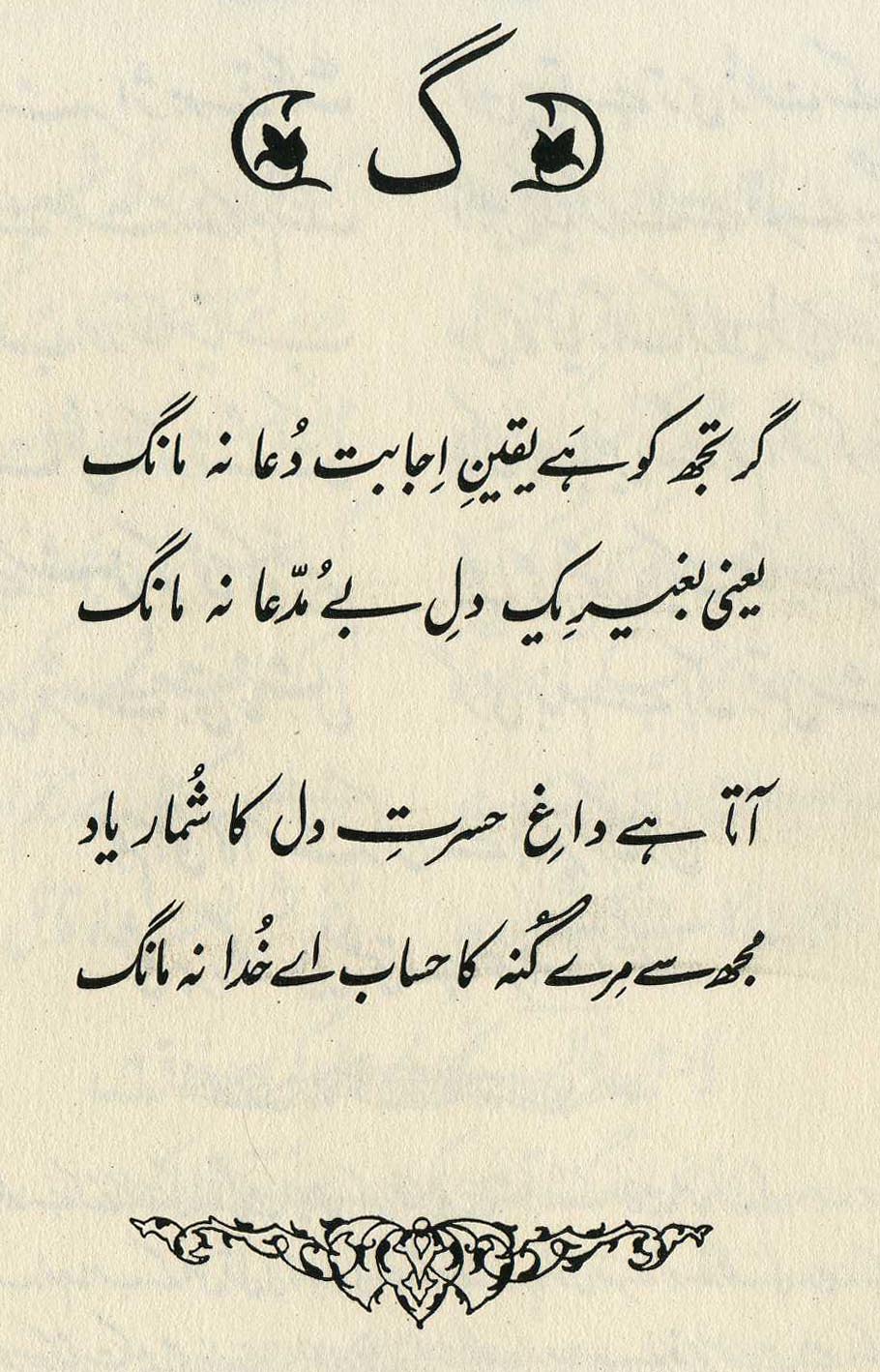
Oh longing that has been martyred by faithfulness, or because of faithfulness-- you have become a martyr. It's better that you not long for or seek compensation or a blood-price from the murderer. Your task is always to pray for the welfare of the hand and arm of the murderer (that is, of your beloved). Beyond this, ask for nothing else.
== Asi, p. 146
The murderer whose aloofness and indifference have thrown cold water on your longings-- don't seek revenge for her cruelty. Rather, pray that her enthusiasm for cruelty and tyranny may increase even further. And this increase is possible when the glory of her beloved-ship would keep progressing. Enough! What more than this does the lover want-- that the beloved's coquettish side-glances would go on scouring him, and that he would remain the slate on which she practices?
== Zamin, p. 212
An is that individual who constantly longed for the beloved to keep faith with him; and when finally he saw her faithlessness, he became a martyr. To such an individual he has said, 'Don't ask for a blood-price; rather, pray that the murderer's hand and arm may be stronger, so that she would be able to martyr you time after time'.
Asi has declared that the addressee of the verse is Longing, and has considered 'martyr of faithfulness' to be his quality. In my view, this isn't correct; is a single construction that has been used for the lover.
== Gyan Chand, p. 240
../raza/068raza231.jpg For background see S. R. Faruqi's choices . For more on Ghalib's unpublished verses, see the discussion in 4,8x .
Gyan Chand poses the obvious question: which of two clumsy grammatical constructions shall we choose? He himself favors a single noun-compound 'Longing-martyr of faithfulness', a vocative epithet addressed to the lover; on this 'reversed ' see 129,6x . But as he notes, Asi favors an address to the semi-personified 'Longing', characterized then as a 'martyr of faithfulness'. In this highly abstract context, it's hard to get excited about the question. Does it really make much difference to the verse?
Whoever exactly the addressee may be, the verse gives us seemingly contradictory information about his situation. For he (or a personified 'it') is addressed as a 'martyr', which clearly implies that his murder has already occurred or will imminently occur. Yet he's also enjoined not to ask for a 'blood-price', and the blood-price is something to be dealt with not by a murder victim, but by his heirs. For more on the 'blood-price', see 21,9 .
Far from seeking a 'blood-price', the addressee is enjoined to pray only 'for the sake of' the murderer's 'hand and arm'. What kind of prayer is this to be? Perhaps an expression of gratitude for the favor (soon to be?) rendered by the hand and arm, in liberating the speaker from his transient and wretched existence. Perhaps a prayer that the hand and arm may consent to render this favor, and to render it quickly. Or perhaps a general prayer to the Lord to make the hand and arm strong and powerful, to look out for their welfare. But in any case, it's something that seems to require a living presence-- a survivor rather than a murder victim.
So perhaps the speaker is one lover/martyr, giving advice to a younger comrade about the proper etiquette to be observed on the path of love and death. Or perhaps this verse is one of the 'dead lover speaks' group; for others, see 57,1 .
On the possibilities of , see 101,1 .
graphics/swordhand.jpg
