Verse 1after 1826aadnahii;N
G5
In this meter the first long syllable may be replaced by a short; and the next-to-last long syllable may be replaced by two shorts.
1 a
there is no lament apart from 'beauty of seeking', oh Tyranny-invention
1 b
a lament is nothing except 'beauty of seeking', oh Tyranny-invention
2 a
there is a claim of/for cruelty, there is no complaint of injustice/oppression
2 b
it is a claim of/for cruelty, it is not a complaint of injustice/oppression
'Besides, except'. (Platts 381)
talab>> : 'Search, quest; wish, desire; inquiry, request, demand, application, solicitation; sending for, summons; an object of quest, or of desire'.
'Creation, production; invention, contrivance'.
| References | |
|---|---|
| Arshi, Imtiyaz Ali | Ghazal# 104 |
| Raza, Kalidas Gupta | 371-72 |
| Hamid Ali Khan | Open Image |
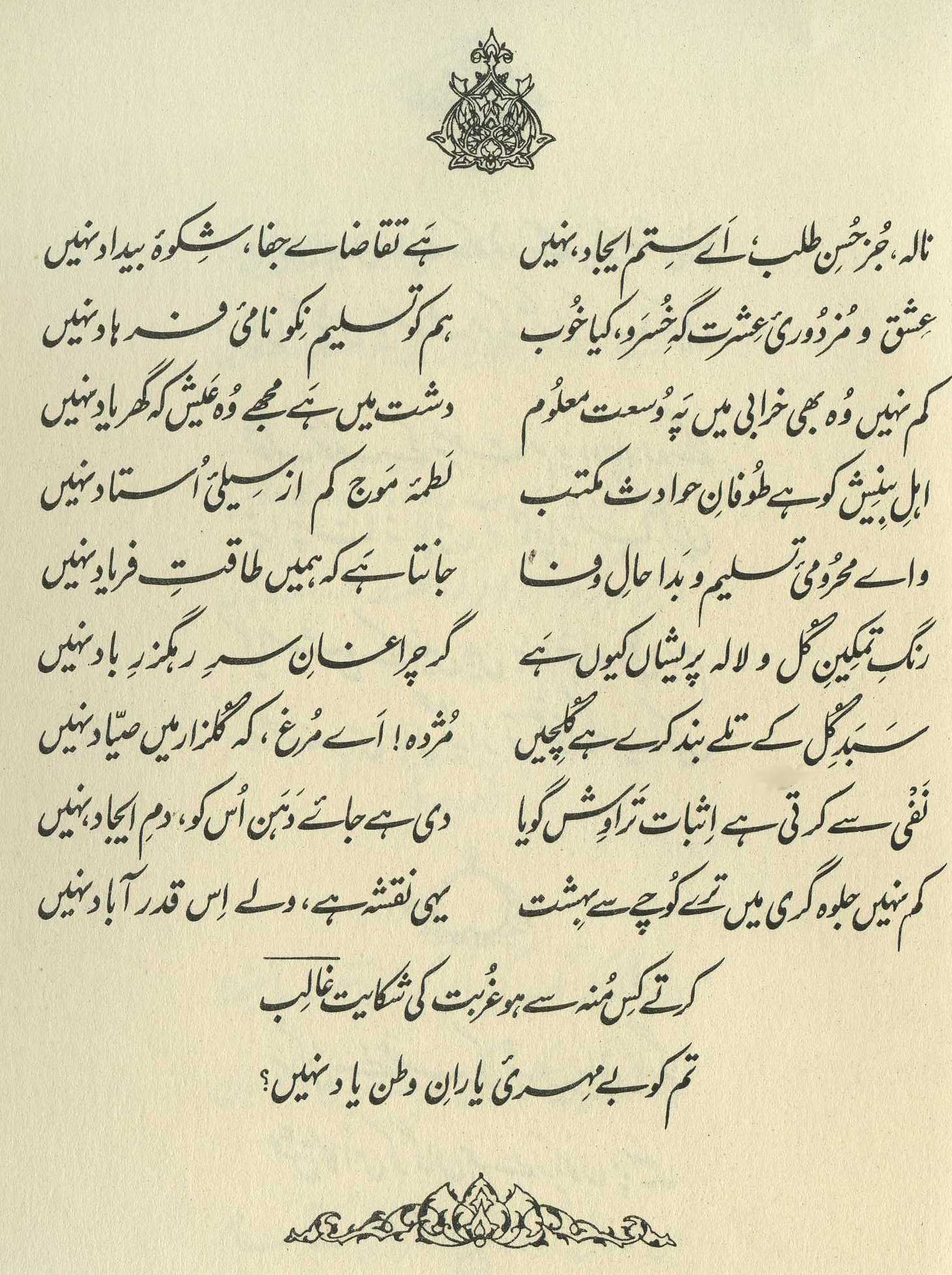
That is, the longing for cruelty will not be accepted. Indeed, if she becomes angry at my lament and practices cruelty, then so be it. The gist is that lamentation is the 'beauty of seeking', not a complaint. (106)
== Nazm page 106

He says, my lament has no connection with a complaint of injustice. That is, I don't make a lament as a complaint about cruelty and tyranny. Rather, it is 'beauty of seeking', a claim for cruelty. The meaning is that you don't practice cruelty and tyranny on us casually; rather, you'll get annoyed at our laments and practice cruelty on us. (157)
Alas, you inventor of ever-new cruelties! Our lament doesn't complain about your cruelties. Rather, we are so fond of suffering that the purpose of our lament is that you should practice more cruelty upon us, or become angry at our laments and treat us cruelly. (607)
ABOUT : The flexibility of is excellently illustrated here: it's a contraction of the Persian , which literally means 'apart from'. Thus it can be used to mean 'apart from A, there is no B', so that A is a prerequisite for the existence of B (1a). Or, more narrowly, it can mean 'except for A, there is no B', so that A is the only B (1b). For other examples of , many clearly invoking its flexibility, see 3,1 (a relative straightforward case); 39,3 ; 61,7 ; 78,7 ; 9,3x ; 82,1 ; 92,3 ; 92,6 ; 221,2 ; 230,5 (in which Ghalib himself suggests inserting it into a verse in which it doesn't appear).
'Beauty of seeking' for is the best translation I could come up with, but it doesn't do the job very well; seems to be a broader word here. I first encountered this difficulty with the technical poetic term , for which I finally came up with ' elegance in assigning a cause '. In the case of the poetic term, attention is being called both to the act of assigning a (freshly imagined) cause to something, and also to the beauty, elegance, wit, and general praiseworthiness with which the act is done. Other usages, like 'the beauty of coincidence' [], call attention not to deliberate acts, but to simple facts or events. With those two examples in mind, we could imagine either that the lover is showing conscious cleverness by doing his 'seeking' in an admirably ingenious or devious way, or else that the act of 'seeking' in itself sometimes produces fine, surprising effects (as in 'the beauty of coincidence').
The first line is literally addressed to a semi-personified abstraction, 'Tyranny-invention' []. The commentators take it as an epithet for the beloved, and indeed it could be, if read as something like 'tyranny-invention-person'. But it might also be taken literally, as one of Ghalib's remarkable abstract personifications .
What is the relationship between the two lines? The question is complicated by the cleverly framed grammar of the second line: 'A is, B is not' would become 'there is A, there is no B' (2a). But since the subject can be colloquially omitted in Urdu, a reading of 'it is A, it is not B' (2b), where 'it' is the omitted subject, is equally possible. (And then the 'it' could be either 'lament' or 'beauty of seeking'.)
And then, does one line describe a cause, and the other a result of it? (And if so, which way around?) Or do both lines describe the same situation? There seems to be a definition or description somewhere in all this, but it has such a penumbra of alternatives floating around it that the contours are impossible to demarcate precisely. This verse itself is a pretty good mental 'tyranny-invention'.
graphics/lament.jpg