Verse 51816aahai
G13
1
the Ring-dove , a palmful/froth of ashes; and the Nightingale , a cage of color
2
oh Lament, what is the mark/sign/scar of a burnt liver?
'Froth, foam, scum, soap-suds, spittle; a small quantity; ... the palm of the hand; the sole of the foot'. (Steingass p.1036)
'Complaint, plaint, lamentation, moan, groan; weeping'.
'Sign; signal; mark, impression; character; seal, stamp; proof; trace, vestige; --a trail; clue; --place of residence (of a person), whereabouts; --a scar, cicatrice; --a mark, butt, target ... emblem, device; order, badge; --ensign, flag, banner, standard, colours'.
| References | |
|---|---|
| Arshi, Imtiyaz Ali | Ghazal# 179 |
| Raza, Kalidas Gupta | 268-69 |
| Nuskhah-e-Hamidiyah | 275-276 |
| Gyan Chand | 395 |
| Hamid Ali Khan | Open Image |
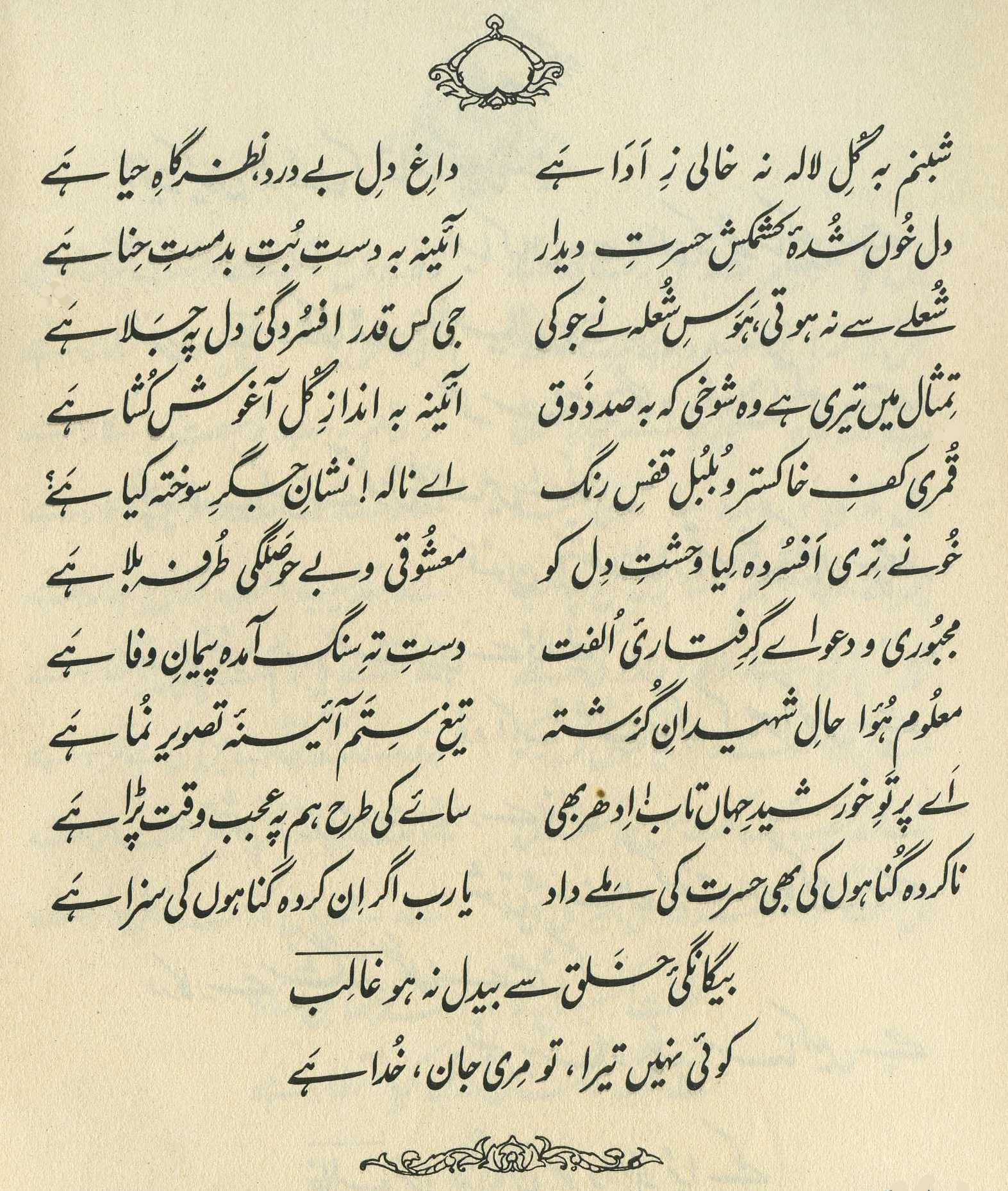
A number of principles of expression were Mirza Sahib's own, which before him had been seen neither in Urdu nor in Persian. For example, in his present Urdu divan there is one verse: {230,5}. I myself asked Mirza the meaning of this. He said, 'In place of "oh," read "{apart from / except for}" []; the meaning will come to your understanding by itself.' The meaning of the verse is that the Ring-dove, which is not more than a palmful/froth of dust, and the Nightingale, which is not more than a cage of elements-- the proof of their being liver-burnt, that is, lovers, is only from their warbling and speaking.
Here, the meaning in which Mirza has used the word is obviousy his own invention. One person, having heard this meaning, said, 'If in place of he had put , or if he had composed the second line like this, "Oh lament, except for you, what is the sign of love," then the meaning would have become clear.' This person’s utterance is absolutely correct, but since Mirza avoided common principles as much as possible, and didn't want to move on the broad thoroughfare, rather than wanting every verse to be widely understandable he preferred that inventiveness and un-heard-of-ness would be found in his style of thought and his style of expression.
==Urdu text: Yadgar-e Ghalib , pp. 113-14
==another trans: Russell and Islam , p. 39
In the Ring-dove, because of its lamentation, some ashes/calcination of the liver is found; and in the Nightingale, some color of the liver is seen; for the rest, there's no information about the liver. The meaning is that lamentation is a thing that burns up the liver and makes it nonexistent. And the meaning of is also 'bondage'; here that meaning is intended. The Persian-users always versify the Ring-dove as a 'palmful/froth of ashes'; but to call the Nightingale a basket [] (?) of color is a new thing, but without pleasure. To make the 'Lament' the addressee too is a thing without pleasure; and by 'liver' apparently the livers of the Nightingale and the Ring-dove are meant. It also gives rise to the idea that the poet is asking about the mark of his own burned liver. In the verse, where a second meaning was generated, it became limp. (260)
== Nazm page 260

[Disagreeing with Nazm:] (1) In calling the Nightingale a cage, the affinity is obvious. Then to call the Nightingale a cage of color, or to label him a prisoner of color, adds a subtle phrase to the meaning of 'Nightingale', to which people of taste will unquestionably do justice.
(2) No telling why it's a pleasureless thing to make the Lament an addressee. To address lifeless things as though they were alive is common among the poets of Iran and Hind, and it isn't unavailable in English poetry either.
(3) The statement that where in the verse a second meaning is generated, the verse became limp-- the Lord knows on what investigation it's based! In poetry, to the extent that extensive and diverse meanings would emerge, it's good; and this is the poet's miraculous craftsmanship, that the verse would have two intended meanings, and both of them in their place would be subtle and powerful. The way when a painter makes an eye, it's a sign of his accomplishment that he would make the eye in the picture in such a way that from whichever direction a person would look at the picture, he would consider that the figure in the picture was looking right at him. (480)
Compare 96,5 . (219, 283)
[A special commentary page translating and discussing Iqbal's use of this verse in his [Persian] , to frame a dialogue in which Ghalib is made to participate.]
Here is one of the most irresistibly discussable of all verses. It's as as possible, with no verbs at all in the first line (so that it becomes one of his 'list' verses, a group analyzed in 4,4 ), and with an interrogative second line.
The first line is dominated by two birds. The Ring-dove is (since we basically have to assume a copulative construction) a -- either a 'palm[-ful]' or a 'froth, foam' (see the definition above)-- of ashes; and the Nightingale is a 'cage of color'. This line is arresting, compelling. Even before we're allowed (after the mushairah -performance delay) to hear the second line, we can't possibly refrain from playing with and enjoying the first one. The Ring-dove is a handful or 'palmful' of ashes because he's a small, unobtrusive bird of a grey, ashy color; he's also a 'froth' or 'foam' of ashes because a handful of ashes would indeed be slithery and ungraspable like froth or foam. Similarly, the Nightingale is a 'cage of color' because he too is basically a small, drab-colored bird who contains within his inconspicuous body the invisible, potent 'color' of his famous song. (For another vision of a 'cage of color and scent', see 347x,7 .)
Then, as so often, the second line starts completely afresh in grammar and imagery; such 'A,B' verses allow (and require) us to decide for ourselves what kind of connection there is between the two lines. Here are some possible ways we might perceive, by the powers of implication , answers to the question in the second line:
=The birds' drab bodies have been 'burnt' (and thus 'marked') by the fire of their burning, suffering, livers.
=The birds' exquisite voices have been generated (and thus 'marked') by their burning, suffering livers.
=The birds' livers have been 'burnt' (and thus 'marked') by the fire of their melancholy laments.
=The birds' drab bodies conceal the passion of their burning livers-- a passion which is revealed and 'marked' only in their song.
=Unlike the birds, who live and sing in their passion, the lover is dying from the 'mark' or effects of a burnt-out liver.
=Unlike the birds, who still have livers, the lover in his passion has burnt away his own liver until it can no longer be detected by any 'mark'.
=The speaker/lover doesn't know what the 'mark' is, and is brooding about it and addressing his thoughts to 'Lament'.
Why the address to 'Lament'? Perhaps because it's the common factor between the experiences of the bird and the lover. Perhaps because by its very nature it's both a symptom and (in the ghazal world) a disease. 'Lament' seems a particularly suitable entity-- suggesting as it does both a semantic content and a process-- to receive a meditation on the nature of passion, suffering, drab bodies, melancholy songs, and burnt-out livers.
Moreover, this verse is one that Ghalib himself, in a famous anecdote, 'explained' to his pupil and biographer Hali (see Hali's account above). When I first read this anecdote, I was inclined to agree with the plaintive (or exasperated?) 'person' quoted by Hali. What could be more in-your-face arrogant than arbitrarily redefining common words, and giving the reader no way at all to figure out what you had done? Hali too seems to share this reaction, albeit with resignation rather than irritation. (I wrote about all this in 'The Meaning of the Meaningless Verses': Ghalib and his Commentators .)
But now, on further thought, I believe a strong case can be made that Ghalib was not actually telling Hali that he had, in the verse, redefined to mean . Rather, he said that if Hali made that substitution, he would be able to intuit or grasp the meaning of the verse for himself; Ghalib was thus giving Hali an interpretive hint rather than a redefinition. Because of the absence of quotation marks in the Urdu, it's impossible to tell whether the next sentence ('The meaning of the verse is that...') is intended as a direct continuation of Ghalib's own words, or as a paraphrase or explanation provided by Hali himself; I now think the latter is more probable, but it can't be proved either way. (On the possibilities of as either 'apart from' or 'except for', see 101,1 .)
The question that remains to be answered, then, is why Ghalib gave Hali the advice that he did. I'm inclined to see the same process going on as in 57,7 : in a tactful and unintimidating way, Ghalib is encouraging Hali to figure things out for himself. He's showing him a path that would take him deeper into the verse, without actually laying it all out for him. Surely he's trying to be a good teacher.
For if we make the thought experiment that Ghalib recommended, we certainly do find some helpful interpretive guidance: we don't get sidetracked into worrying about how a personified 'Lament' fits into it all, and 'lament' becomes an obvious possible answer to the question that is being asked. Yet the verse still retains some of its complexities. If we ask of some unnamed person, or the world in general, 'Apart from lament, what is the mark/sign/scar of a burnt liver?', then on the basis of the verse the answer can be at least fourfold: (1) the mark is a 'colorful' but melancholy singing voice; (2) the mark is a small, dark, even 'ashy' body; (3) the mark is really nothing except lament (since the lover's liver has been burnt away completely), so that the question is rhetorical; or (4) the nature of the mark is unknown (since the speaker has to ask a question about it). Hali firmly chooses (1). These are not of course all the possibilities. But perhaps 'after further reflection' (as in 57,7 ), Hali might have seen some of the other choices as well. A good teacher never gives up hope.
Thus, ultimately, we ought not to take Ghalib's purported advice. Not only do we not need to change 'oh' to 'apart from, except for'-- we definitely shouldn't. For the original address to 'Lament' can imply, in the context of the verse, either that one is saying to Lament, 'Apart from you...' --or, alternatively, that one is asking of Lament a completely open-ended question, with no ready-made possible answer (or partial answer) popping up. By contrast, saying 'apart from lament' cannot imply that one is addressing 'Lament', nor can it retain the possibility that one is asking a completely open-ended question. Thus if we were to remove the vocative, we would lose the possibly radical open-endedness of the question, and would find ourselves with a verse diminished in subtlety and complexity. Why would we want to make such a restrictive change? What would we gain?
graphics/qumri.jpg
graphics/bulbul.jpg