Verse 91816aahai
G13
1
oh ray of the world-warming sun-- even/also in this direction!
2
like a shadow, a strange time has fallen upon us
'Wonderful, marvellous, astonishing, amazing, miraculous, strange, extraordinary, rare; droll, &c.'.
'Occasion to arise (for); need (for a thing) to arise; to stand in need (of); adversity or misfortune to befall (- ), to suffer misfortune, to be in distress'.
| References | |
|---|---|
| Arshi, Imtiyaz Ali | Ghazal# 179 |
| Raza, Kalidas Gupta | 268-69 |
| Nuskhah-e-Hamidiyah | 275-276 |
| Gyan Chand | 395 |
| Hamid Ali Khan | Open Image |
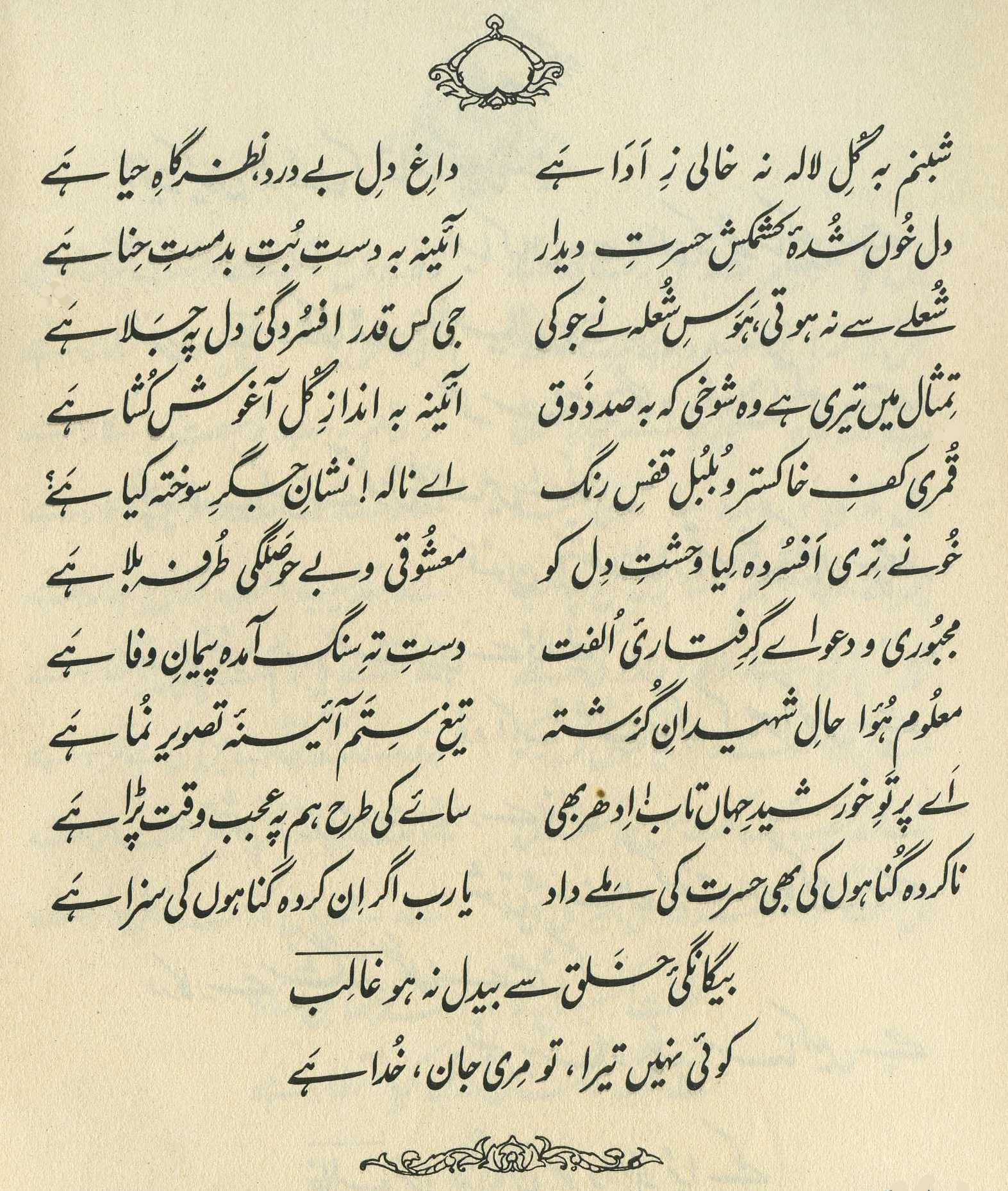
This is an address to the True Sun. He says that the way a shadow appears to be present, and in reality has no existence, in the same way we too have fallen into this error. If some of the glory of the True Sun would fall upon us, then this error would vanish, and we would vanish into the sun, because where the sun shines, the shadow vanishes.
==Urdu text: Yadgar-e Ghalib , p. 165)
That is, show benevolence this way too. And the setting in which the author has used the idiom -- its excellence is beyond description. (260)
== Nazm page 260

'A strange time has befallen us'-- that is, the harshest possible difficulty has befallen us, for which there are no words; nor can anybody guess what this difficulty is like. (485)
This verse provides information only indirectly, through implication . The speaker's urgent appeal not for a whole sunny day, but for even a single 'ray' of sunlight, suggests that his need is desperate and his bargaining power nonexistent. The address to the sun as 'world-warming' suggests that the speaker is appealing for an antidote to coldness as well as darkness. The doubleness of also works well here: are the sun-deprived people one more item in a series, or a unique and special case? The appeal for a ray 'in this direction too' also suggests that the sun may be selective, choosing the direction for its rays, warming and illuminating the whole world but leaving the speaker and his group in darkness, coldness, and despair.
If the sun's rays are directed 'in that direction' (such that the speaker must beg for a single ray to be sent 'in this direction'), and if the sun warms 'the world', the speaker may even be somewhere other than in the world, and there may be some barrier between the world and him-- perhaps a barrier of the kind that would cast a deep shadow.
The idiom -- for misfortune to befall (see the definition above)-- is invoked very elegantly, as Nazm admiringly testifies. (I imagine its resonance must be something like 'the hour is at hand' or 'the time has come' in English, only with more exclusively sinister overtones.) But as usual, Ghalib contrives to make the idiom work literally as well, for the line can also be read perfectly normally as 'a strange time has befallen us'.
The simile 'like a shadow' is an obviously suitable for a deprivation of light and warmth. Then we're also led by the grammar to ask, does 'like a shadow' [] describe the strangeness (strange like a shadow), the time (a time like a shadow), or the manner of arrival (fell upon us the way a shadow would)? Each of these possibilities can work well, adding new facts to the line and making the phrase an example of what I call 'midpoints'.
This ominous, mysterious-feeling verse also works in what I call a 'fill-in' way. What's the nature of the 'strange' quality? How long is the period of the 'time'? Who is 'us'? We readers find that answers to these questions readily rise to the surface from the depths of our own lives, and the darkness and coldness of our own shadowed spaces.
graphics/shadow.jpg
graphics/eclipse.jpg